Good news if you're watching the budget: the Canary Islands are one of the best-value warm-weather escapes in Europe. A low local sales tax, fierce competition between resorts and a year-round season all conspire to keep prices gentler than much of the mainland Mediterranean — and, crucially, how much you spend is largely up to you. Eat and drink where the locals do and a holiday here costs a fraction of what the seafront terraces charge. This guide lays out realistic 2026 prices for food, drink, getting around and the big attractions, compares the cheaper and pricier islands and resorts, and gives you sample daily budgets so you can plan with confidence. Treat every figure as a typical range that shifts with season, venue and island — always worth a quick check before you book.
Are the Canary Islands expensive?
In a word: no — not by European standards. The islands sit outside the EU's VAT area and levy their own low sales tax, IGIC, at a general rate of just 7% in 2026 — a third of mainland Spain's 21% IVA. You won't see it itemised on your coffee, but it filters through into lower prices on restaurant bills, fuel, electronics, perfume and spirits, and it's a big part of why the Canaries feel such good value. That said, "cheap" and "expensive" here depend far more on where you go than on the islands themselves. A beachfront bar in a package resort can charge double a backstreet café a few streets inland for exactly the same caña of beer. Get the geography right and your money stretches a long way. For the wider picture on tax, tipping and cards, see our companion guide to costs and money.
The single biggest lever on your daily spend isn't the island — it's the postcode within it. Walk two or three streets back from the promenade and prices routinely drop by a third.
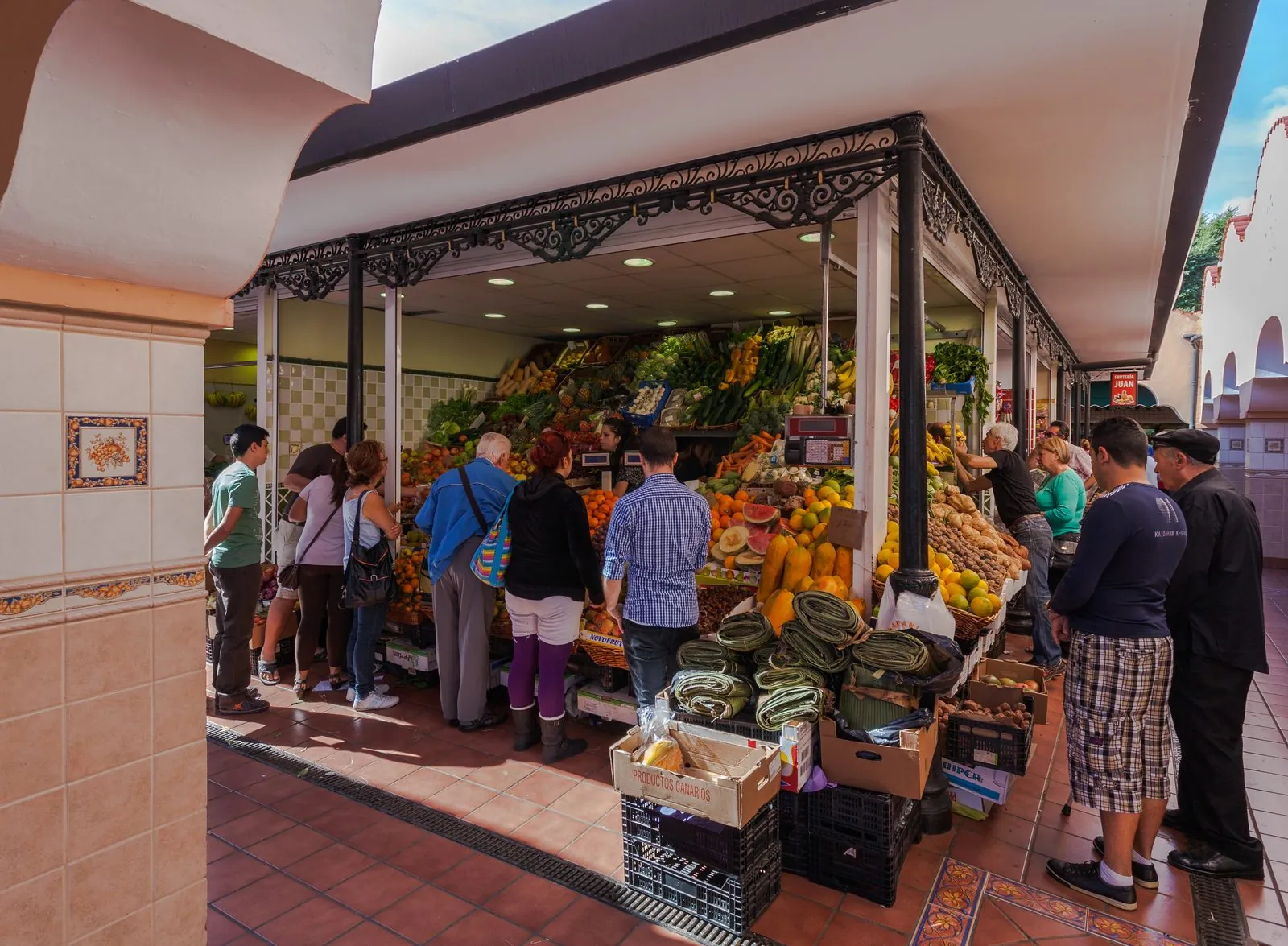
Photo: Diego Delso · CC BY-SA 3.0 · Wikimedia Commons · scaled
Canary Islands prices: food and drink
This is where the Canaries shine. The famous menú del día — a fixed-price lunch of two or three courses with bread and a drink — is consistently among the cheapest in Spain, and a proper sit-down dinner of fresh fish and local wine still won't break the bank. The table below shows typical 2026 ranges; the lower end applies in local towns and northern cafés, the higher end on the southern tourist strips.
| Item | Typical price (2026) | Notes |
|---|---|---|
| Coffee (café con leche) | €1.20–€3 | ~€1.20–1.50 in a local cafetería; €2.50–3 on a resort terrace |
| Small local beer (caña) | €2–€3.50 | Dorada and Tropical are the island brands |
| Bottle of water (shop) | €0.40–€1 | Far dearer bought from a beach vendor |
| Soft drink / juice (bar) | €2–€3 | |
| Menú del día (set lunch) | €10–€16 | Starter, main, dessert and a drink — the day's best value |
| Casual lunch, per person | €12–€20 | Tapas or a plato in a neighbourhood bar |
| Mid-range dinner, per person | €25–€40 | Three courses with wine at a good local restaurant |
| Glass of Canary wine | €2.50–€5 | Local reds and whites; bottles from ~€10 in shops |
| Barraquito (layered coffee) | €2.50–€4 | The islands' signature coffee treat |
Supermarket basics
Self-catering slashes costs, and the big chains (Mercadona, Hiperdino, Spar, Lidl) are cheap. A week's breakfasts, snacks, water and picnic lunches for two might run €40–€70. Expect roughly €0.80–€1.50 for a litre of milk, €1–€2 for a loaf, a couple of euros for a dozen eggs, and local bananas, tomatoes and cheese at very friendly prices. Bottled water in six-packs is cheapest of all — stock up on day one rather than buying by the beach.
Head for a guachinche — a rustic, family-run eatery serving home cooking and their own wine — for the cheapest, most authentic meal on the islands, especially in the wine-country hills of northern Tenerife. For more on eating well without overspending, see eating out in the Canaries.
Getting around: bus, taxi, car hire and petrol
Public transport is cheap and good. Island bus networks — TITSA on Tenerife, Global on Gran Canaria — cover the resorts and towns for a few euros a ride, and a contactless travel card (ten/tenmás, TeGuío) cuts fares further. Taxis are metered and regulated, so a short hop is inexpensive, though airport runs to the far resorts add up. Car hire is the Canaries' quiet bargain: competition keeps daily rates among the lowest in Europe, and cheap IGIC-taxed fuel makes exploring painless.
| Journey / item | Typical price (2026) | Notes |
|---|---|---|
| Local bus fare (single) | €1.50–€4 | Cheaper again with a rechargeable travel card |
| Airport bus to nearby resort | €3–€5 | e.g. LPA–Maspalomas, TFS–Costa Adeje |
| Airport bus to island capital | ~€10 | e.g. TFS–Santa Cruz |
| Short taxi hop (in-resort) | €5–€12 | Metering starts around €3.50 plus ~€1.10/km |
| Airport taxi transfer | €25–€45 | To the main southern resorts; night/holiday supplements apply |
| Car hire, per day | €20–€40 | Small car; cheapest in low season, dearest at Christmas |
| Petrol, per litre | ~€1.20–€1.35 | Notably cheaper than mainland Spain or the UK |
| Inter-island ferry (foot passenger) | €30–€70 | Varies by route and operator |
For a full breakdown of routes, passes and door-to-door options, see getting around the Canary Islands, our dedicated car hire guide, and the useful route-planning tool at getting between the islands. If you'll do any exploring beyond your resort, a hire car usually pays for itself within a day or two versus taxis.
How much do attractions cost?
The big-ticket theme parks are the main splurge on a Canaries holiday, and prices change with season and package, so we give bands rather than exact euros — always buy from the official website (usually the cheapest, and it skips the queue) and check the current price there.
| Attraction type | Rough adult price band (2026) | Tips |
|---|---|---|
| Flagship water park (e.g. Siam Park) | Upper €30s–high €40s | Twin tickets with a sister park save money |
| Big animal park (e.g. Loro Parque) | Around €40 and up | Combo and multi-day passes available |
| Gran Canaria parks (Palmitos, Aqualand) | Mid-€20s–mid-€30s | Online booking is cheaper than the gate |
| Teide cable car | Mid-range; book ahead | Free to drive up and walk the trails |
| National parks & nature | Often free | Timanfaya and boat trips charge; hiking is free |
| Boat / dolphin trip | €25–€60 | Half-day excursions; lunch sometimes included |
Children's tickets typically run a good deal lower than adult prices, and under-3s are usually free. Remember that some of the islands' finest experiences cost nothing at all: the Maspalomas dunes, the trails around Roque Nublo, the laurel forests of Anaga and most of the islands' spectacular beaches are free to enjoy. See things to do for the full range, and lean on our budget guide for free-and-cheap ideas.
Never pay a card machine or ATM "in your home currency" (dynamic currency conversion). Always choose euros and let your own bank do the conversion — picking pounds hands the machine a poor exchange rate and quietly costs you more.
Which islands and resorts are cheapest?
Prices don't vary hugely from island to island for everyday things — a coffee costs much the same on Fuerteventura as on La Palma. What really moves the needle is the type of area you stay in. Local towns, island capitals and low-key resorts are markedly cheaper than the polished, purpose-built luxury enclaves. Here's the lie of the land.
| Area type | Value | Examples |
|---|---|---|
| Island capitals & local towns | Cheapest — local prices, real menús del día | Las Palmas, Arrecife, Puerto de la Cruz |
| Established mid-market resorts | Good value; wide choice | Playa del Inglés, Los Cristianos, Puerto del Carmen |
| Quieter western islands | Simple and affordable, fewer luxury options | La Palma, La Gomera, El Hierro |
| Smart, purpose-built resorts | Priciest — premium hotels and dining | Meloneras, Costa Adeje, Playa de las Américas |
What drives the difference?
Three things. First, who the venue serves: a bar catering to local workers charges local prices, while one on a manicured seafront promenade is pricing for holidaymakers with an English menu and a sea view. Second, the property itself: five-star resorts in Costa Adeje or Meloneras were built for the premium market, so everything from the sunbed to the cocktail is dearer. Third, how local you go: a guachinche in the hills or a market stall in Las Palmas undercuts a beachfront tourist restaurant every time. The trick isn't to avoid the smart resorts — they're lovely — but to stay wherever suits you and then eat and drink a little way back from the front.
Stay where you like the beach; eat where the locals queue. That one habit does more for your budget than choosing the "cheap" island ever could.
Sample daily budgets
Here's roughly what a day costs per person, excluding flights and accommodation, based on typical 2026 spending. Your style of holiday matters more than the calendar, but peak weeks (Christmas, New Year, Carnival and school holidays) push everything higher.
| Style | Per person, per day | What it looks like |
|---|---|---|
| Budget | €40–€65 | Self-catering breakfast, menú del día lunch, supermarket dinner, buses, free beaches |
| Mid-range | €80–€130 | Café breakfast, relaxed lunch, restaurant dinner with wine, a hire car or the odd taxi, one paid attraction |
| Luxury | €200+ | Hotel dining, cocktails, excursions, private transfers and premium experiences |
Roughly what does a week cost for a couple?
Adding accommodation into the picture, a seven-night trip for two in 2026 tends to land in these brackets (excluding flights, which swing widely by season and how far ahead you book):
- Budget: around €1,000–€1,500 for two — self-catering apartment, local eating, buses and free days out.
- Mid-range: around €2,000–€3,500 for two — a comfortable hotel or smart apartment, restaurant meals, a hire car and a couple of big attractions.
- Luxury: €5,000 and up — a premium resort, fine dining, excursions and private transfers.
Flights on top vary enormously; booking early and travelling outside the peaks is the biggest saving of all. For deeper planning, see our one week in the Canaries itinerary and the full budget guide.
When are prices lowest?
The weather is reliably warm year-round, so you're not paying a premium for good conditions — but you are paying for demand. The dearest times are the northern-European winter-sun peak (December to February, and especially Christmas and New Year), plus Carnival and the Easter and summer school holidays. The best value comes in the shoulder windows — roughly late spring and early autumn, and quieter weeks in November and January outside the festive spike — when flights and rooms soften but the beaches are still glorious. Our guide to the best time to visit maps out the cheaper weeks in detail, and the winter-sun page explains why the coolest months are still the busiest.
Extra costs that catch people out
The headline prices are only part of the story. A few smaller charges have a habit of creeping onto the final bill, so it's worth knowing about them before you go:
- Sunbeds and parasols: on many popular beaches a pair of loungers plus a parasol runs roughly €10–€20 a day. Bring a towel and you keep that money.
- Bread, olives and "cover": some restaurants bring bread, olives or a small starter to the table — occasionally chargeable. A quick "is this included?" avoids surprises.
- Resort mark-ups on water and snacks: a bottle of water bought from a beach vendor or minibar can cost several times the supermarket price.
- Car hire extras: the headline daily rate rarely includes full insurance excess waiver, a second driver or a full-to-empty fuel policy — read the terms and consider your own excess cover. Our driving guide covers the pitfalls.
- Airport transfers at night: taxi meters carry night and public-holiday supplements, so a late arrival costs a little more.
Reassuringly, there's currently no separate tourist or bed tax across the Canary Islands in 2026, unlike some European city breaks — one less line on the bill. And tipping stays modest and optional: rounding up or leaving a euro or two for good service is plenty, and never expected as a fixed percentage.
The bottom line on Canary Islands prices
The Canaries reward the savvy traveller. Thanks to low IGIC tax, cheap fuel and stiff competition, the essentials are affordable, and the gap between a resort-strip holiday and a local-flavoured one is huge — entirely in your favour if you eat where islanders eat, self-cater a few meals, carry a little cash, decline currency conversion and travel off-peak. Do that and you'll enjoy one of Europe's sunniest, best-organised holidays for a genuinely reasonable outlay. Plan the rest of your trip with our guides to where to stay and getting around, and keep in mind that the prices here are typical 2026 ranges — always worth a quick check against the venue or official site before you commit.