Driving in the Canaries is one of the great pleasures of a holiday here — and, for most visitors, refreshingly stress-free. The islands have modern motorways, good signage and some of the cheapest fuel in Europe, so once you've collected your car the whole archipelago opens up: volcanoes, cloud forests, fishing harbours and beaches the coaches never reach. This guide is about the actual driving — the rules of the road, the road types, parking and the knack of the mountain passes — rather than the renting, which we cover separately in our car hire guide. Read both before you set off and you'll drive with confidence from the airport onwards.
Drive on the right
Spain, and therefore the Canaries, drives on the right, with the steering wheel on the left of the car. UK and Irish visitors adapt within a few junctions, but the first day takes concentration: the driver sits nearest the centre line, you overtake on the left, and the instinctive glance goes the "wrong" way at first. Take the earliest roundabouts and junctions slowly, keep saying "right, right" to yourself when you pull out, and you'll soon stop thinking about it. Everyone in the car should wear a seatbelt, dipped headlights are used in tunnels, and using a handheld phone at the wheel is illegal.
The trickiest moments are pulling out of a car park or petrol station onto an empty road — with no other traffic to follow, it's easy to drift to the wrong side. Pause, picture the centre line on your left, and go.
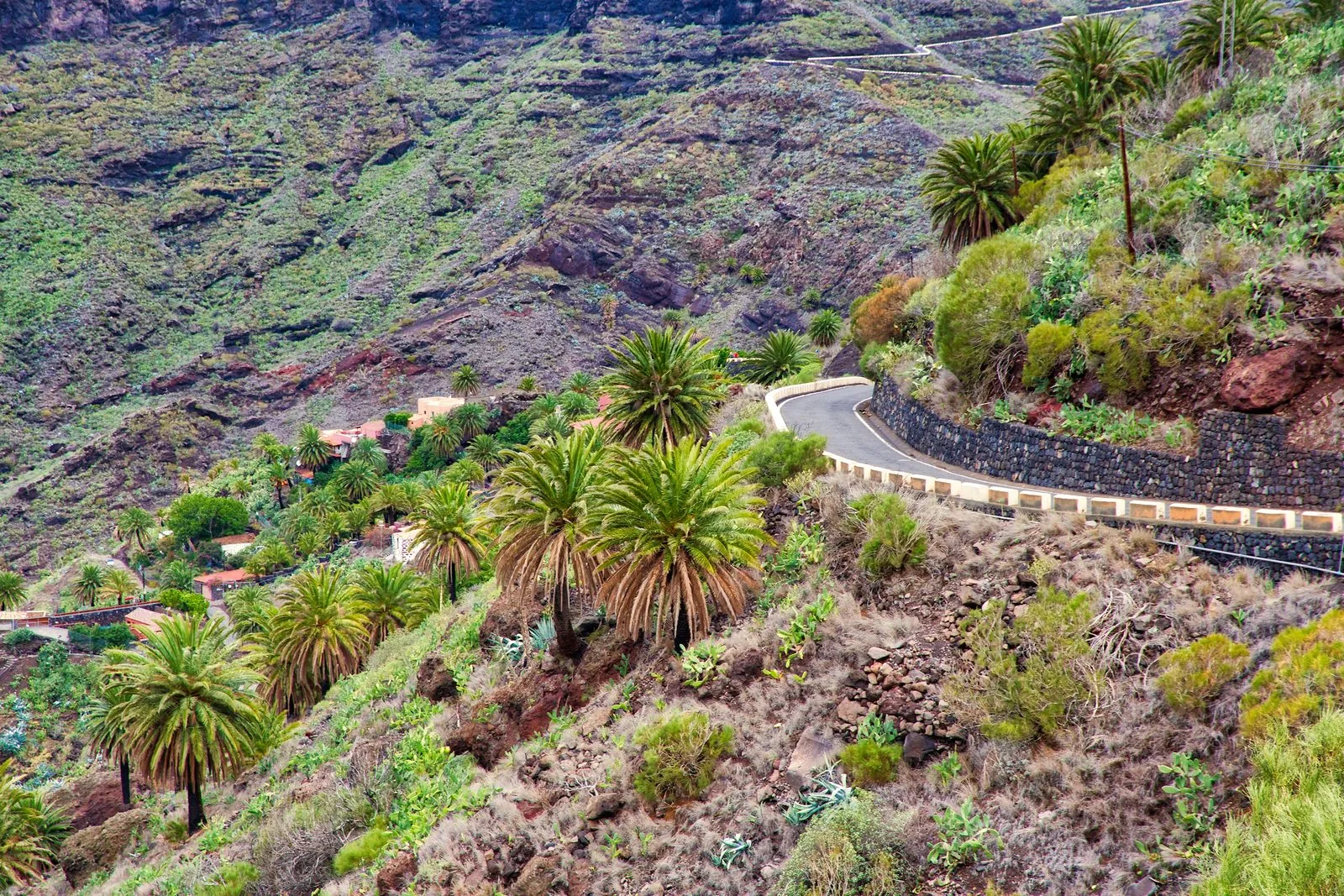
Photo: Marek Slusarczyk (Tupungato) · CC BY 3.0 · Wikimedia Commons · scaled
The two kinds of road
Canary roads fall into two very different worlds, and knowing which you're on changes how you drive.
Fast coastal motorways
The big islands are ringed by excellent dual carriageways: Gran Canaria's GC-1 sweeps down the east coast from Las Palmas to the southern resorts, while Tenerife's TF-1 (south) and TF-5 (north) do the same. These are smooth, fast and easy, whisking you between Maspalomas, Las Palmas and the airports in good time. Lanzarote, Fuerteventura and the smaller islands have fewer motorways but generally well-surfaced main roads.
Narrow mountain roads
The interior is another matter entirely — and the real adventure. Roads climb through pine forest and cloud in tight switchbacks, often single-lane-ish with a rock wall on one side and a sheer drop on the other. The spectacular route down to Masca in Tenerife, the passes of Gran Canaria's central peaks, and the ridge roads of La Palma and La Gomera are unforgettable, but they demand patience and a steady nerve.
Mountain distances lie. A drive the map says is 40 km can take well over an hour of hairpins. Always allow far more time than the distance suggests, and never plan to reach a viewpoint or ferry "just in time" via the interior.
Roundabouts and priority
Roundabouts (rotondas) are everywhere and traffic flows anticlockwise: give way to vehicles already on the roundabout, coming from your left. Signal right as you leave. At unmarked junctions in towns, traffic from the right generally has priority, but in practice most junctions are signed or controlled. Local drivers are usually courteous; the main hazard is hesitation from unfamiliar visitors, so commit clearly and don't stop dead on a roundabout.
Speed limits and police
Limits are posted in kilometres per hour and broadly follow mainland Spain: motorways up to 120, main roads lower, and 30–50 in towns. Mountain roads are self-limiting — you rarely get near the sign anyway. The Guardia Civil run speed checks and there are fixed and mobile cameras, so stick to the posted figure; fines for speeding, phone use or no seatbelt can be issued on the spot. Drink-driving limits are strict and enforced. When in doubt, drive to the conditions rather than the number.
Fuel — cheaper than the mainland
One of the happiest surprises of a Canaries road trip is the price at the pump. Thanks to the islands' low-tax status, fuel is markedly cheaper here than on the Spanish mainland or in northern Europe — a real bonus when you're touring. Stations on the main roads are plentiful and many are self-service; smaller ones may still have an attendant. Fill up before heading inland, because petrol stations are sparse in the mountains and can be far apart.
Keep the tank above half when exploring the interior of any island. There's little worse than watching the needle drop on a remote pass with no station for 30 km.
Parking: blue and green zones
Parking is easy at most southern resorts, where hotels and beaches have free lots, but tighter in the towns and cities. In busy centres and in Las Palmas or Santa Cruz you'll meet pay-and-display street parking colour-coded by kerb line:
- Blue zone (zona azul) — paid short-stay parking; buy a ticket from the machine and display it.
- Green zone (zona verde) — often reserved or discounted for residents, with limited or pricier visitor stays.
- White or unpainted — usually free, but read any signs.
- Yellow lines — no parking.
When it's busy, an underground or multi-storey car park saves the frustration of circling. At popular trailheads and viewpoints, arrive early in high season as the small car parks fill by mid-morning. Never leave anything visible in a parked car at a beach or trailhead.
Good news: no tolls
There are no toll roads in the Canary Islands — every motorway and main road is free to use. You won't need a toll tag, and your only running cost is the (cheap) fuel. It's one more reason a hire car here is such outstanding value.
Sat-nav and offline maps
Phone navigation works well across the islands and mobile coverage is good on the main routes, but it drops out in deep ravines, long tunnels and remote corners. Download offline maps of your island before you set off so you're never stranded without directions. A cheap phone mount clipped to the vents saves paying the rental desk for a GPS unit, and it's worth glancing at the route beforehand so a missed mountain turn doesn't send you the long way round.
Mountain driving with confidence
The hairpins are the part visitors worry about, but a few habits make them genuinely enjoyable:
- Use low gears on long descents to save the brakes from overheating — let the engine slow you rather than riding the pedal.
- Hug your own side and take blind bends wide of the drop; a light tap on the horn on the tightest blind hairpins warns oncoming traffic.
- Let locals pass. If a queue builds behind you, pull into a lay-by — there's no shame in it, and no rush.
- Watch for cloud. The interior can be shrouded in mist even when the coast is sunny; slow right down and use dipped headlights.
- Avoid the interior after dark on your first trips if you're not confident — the same road feels very different at night.
Putting it all together
With the right car and a little care, the Canaries are made for driving. See how a car fits your wider plans in getting around the Canary Islands, and once you've got wheels the whole archipelago is yours — the green heart of Gran Canaria, the road up to Teide on Tenerife, the fire-formed landscapes of Lanzarote and the endless beaches of Fuerteventura. Drive on the right, take the mountains slowly, keep the tank topped up — and enjoy the best-value freedom in European travel.