Hidden deep in the Teno mountains of north-west Tenerife, Masca is the island's most spectacular village — a scatter of stone houses clinging to a knife-edge ridge above a plunging gorge. For years it was cut off from the world, reachable only on foot or by mule, and even today the drive in feels like an adventure. Add the famous barranco walk down to the sea and the palm-dotted views in every direction, and Masca earns its reputation as one of the great days out on Tenerife.
The village on the ridge
Masca sits at around 600 metres, strung along a sharp spur of rock where two deep ravines meet. Whitewashed and stone-built houses tumble down the slopes among terraces, dragon trees and palms, with the volcanic peaks of the Teno massif rising all around. It is tiny — a handful of homes, a small church, a couple of bar-restaurants serving local food — but the setting is unforgettable. Long isolation gave the place a certain mystery (local legend even ties it to pirates and witches), and it still feels wonderfully remote despite the day-trippers.
Give yourself time simply to wander, take in the viewpoints and enjoy a coffee or a plate of Canarian country cooking with a jaw-dropping view. If you love this kind of wild, green, mountainous Tenerife, the neighbouring hills reward slow exploration far from the southern resorts.
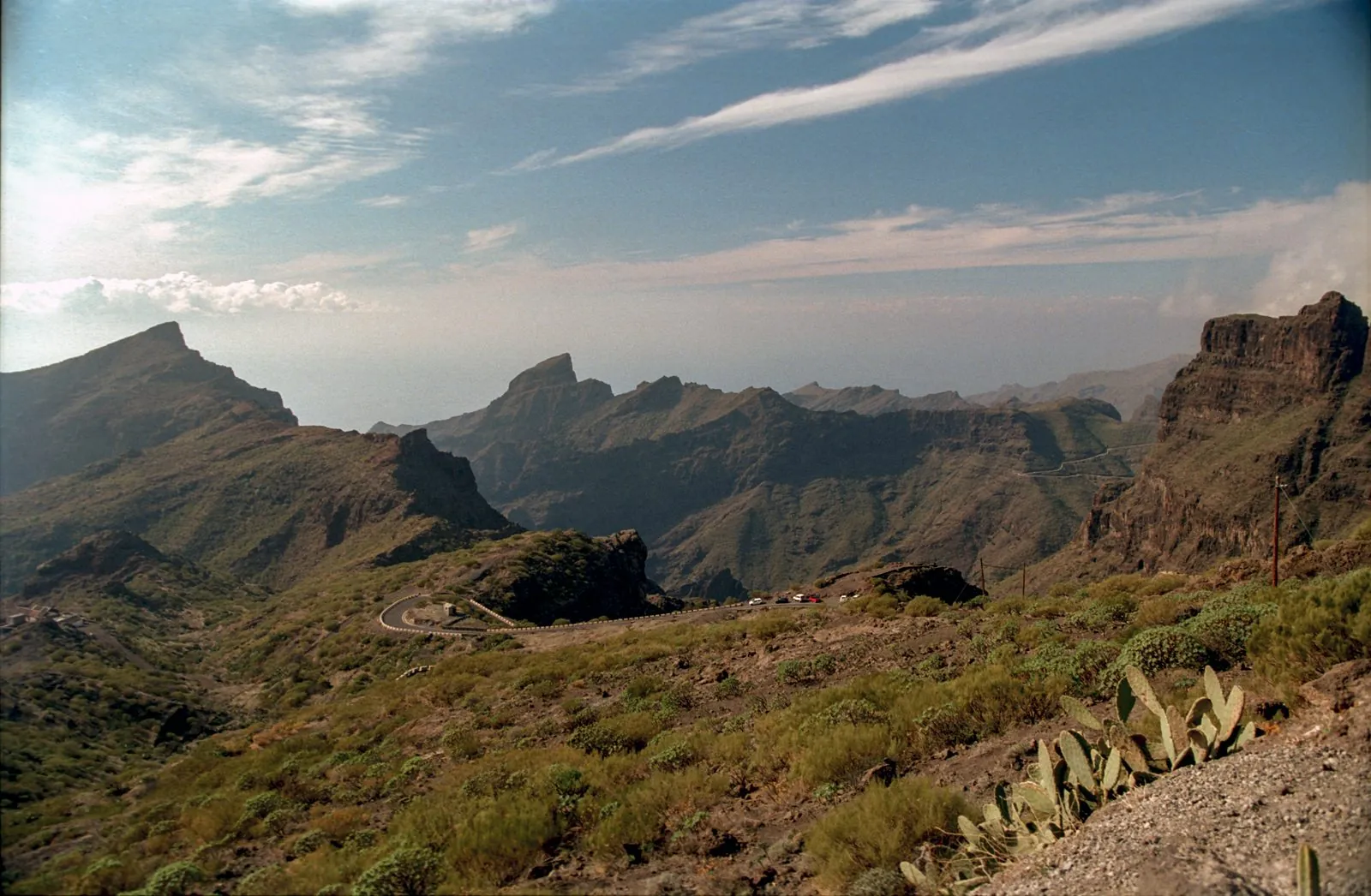
Photo: Jerzy Strzelecki · CC BY-SA 3.0 · Wikimedia Commons · scaled
The drive: the TF-436
Getting to Masca is half the experience. The village is reached by the TF-436, a narrow, gloriously twisting mountain road that snakes over the Teno hills between Santiago del Teide and Buenavista del Norte. It is a procession of tight hairpins, sheer drops and knock-out views — thrilling for confident drivers and, for passengers, one of the most scenic routes in the Canaries.
The road is not for the nervous. The TF-436 is single-lane in places, with blind bends and steep edges; take it slowly, use the horn on tight corners and be ready to reverse to a passing point. Parking in Masca is very limited and fills fast, so arrive early. If you would rather not drive it, organised excursions and buses run to the village.
You will really want a hire car for the freedom to stop at viewpoints along the way, though nervous drivers may prefer a coach tour that tackles the hairpins for you. Either way, allow far longer than the distance suggests.
The Masca gorge walk
The barranco de Masca is one of the most famous hikes in the Canary Islands: a dramatic descent from the village through a narrow, towering gorge down to a hidden black-sand cove on the Atlantic. It is roughly 5 km one way and steeply downhill, threading between soaring rock walls, past pools, palms and boulders, before delivering you to the sea. The scenery is extraordinary — but it is a proper mountain walk, not a stroll.
Plan the gorge walk carefully — the rules have changed. Access is now controlled: you must book a timed entry in advance, the route is walked downhill only, and everyone is issued a safety helmet that must be worn and returned. It typically opens only on certain days and hours. Because the beach has no road, most walkers return by boat to Los Gigantes (a separate ticket). Wear proper hiking shoes, carry water and sun protection, and check the official Masca trail website for current opening days, prices and booking before you set out.
As of 2026 the combined cost — trail entry plus the boat transfer — comes to a few tens of euros per adult, but figures and opening days change, so always confirm on the official site when you book. The walk takes most people around three to four hours down, and it is genuinely demanding on the knees; it is best suited to reasonably fit walkers with good footwear. For an overview of the island's trails and grading, see our guide to hiking in the Canary Islands.
The boat back to Los Gigantes
Because there is no road to the foot of the gorge, walkers are collected from the little beach by water taxi and carried along the coast to Los Gigantes, past its famous cliffs — a fitting, cinematic end to the day. The colossal rock walls plunge straight into the sea here and look magnificent from the water. From Los Gigantes you will need to arrange transport back to your car in Masca (a taxi or a pre-booked transfer), so factor that into your plans, as the two points are on opposite sides of the mountains.
Not up for the full hike? You don't have to walk the gorge to enjoy Masca. Many visitors come just for the village, the viewpoints and the drive, then head on to explore the Teno hills or the coast. It makes a brilliant half-day even without the descent.
Viewpoints and combining your day
The road to Masca is lined with miradores (viewpoints) worth stopping at — the lookout just above the village gives the classic postcard shot of the houses on their ridge with the gorge falling away behind. On a clear day you can see across to the neighbouring island of La Gomera, floating on the horizon beyond the western cliffs.
Masca pairs naturally with other highlights of north-west Tenerife. Many people combine it with the historic harbour town of Garachico, the dragon-tree town of Icod, or a coastal stop at Los Gigantes for lunch and the cliffs. Together they make a wonderful loop through the greener, older, less-touristy side of the island — a proper contrast to a beach-based holiday.
A ridge-top village at the end of an impossible road, and a gorge that leads to the sea — Masca is Tenerife at its wildest and most romantic.
Whether you tackle the full barranco descent or simply soak up the village and the drive, set aside the best part of a day, start early, and bring your camera. Masca is the kind of place that reminds you the Canaries are so much more than sun-loungers — and it is one of the finest things to do anywhere in the islands.