Timanfaya National Park is where you feel Lanzarote's volcanic heart still beating. Spread across the island's western flank, the Montañas del Fuego — the "Mountains of Fire" — are the raw, barely cooled remains of the great eruptions of the 1730s that buried a quarter of the island under lava and ash. Today it's Lanzarote's unmissable natural wonder: a Martian sweep of red, black and ochre where the ground is still hot enough just below the surface to set brushwood alight and boil water into a geyser. It's dramatic, genuinely strange, and unlike anywhere else in the Canaries.
A landscape frozen mid-eruption
Between 1730 and 1736, and again briefly in 1824, dozens of vents opened across this corner of Lanzarote in one of the longest eruptive episodes in recorded European history. The lava swallowed villages and farmland but left behind an eerie, beautiful desert of cones, craters and frozen rivers of rock. The park was created in 1974 to protect it, and because the terrain is so fragile — and the ground genuinely dangerous in places — this is one attraction you experience on set routes rather than on your own two feet.
You can't wander freely in Timanfaya. To protect the ecosystem and keep visitors safe, there's no roaming across the lava fields. The core of the park is seen from the Ruta de los Volcanes coach and from the viewing terrace at Islote de Hilario. If you want to walk, do it on the official guided trails (which must be booked ahead) or on marked paths around the park's edges — never strike out across the malpaís alone.
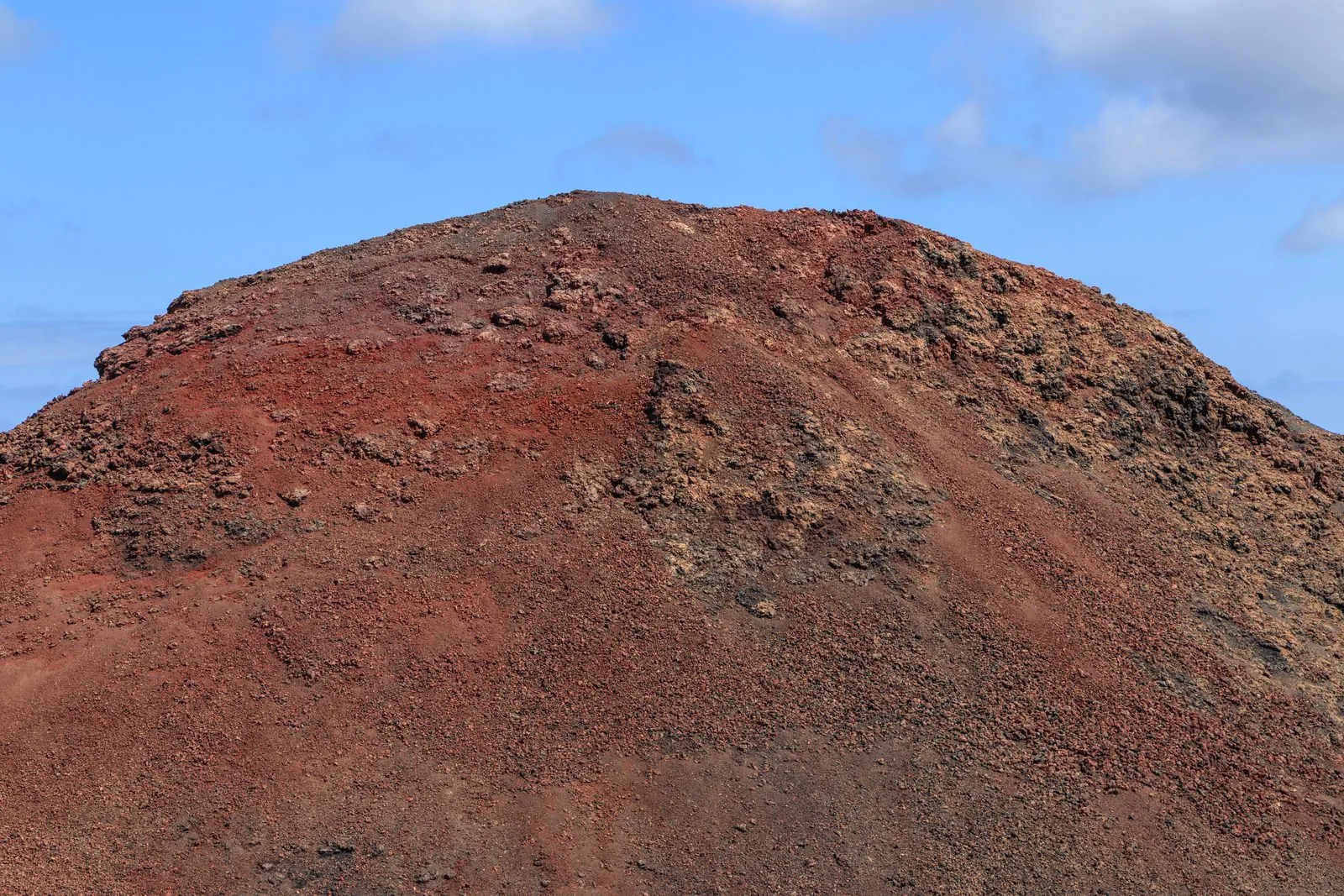
Photo: H. Zell · CC BY-SA 3.0 · Wikimedia Commons · scaled
Islote de Hilario and the geothermal demonstrations
Every visit centres on Islote de Hilario, the visitor hub perched on a hot spot where subsurface temperatures climb to several hundred degrees just metres down. Park staff put on short, memorable demonstrations that make the heat vivid: dry gorse stuffed into a shallow pit bursts into flame within seconds, and a bucket of water tipped into a borehole erupts back out as a scalding jet of steam. It's a simple show but a brilliant one — proof that the "Mountains of Fire" are no exaggeration.
El Diablo restaurant
Right on the Islote sits El Diablo, one of the most extraordinary restaurants you'll ever eat in. Designed by the Lanzarote artist César Manrique and opened in 1970, it grills meat, chicken and fish over an open well that draws heat straight from the volcano below — no gas, no charcoal, just geothermal warmth. The circular dining room has floor-to -ceiling glass framing the lava fields, so the view is as much of a draw as the food. It's worth a look even if you only stop for a coffee at the tapas counter; the mesmerising device is Manrique's genius, turning the volcano itself into a cooker.
The Ruta de los Volcanes coach tour
The star experience is the Ruta de los Volcanes, a roughly 14 km coach route that loops deep into the closed heart of the park along a road no private cars may use. From the comfort of the bus you glide past craters, tunnels of collapsed lava, mineral-streaked cones and viewpoints out to the Atlantic, with commentary (usually in several languages) explaining what you're seeing. It takes around 30–40 minutes and is included with your park entry — coaches leave regularly from Islote de Hilario, so you rarely wait long.
Camel rides at the Echadero de Camellos
On the approach road to the park, at the Echadero de Camellos, you can take a short, gentle camel ride up the flank of a volcanic slope — a Lanzarote tradition dating back to when camels worked the island's fields and vineyards. It's a fun add-on, especially with children, and the swaying climb offers lovely views back over the ash plains. The ride is a separate, low-cost ticket paid on the spot, and it's entirely optional — many visitors skip it and head straight for the main park.
Tickets, timing and what to know
Timanfaya charges a single park entrance fee that covers the Islote de Hilario demonstrations and the Ruta de los Volcanes coach. As of 2026, adult tickets are typically in the region of €12, with reductions for children and free entry for under-7s — but because the park manages visitor numbers, buying a timed ticket online in advance is strongly recommended and can save a long wait at the gate, especially in peak season. Always check the current price and booking arrangements on the official park website before you go.
Go early or late. Timanfaya is one of Lanzarote's busiest attractions, and a queue of tour coaches builds through the middle of the day. Arrive near opening or in the later afternoon for shorter waits, softer light on the red cones and a calmer visit. Bring water, sun cover and a light layer — it can be windy up on the exposed terrace.
Getting there and making a day of it
Timanfaya sits inland between Yaiza and Tinajo, an easy drive from the southern resorts of Playa Blanca and Puerto del Carmen, or from the capital Arrecife. A hire car is by far the simplest way to arrive and lets you set your own timing; there's parking at the entrance, from where you're directed up to Islote de Hilario. Without a car, half-day and full-day coach excursions run from most resorts and fold the park into a wider island tour.
The park pairs perfectly with the rest of Lanzarote's volcanic story. Combine it with a walk through the wine country of La Geria, whose vines grow in black ash-filled pits nearby, or with the extraordinary sites left by César Manrique — the caves of Jameos del Agua and the clifftop Mirador del Río — for a full day of the island at its most distinctive. It's a landscape that stays with you long after the tan has faded.
Fire from brushwood, steam from stone, and lunch grilled by a volcano — Timanfaya turns geology into pure theatre.