To understand Lanzarote, you have to understand César Manrique. The island's most famous son was an artist, architect and fierce environmentalist who, from the 1960s onward, more or less designed the Lanzarote you see today — low-rise, whitewashed, billboard-free and built in dialogue with its volcanic landscape rather than on top of it. His extraordinary visitor attractions, from a concert hall inside a lava tube to a garden of cacti in an old quarry, are the cultural backbone of any trip to Lanzarote — and collectively they're what makes the island feel so unlike anywhere else in the Canaries.
The man who saved Lanzarote from itself
Born in Arrecife in 1919, Manrique trained as a painter and spent time in Madrid and New York before returning home in the mid-1960s, just as mass tourism was arriving. Horrified by the high-rise concrete blighting other coasts, he persuaded the island authorities to adopt rules that still hold today: buildings kept low and painted white (with green or blue woodwork inland, blue on the coast), no roadside advertising hoardings, and development that works with the terrain. The result is a strikingly harmonious island — and a rare example of one visionary shaping a whole place. His mantra was that art and nature should be inseparable, and every site he built proves the point.
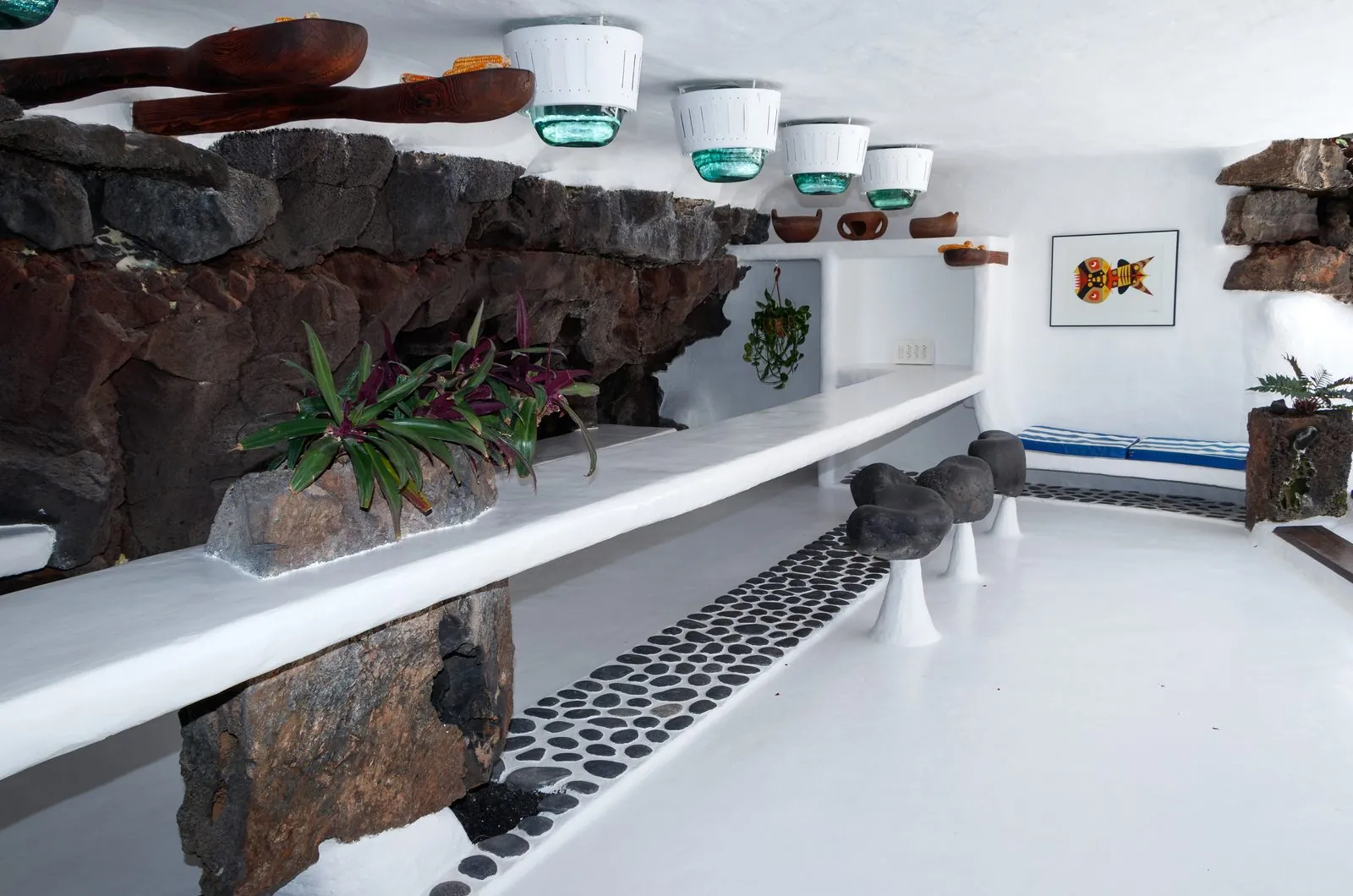
Photo: H. Zell · CC BY-SA 3.0 · Wikimedia Commons · scaled
Jameos del Agua
Manrique's first great intervention, Jameos del Agua, sits inside a collapsed section of a vast volcanic tunnel formed by the eruption of the Corona volcano. He turned the caverns into a surreal blend of nature and design: a still, crystal-clear underground lagoon home to tiny blind albino crabs found nowhere else on Earth, a dazzling white-edged pool among the palms, and a concert auditorium with astonishing acoustics built right into the lava tube. It's magical by day and even more so at the occasional evening events.
Cueva de los Verdes
Part of the same lava tube system, Cueva de los Verdes is the wilder, rawer half — a long stretch of underground tunnel that islanders once used to hide from pirate raids. The guided walk winds through soaring volcanic galleries, subtly lit to pick out the colours and textures of the rock, and builds to a genuinely jaw-dropping optical surprise near the end that visitors are asked not to spoil for others. It's a highlight for children and adults alike.
Mirador del Río
At the island's northern tip, Manrique carved a viewpoint into the top of the Famara cliffs so cleverly that from the road you barely see it's there. Inside, Mirador del Río opens onto huge curved windows and a terrace with one of the best views in the Canaries: nearly 500 metres straight down to the salt flats, out across the strait to the little island of La Graciosa and the rest of the Chinijo archipelago. It's Manrique's architecture and the natural drama working as one — exactly as he intended.
Jardín de Cactus
His final major work, the Jardín de Cactus, transforms a disused ash quarry near Guatiza into an elegant terraced amphitheatre planted with thousands of cacti from around the world. Sculptural spines, curving stone walls and a restored windmill make it as much an artwork as a garden — a masterclass in turning an industrial scar into something beautiful, which was Manrique's lifelong theme.
Fundación César Manrique
To see how he lived, visit the Fundación César Manrique in Tahíche, built into the flow of the 1730s eruptions. His former home is astonishing: a series of living spaces set inside five volcanic bubbles, connected by whitewashed tunnels, with a fig tree growing up through the lava and a lava-lined pool. Today it houses a gallery of his work and that of contemporaries such as Picasso and Miró, and it's the best place to grasp the whole philosophy behind everything else you'll see. (His later home at Haría, where he died in 1992, can also be visited.)
Tickets: the CACT network
Most of these sites are run by the island's public cultural body, the CACT (Centros de Arte, Cultura y Turismo), and are ticketed individually. If you plan to visit several, look for a combined ticket, which bundles two or more of the main attractions at a lower total cost than paying separately.
Buy a combined ticket if you're doing more than one. As of 2026, single-site adult entry is typically in the region of €10, with multi-site passes offering useful savings and reductions for children and residents. Because prices, opening hours and which sites are included can change, always check the current details on the official CACT Lanzarote website before you set out — and note the Fundación is run separately with its own ticket.
Planning your Manrique days
The sites are spread across the island — the caves and Mirador cluster in the north, the Fundación is central, the Jardín de Cactus sits between them — so a hire car makes visiting far easier and lets you link two or three in a day without rushing. Pair the northern trio (Jameos, Cueva de los Verdes, Mirador del Río) on one outing, then combine the Fundación and the Jardín de Cactus with a drive through the pretty valley of Haría on another.
Beat the coach parties: the caves and Jameos are firmly on the tour-bus circuit, so arriving early or in the later afternoon means quieter galleries and better photos.
Together with the fire-and-lava spectacle of Timanfaya National Park — where Manrique also designed the unforgettable El Diablo restaurant — his works make the cultural core of a Lanzarote holiday. Beach days at Playa Blanca or the family resorts are lovely, but it's Manrique's vision that gives the island its soul.
Concert halls in lava tubes, gardens in old quarries, viewpoints hidden in a cliff — Manrique didn't decorate Lanzarote, he composed it.
See more things to do across the Canaries to weave his sites into a wider island-hopping trip.