La Graciosa is the Canaries' newest and most disarmingly simple island — a tiny, roadless speck of sand and volcanoes off the north coast of Lanzarote, where you swap tarmac for dirt tracks and the pace drops to almost nothing. Officially recognised in 2018 as the eighth inhabited Canary Island, it is home to a single small village, a scatter of wild beaches, no paved roads and barely a few hundred residents. You reach it by a short ferry hop, and within minutes of stepping ashore you understand the appeal: this is the archipelago stripped right back to sea, sand, sky and silence.
Part of the Chinijo Archipelago — a cluster of islets and a vast marine reserve off northern Lanzarote — La Graciosa is protected, unspoilt and gloriously low-key. Most people come for the day; the lucky few stay a night or two and never quite want to leave.
Getting there: the ferry from Órzola
There is no airport, so everyone arrives the same way — by the short ferry crossing from Órzola, the little port at the northern tip of Lanzarote. The main operator, Líneas Marítimas Romero, runs boats across the strait known as El Río to the island's only village, Caleta de Sebo, in around 25 minutes, several times a day. The crossing itself is lovely, with the cliffs of Lanzarote's Famara massif rising behind you and clear water below.
Plan the connection with our ferries between the islands guide, and let the route-planning site Viamo help you stitch together the drive up to Órzola and the boat beyond. If you are staying overnight, check the last return sailing carefully and book ahead in busy periods.
Getting to Órzola takes time — it is at the far north of Lanzarote, well over an hour from the southern resorts. Set off early to make the most of a day trip, and build in a margin so a slow drive doesn't cost you your ferry.
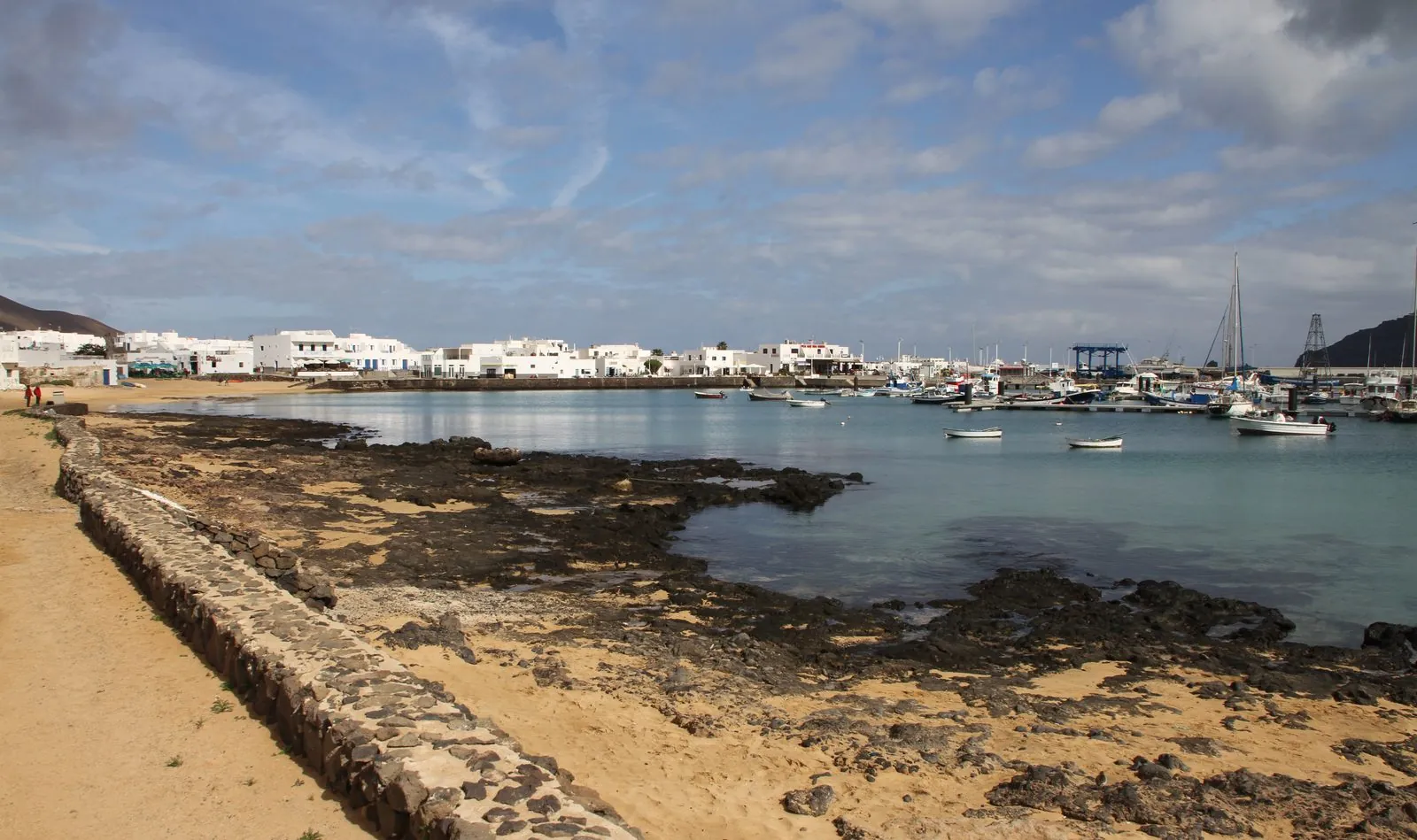
Photo: Gerd Eichmann · CC BY 4.0 · Wikimedia Commons · scaled
What to do
The whole point of La Graciosa is that there is gloriously little to "do" in the organised sense — and everything to enjoy. The island has no paved roads: you get around on foot, by bicycle, or in one of the rugged 4x4 taxis that bump along the sandy tracks to the more distant beaches. Cycling is the classic way to explore, and bikes are easy to hire in the village, though the sandy going can be hard work in the wind.
Beyond the beaches, the pleasures are simple: walking or riding out to a lonely cove, climbing one of the low volcanic cones for a view over the whole flat island and the cliffs of Lanzarote, snorkelling in the clear, protected waters of the marine reserve, and eating fresh fish by the harbour. It is a place for slowing down, not ticking off sights.
The village: Caleta de Sebo
Caleta de Sebo is the island's only real settlement — a cluster of low white houses along sandy, unpaved streets around the little harbour where the ferry docks. It holds nearly all the island's services: a handful of restaurants and bars, a couple of small shops and the modest range of places to stay. It is unhurried and friendly, and it is where every visit begins and ends.
Beaches
La Graciosa's beaches are its glory — wild, undeveloped and often nearly empty. The showpiece is Playa de las Conchas on the north-west coast, a stunning stretch of pale sand beneath a red volcano, framing views across to the dramatic islet of Montaña Clara. It is breathtaking to look at, but the open-Atlantic water here has strong currents and is not safe for swimming.
For calmer bathing, Playa Francesa and the beaches on the sheltered, Lanzarote-facing side are the better bet, with clearer, more protected water. Reaching the further beaches means a walk, a cycle or a 4x4 taxi along the tracks — there is no shade and few, if any, facilities, so come self-sufficient. For the wider picture of the archipelago's sands, browse our beaches section.
Several of La Graciosa's most beautiful beaches, including Playa de las Conchas, face the open Atlantic and have dangerous currents. There are no lifeguards. Admire them, but only swim where the water is calm and sheltered, and never alone.
Practicalities
Services are very limited, and that is part of the charm — but it means planning ahead. There are no big supermarkets, no petrol stations, no cash machines to rely on and only a small choice of accommodation, so bring what you need (water, sun protection, some cash) and book any overnight stay well in advance. Cars are essentially not for visitors; you explore on foot, by bike or by 4x4 taxi. Mobile signal and opening hours can both be patchy, so keep your plans loose.
As part of a strictly protected marine reserve, the island asks visitors to tread lightly — stick to the tracks, take your litter with you and respect the fragile dunes and wildlife.
Who La Graciosa suits
La Graciosa is made for day-trippers from Lanzarote wanting a complete change of pace, for cyclists and walkers, and for escapists who dream of empty beaches and starry, silent nights with no traffic. It is perfect as an easy adventure bolted onto a Lanzarote holiday — pair it with the César Manrique sights and the beaches of the main island — and it rewards anyone willing to leave comfort and crowds behind for a day.
It will not suit those who want resorts, nightlife or easy luxury; there simply isn't any. But if the idea of an island with no roads and nothing to prove sounds like bliss, book the ferry. Plan the wider trip with our Lanzarote island guide and our best time to visit page.