For a week in Fuerteventura, spend four nights in Corralejo in the north and three in the south around Costa Calma or Morro Jable, and keep a hire car for the whole stay: that lets you see Isla de Lobos, the dunes, El Cotillo, Betancuria and the far end of the Jandía peninsula without any day starting with a two-hour drive. The one thing that needs real planning is Cofete, the great empty beach on the far side of the Jandía mountains, which is reached only by a dirt track that most hire-car contracts do not cover. There is a bus that takes the strain, and this page explains it.
Fuerteventura is long and thin, about 100 kilometres from Corralejo at the northern tip to Punta de Jandía at the south-western end, and the island's beaches are spread along almost all of it. People who base themselves in one resort for a week tend to see one end of the island well and the other end through a windscreen. Splitting the week cuts out most of that driving, and the change of hotel falls naturally on the day you cross the island's mountainous middle.
The plan below runs from north to south, with one day kept for nothing more than a beach and a tide table. Driving times are realistic ones, not the optimistic figures a satnav gives you on an empty road, and there is a list at the end of what to book before you leave home.
Where to sleep: north first, then south
Corralejo is the right first base. It is a lively, walkable town with a harbour, a long main street of bars and restaurants and the ferry to Lobos at the end of it, and it is the closest resort to the dunes and to El Cotillo. For the second half, Costa Calma sits right on the Sotavento coast and is the quieter, cheaper choice; Morro Jable is a real town with a promenade and a longer beach, and it is 25 minutes closer to the start of the Cofete track. Either works.
If you would rather not pack twice, Caleta de Fuste on the east coast is the compromise. It is only a few minutes from the airport and roughly in the middle, so nothing is more than about an hour away, but it also means every big day out starts and ends with a long drive. Our page on where to stay in Fuerteventura sets the resorts side by side.
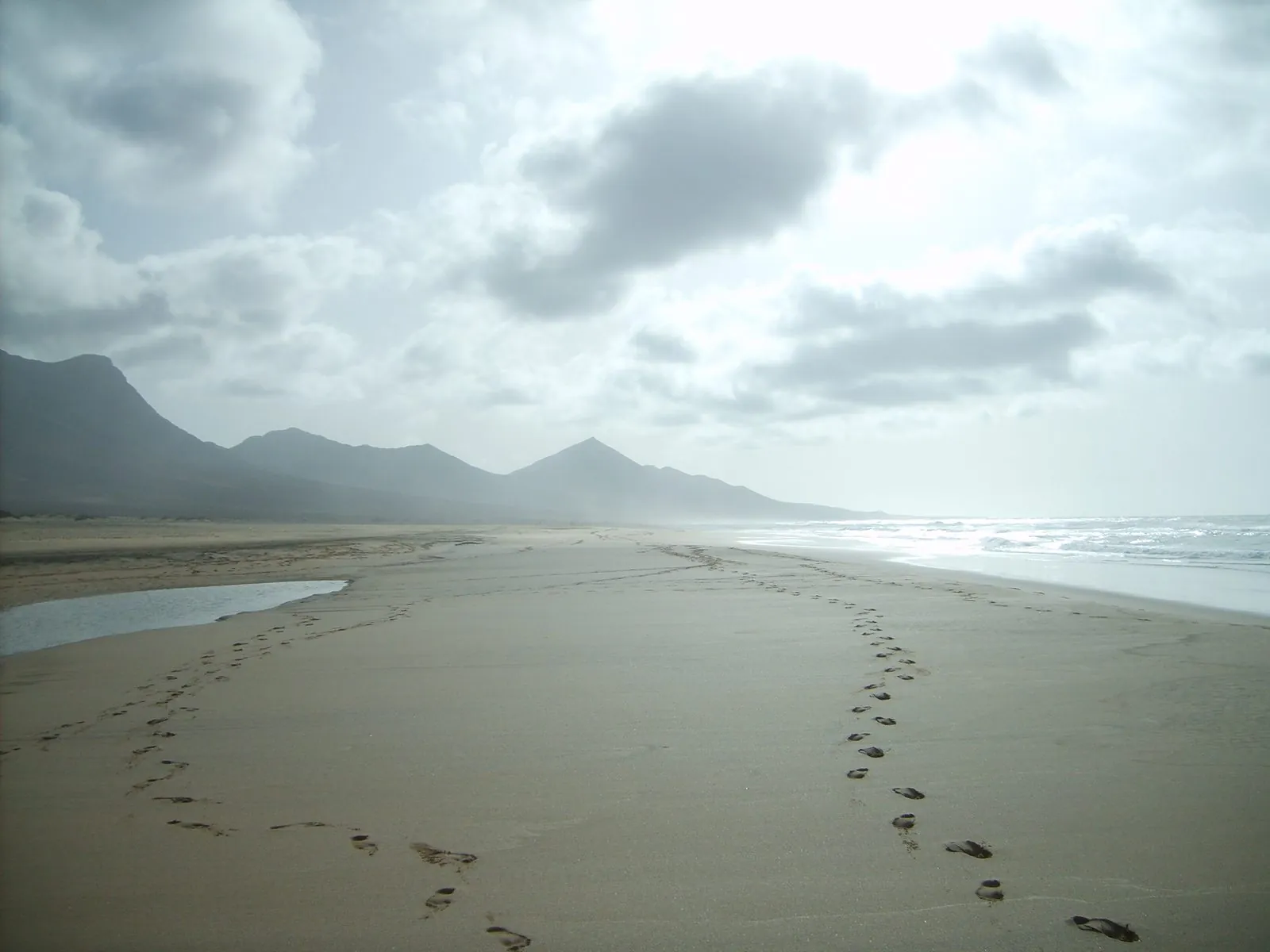
Photo: Xosema · CC BY-SA 4.0 · Wikimedia Commons · scaled
How far things really are
Fuerteventura's main roads are wide, straight and quiet by Canarian standards, and the FV-1 and FV-2 along the east coast are fast. What catches people out is the distance, and the mountain roads across the middle, which are slower than they look. These are typical times without stops.
| Route | Typical time | Road |
|---|---|---|
| Airport to Corralejo | 35–40 min | FV-1 |
| Airport to Caleta de Fuste | 10–15 min | FV-2 |
| Airport to Morro Jable | about 1 hr 15 min | FV-2 |
| Corralejo to El Cotillo | 20–25 min | FV-101 via Lajares |
| Corralejo to Betancuria | 50–60 min | FV-10 and FV-30, mountain at the end |
| Betancuria to Ajuy | 25–30 min | FV-30 via Pájara |
| Ajuy to Costa Calma | 45–55 min | FV-605 and FV-2 |
| Morro Jable to Cofete | 45–60 min | unpaved track |
| Morro Jable to Puertito de la Cruz | 45–60 min | unpaved track |
Fill up before you go south of Morro Jable or up into the interior. Filling stations thin out quickly once you leave the coast, and there are none on the Jandía tracks.
Days 1 and 2: Corralejo and Isla de Lobos
Day 1: settle in by the harbour
If you land by mid-afternoon there is time to drive north, check in and wander down to the old harbour in Corralejo for the evening. The little beaches by the old town are sheltered and fine for a first swim. Walk along the seafront at dusk and look across the strait: the low brown hump just offshore is Lobos, where you are going tomorrow, and the mountains beyond it are Lanzarote.
Day 2: a morning on Lobos
The ferries to Isla de Lobos leave from Corralejo harbour and take around 15 to 20 minutes. The islet is a protected natural park with a cap on daily visitors, and you need a free authorisation for a morning or an afternoon slot, issued online through the Cabildo's LobosPass. A boat ticket does not necessarily include it, so check with the operator or apply yourself. Take the morning slot. Walk the path to the shallow lagoon at El Puertito, climb the little volcano of La Caldera for the view back over the dunes, and swim at Playa de la Concha. There is almost no shade and very little food, so carry water and lunch. Back in Corralejo by early afternoon, spend the rest of the day on a town beach.
Day 3: the dunes and the north-west coast
Start early at the Grandes Playas, the long white beaches on the edge of the dune natural park south of town. The FV-1 runs straight through the dunes, and by mid-morning the wind is lifting sand across the road; at nine o'clock the beaches are empty and the light is soft. Walk out across the sand rather than just parking at the first beach bar.
Then cut across to the west coast through Lajares, a village of surf shops and cafés, and on to El Cotillo. North of the village the lagoons are calm, shallow and good for children; south of it the big west-facing beaches take the full Atlantic swell and are for looking at, not swimming in, unless the flags are green. The squat 18th-century watchtower by the harbour, the Torre del Tostón, is worth a look. Stay for the sunset, which is the best on the island, and eat fish at one of the restaurants over the old harbour before the 20-minute drive back.
Day 4: across the middle, from La Oliva to Ajuy
This is moving day and the most varied drive of the week. Check out early and head south through La Oliva, with its fortified Casa de los Coroneles, and past Montaña Tindaya, the sacred mountain of the island's first people, where you can stop and look but not climb without a permit. The road then climbs into the hills to the Mirador de Guise y Ayose, where two giant bronze figures of the island's last native kings stand above the valley, and drops into Betancuria, founded in 1404 and the island's capital for more than four centuries. Arrive by mid-morning; the village keeps short hours and empties by late afternoon.
Continue south through the palm groves of Vega de Río Palmas and Pájara to the black-sand cove at Ajuy. A path along the cliff leads in about ten minutes to great sea caves wrapped in pirate legends, and the pale layered rock you walk over is among the oldest exposed in the whole archipelago: seabed sediment laid down long before the island rose from the ocean. Have lunch in one of the fish restaurants on the beach, then take the road down to Costa Calma or Morro Jable for the evening.
Pack the boot the night before. On moving day you will leave the car at viewpoints, in Betancuria and at Ajuy with all your luggage in it. Keep everything out of sight in the boot from the moment you leave the hotel, not after you park.
Day 5: the easy day at Sotavento
After four busy days, do nothing. Playa de Sotavento, just south of Costa Calma, is one of the finest beaches in Spain, and its party trick depends entirely on the sea. Around low tide a long sandbar emerges and traps a vast, shallow lagoon behind it, warm and knee-deep, where you can wade for hundreds of metres; at high tide it fills and the beach looks like any other. Look up the tide time the evening before and plan to arrive an hour or two before low water.
The other thing to know is the wind. Sotavento is a world-class windsurfing and kitesurfing spot because the trade wind blows hard along it, especially in the afternoon and in summer. A windbreak or a spot in the lee of the dunes makes the day far more comfortable. If it is blowing a gale, the beaches around Morro Jable are usually more sheltered.
Day 6: Cofete and the end of the island
This is the day most visitors remember longest. From Morro Jable a gravel track runs west through the Jandía natural park. After a while it forks: one branch climbs over a pass in the mountains and drops to Playa de Cofete, about 12 kilometres of empty sand under a wall of rock, with the hamlet of Cofete, its small cemetery and the much-mythologised Villa Winter above it. The other branch continues along the south coast to Puertito de la Cruz, a straggle of fishermen's huts with a couple of fish restaurants, and the lighthouse at Punta de Jandía. You can do both in a day, but not slowly.
Do not swim at Cofete. There is no lifeguard, the currents are strong, and help is an hour away. Take water, food and sun cover, and start back in good time: the track is not somewhere to be driving after dark.
The track and your hire-car insurance
A zero-excess policy will not save you on a road your contract bans. Most hire-car contracts in the Canaries exclude unpaved roads, and the Jandía tracks are exactly that. If you drive them anyway, damage to tyres, the underside, the windscreen or the paintwork can fall on you in full, whatever cover you bought at the desk. A standalone excess policy usually only pays out when you kept to the rental terms, so it will not help either. Read the contract before you turn off the tarmac.
There are three honest ways round this. The first is Tiadhe's line 111, the public bus from Morro Jable to Cofete and Punta de Jandía, which runs on the track itself; it has only a few departures a day, so check the timetable on Tiadhe's website the evening before and be at the return stop early. The second is an organised 4x4 excursion from the southern resorts. The third is to hire from a firm whose contract explicitly allows the track, and keep that permission in writing. Our pages on hiring a car in the Canaries and on car-hire excess insurance explain what the different kinds of cover do and do not include.
Day 7: Morro Jable and the drive north
Spend the morning on the beach at Morro Jable, where the long sweep of sand runs beside the promenade, and walk out to the lighthouse at the end of it. Leave about an hour and a quarter for the drive to the airport, and more if you want to stop on the way. The salt pans at Salinas del Carmen near Caleta de Fuste are a short, easy detour close to the airport; the fishing town of Gran Tarajal and the beach at Las Playitas are good for a last lunch. Refuel before you reach the airport so the car goes back full, or the hire firm will charge you for the difference.
What to book before you go
- The hire car, for all seven days. Reserve early with free cancellation, and read the clause on unpaved roads before you pay.
- The Lobos ferry and permit. Book a few days ahead in winter and at Easter, and weeks ahead in August. Make sure the ticket includes the authorisation, or apply for it yourself.
- Your Cofete plan. Either a seat on a 4x4 excursion or the line 111 timetable for your date, checked again the evening before.
- A surf or kite lesson, if you want one, in Corralejo or at Sotavento. Schools fill up in the school holidays.
- Not needed: the dunes, El Cotillo, Betancuria, Ajuy and Sotavento, all of which you can simply turn up at.
A week at the island's own speed
Fuerteventura is not an island of sights so much as an island of space, and a week fits it well, provided you split the stay. Four nights in Corralejo give you Lobos, the dunes and the west-coast sunsets; three in the south give you Sotavento's tide lagoon and the long track to Cofete. Book the Lobos ferry and the car first, read the unpaved-road clause before you sign, and let the bus or a 4x4 tour take you to the end of the island if your contract says no. The days here are long and empty in the best sense, and that is the point of coming.