Punta de Jandía is the south-western tip of Fuerteventura, about 20 kilometres beyond Morro Jable at the end of an unpaved track, where a lighthouse from 1864 stands over the Atlantic and the fishing hamlet of Puertito de la Cruz serves grilled fish a short walk away. You can get there in an ordinary car, but most hire contracts exclude unpaved roads, so the uninsured risk is yours. The safer alternatives are the island's line 111 bus, which runs daily over the track, or an organised 4x4 tour.
The drive is the experience as much as the destination. Once the tarmac ends past Morro Jable's harbour, the track runs west along the foot of the Jandía mountains through the Jandía Natural Park, with the sea on one side and bare brown slopes on the other. Partway along, a branch climbs over the mountains to the great empty beach of Cofete; the main track carries on to the end of the island.
There is not much at the end, and that is the point. A lighthouse, a cluster of low houses, a few restaurants, a rocky shore and a great deal of wind. This page explains the track and how to drive it, the honest position on hire-car insurance, the bus, what to eat at Puertito de la Cruz and how to combine the trip with Cofete.
Where the road ends
Fuerteventura is long and thin, and the Jandía peninsula is its southern tail. The main road, the FV-2, runs down the east coast through Costa Calma to Morro Jable, the last town and the ferry port for Gran Canaria. Beyond the harbour the asphalt gives out and a wide gravel track takes over. From here to Punta de Jandía is roughly 20 kilometres, which takes most drivers 45 minutes to an hour each way at sensible speeds.
Stark and beautiful, the landscape changes little. The track crosses the mouths of dry ravines, passes goat enclosures and the odd building, and in places runs close above the shore. There is no fuel, no shop and almost no shade between Morro Jable and Puertito de la Cruz. Fill the tank and buy water before you leave town.
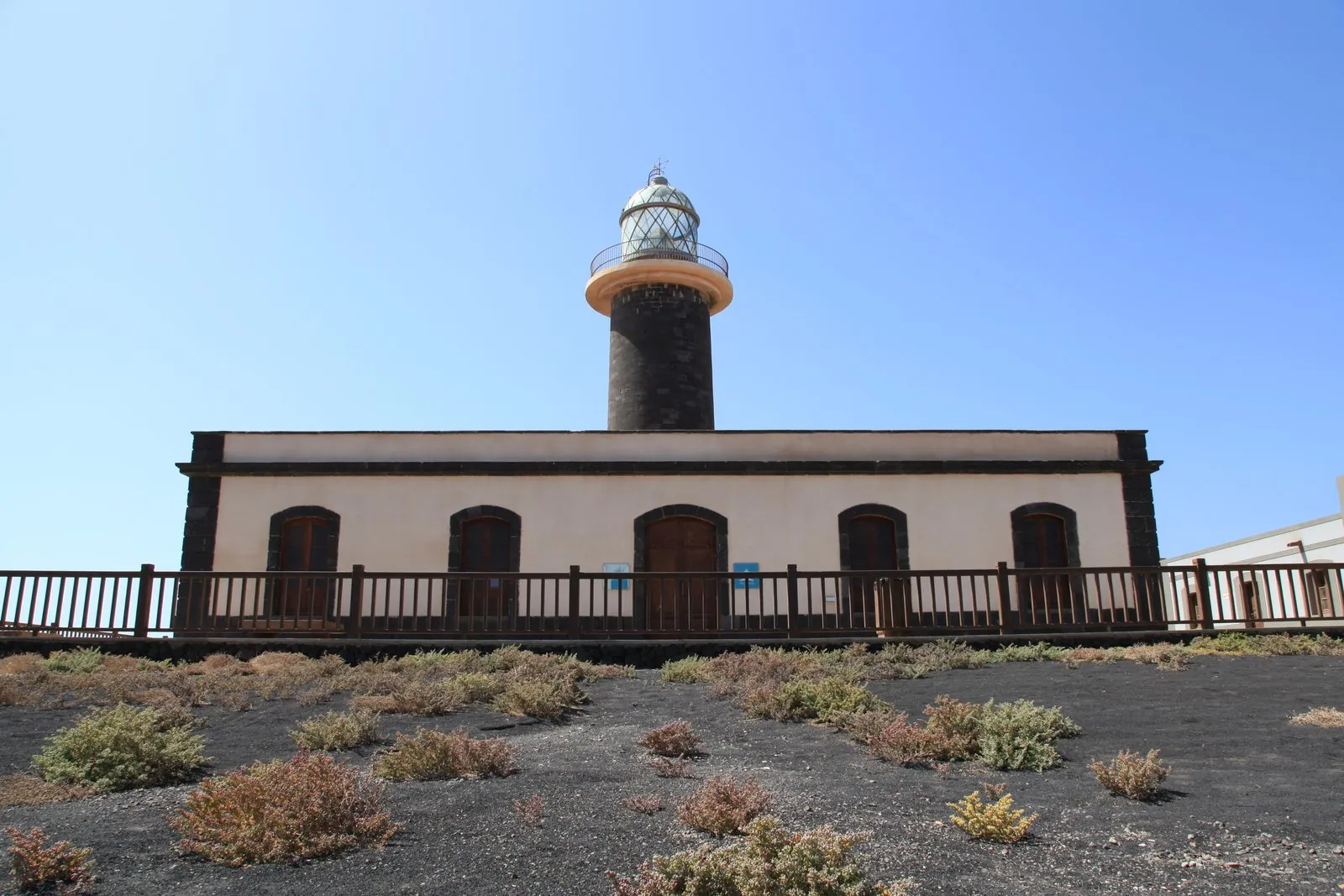
Photo: Frank Vincentz · CC BY-SA 3.0 · Wikimedia Commons · scaled
Driving the track
In dry weather the track to the lighthouse is passable in an ordinary car driven slowly. It is broad, mostly gravel and compacted earth, but it has potholes, washboard ripples that shake everything loose at speed, sharp stones that cut tyres, and the occasional rock in the road. Dust is the other hazard: an oncoming 4x4 can leave you driving blind for several seconds, so slow down and keep right when you see one coming.
- Speed: walking pace over the rough sections, and no faster than 30–40 km/h on the smooth ones. Most punctures happen to drivers in a hurry.
- Tyres: check the spare and the jack before you leave Morro Jable. Mobile coverage is patchy, and a breakdown truck will take a long time to reach you, if it comes at all.
- Weather: do not drive it after heavy rain, when ravine crossings can wash out. Rain is rare, but when it comes it comes hard.
- Daylight: start back with light to spare. The track is no place to be in the dark.
The branch to Cofete is a different matter. It climbs steeply over a mountain pass with long drops on the outside edge and no barrier, then descends in tight bends to the north coast. It is narrow, and meeting a car coming the other way on the steep section means someone has to reverse. Our pages on Cofete beach and on driving in the Canary Islands cover that part of the island in more detail.
Hire cars and unpaved roads: read the contract first
This is the paragraph to read before you book anything. Almost every car-hire contract in the Canaries prohibits driving on unsurfaced roads, and the Jandía track is the most famous example on Fuerteventura. If you damage the car there, a cracked sump, a torn tyre, a stone through the windscreen, chipped paintwork, the cost is usually yours, and the hire company's insurance and most standalone excess policies will not pay. A breakdown out there can also mean a hefty recovery bill.
Counter staff sometimes shrug and say everyone does it. That may be true, but the contract is what counts if something goes wrong. Before you go, check the terms for words such as "unpaved", "off-road" or pistas de tierra. A few local firms do permit certain tracks, sometimes for an extra charge or only in a 4x4; if yours does, get the permission in writing. Our pages on hiring a car in the Canaries and on car-hire excess insurance explain what different kinds of cover include and exclude.
Full cover is not off-road cover. Even a zero-excess policy bought at the desk normally excludes damage on unpaved roads, and so do most excess policies bought at home. If the paperwork does not mention tracks by name, assume you are not covered beyond the end of the tarmac.
The bus that does the driving for you
The simplest way to avoid the insurance question is to let someone else take the risk. Tiadhe, Fuerteventura's bus company, runs line 111, Morro Jable – Cofete – Punta de Jandía, every day of the week. According to the timetable on Tiadhe's website in November 2026, buses leave Morro Jable at about 10:00 and 14:15, and start back from the lighthouse at about 12:15 and 16:15, calling at Puertito de la Cruz and Cofete on the way. The return from Cofete towards Morro Jable is given only as an estimate, somewhere between 13:00 and 17:00.
As for fares, the ordinary ticket listed in 2026 is €8.70, with a much lower fare for holders of the Cabildo's resident card. Seats cannot be reserved, so arrive early at the stop in Morro Jable, especially in high season, when the bus can fill. Check the timetable again the evening before, because times change and services can be altered on public holidays. Our page on buses in Fuerteventura explains the wider network and how to get to Morro Jable from other resorts.
Do the lighthouse on the first bus, Cofete on the way back. Taking the 10:00 bus all the way to the lighthouse gives you about two hours at the tip and Puertito de la Cruz, enough for a look round and an early lunch. The later return then lets you see Cofete through the window, or get off there if the timetable for your date leaves a safe margin for the last bus back.
Alternatively, book an organised excursion. Several firms in the southern resorts run 4x4 tours to Cofete and the lighthouse, usually with a lunch stop at Puertito de la Cruz; our page on jeep safaris and island tours describes what to expect.
The Faro de Punta Jandía
The lighthouse stands on the last point of land, a low promontory of dark rock with the sea on three sides. Completed in 1864, it is a short stone tower, about 19 metres tall, attached to a single-storey keeper's house, whitewashed with dark volcanic stone at the corners and around the windows. Its light, about 33 metres above the sea, flashes white every four seconds and can be seen some 22 nautical miles out. It has guided ships rounding the tip of the island for over 160 years, and is still in service.
Inside, the keeper's house was fitted out as an interpretation centre for the Jandía natural park, with rooms on the geology, plants, animals, marine life and the lighthouse itself. Do not count on finding it open; check locally before you build a visit around it. The outside is the main attraction anyway: the rocks, the spray when a swell is running, and the wide view west into the open Atlantic. More of the islands' lights are on our page about Canary Islands lighthouses.
There are two "Jandía" lighthouses. The tall tower on the beach in Morro Jable is the Faro de Morro Jable, a separate light some 22 kilometres east of this one, and the two are often confused, including by some online maps. If your satnav says you have arrived while you are still beside the hotels, you have not.
Puertito de la Cruz and its fish
Just before the lighthouse lies Puertito de la Cruz, a small straggle of fishermen's houses and holiday cottages around a rocky cove, with a wind turbine on the slope and a few parked campervans. It is a hamlet rather than a village, with very few services, but it has the restaurants that make many people drive out here: plain terraces serving the day's catch grilled, with papas arrugadas, mojo sauces and a salad.
What you eat depends on what the boats brought in. Ask what is fresh rather than ordering from the laminated menu, and expect the price of whole fish to be by weight. Our page on Canarian seafood and fish explains the species you are likely to be offered and how they are cooked. Opening days and hours are informal, and some places close early or take a day off, so if lunch is the point of the trip, have a back-up plan and carry snacks.
Swimming, walking and the wind
Around the tip the coast is rocky and exposed, and this is not a beach-holiday stop. There are a few small coves near Puertito de la Cruz where locals swim on calm days, but currents around the point can be strong, there are no lifeguards and help is a long way off. If you want to swim, do it back at the long, patrolled beach of Playa del Matorral in Morro Jable. On the north side of the peninsula, Cofete's beach is beautiful but dangerous for swimming.
Wind is constant here and often strong, especially in summer, when the trade winds funnel round the end of the island. Bring a windproof layer even on a hot day, sunglasses against the dust, and a hat that will not blow away. Walkers can explore the shore and the low headlands either side of the lighthouse, but stay away from the edges when the sea is up: Atlantic swells break hard on these rocks.
Combining the tip with Cofete
Most people who make the drive want to see both, and you can do it in one day if you start early. The usual plan is to go to the lighthouse first, have lunch at Puertito de la Cruz, then drive back to the Cofete junction and over the pass in the afternoon, when the light comes round onto the mountains above the beach. Allow a full day, and do not rush the Cofete section to beat the dark.
If you only have time for one, choose by what you want. Cofete is the more dramatic landscape: twelve kilometres of empty sand under a wall of mountain, with the mysterious Villa Winter above it. Punta de Jandía is the more relaxed trip, with an easier track, a lighthouse and a good fish lunch at the end. Both feature in our guide to day trips from Fuerteventura.
Worth the dust?
For anyone staying in the south of Fuerteventura, yes. The ride to the end of the island is one of the most memorable half-days on Fuerteventura, and lunch at Puertito de la Cruz at the end of it tastes better for the effort. It is a trip for people who like empty places, wind and a slightly rough edge, not for anyone who wants a sunbed and a lifeguard.
Get the logistics right and it is easy. Take line 111 or a 4x4 tour, or check that your hire contract genuinely allows unpaved roads, carry water and a windproof layer, and start back with daylight to spare. Then let the end of the road be the end of the road.