Playa de Cofete is the wildest beach in the Canary Islands — a colossal 12-kilometre stretch of empty golden sand on the remote Atlantic side of Fuerteventura's Jandía massif, reached only by a long, rough, unpaved mountain road. There are no hotels, no sunbeds, no shops and, crucially, no safe swimming; what there is instead is one of the most awe-inspiring coastal landscapes in Europe. People come to Cofete not to bathe but to stand before something genuinely wild and vast on Fuerteventura.
How to get there
Cofete lies beyond the mountains on the far side of the Jandía peninsula, reached from the southern resort of Morro Jable by a long unpaved track that climbs over the massif and drops to the coast. It's slow, dusty, narrow and winding, with steep drops and passing places, and it takes real care and time. Many hire-car companies advise against or forbid taking ordinary cars on it, so plenty of visitors go by 4x4, guided tour or the local shuttle bus instead. Whichever way you come, treat the journey as an expedition, not a quick hop.
The road is serious. The track to Cofete is rough, unpaved and exposed, unsuitable for a normal 2WD hire car and often not covered by rental insurance. Consider a 4x4, an organised tour or the local bus, go slowly, carry plenty of water and fuel, and don't attempt it in poor conditions or after heavy rain.
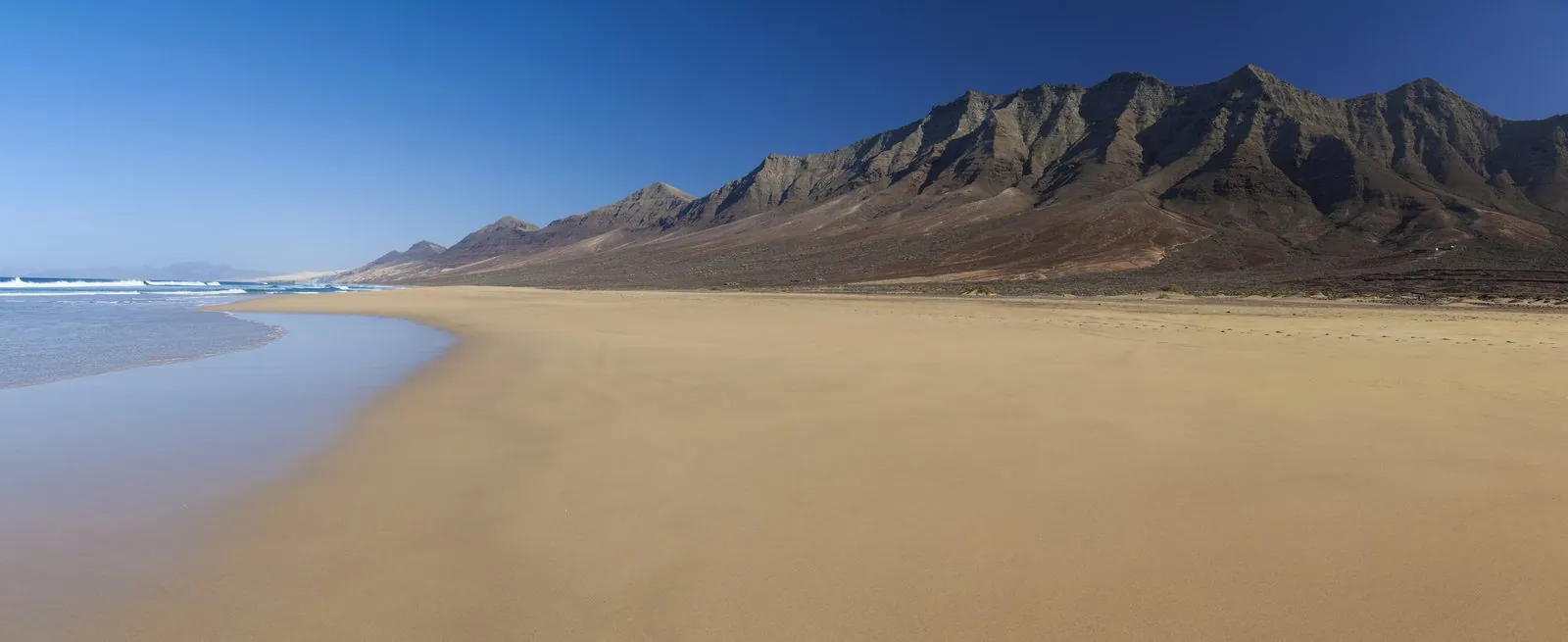
Photo: Tamara k · CC BY-SA 4.0 · Wikimedia Commons · scaled
What it's like
Cofete is pure drama. A near-endless beach of pale sand runs beneath the steep, barren wall of the Jandía mountains, with the open Atlantic crashing in and, more often than not, barely another soul in sight. The scale is humbling. Above the beach stands the mysterious, isolated Villa Winter, a lone house wrapped in local legend, and a tiny hamlet with a rustic restaurant. There's no development, no noise and no shelter — just wind, waves, mountains and sky. It is one of the most photographed and least tamed places in the whole archipelago.
Cofete is not a beach you swim at — it's a beach you stand in front of, humbled.
Swimming and safety
This is the essential warning. Cofete faces the full force of the open Atlantic and is known for powerful surf, fierce rip currents and dangerous undertow. There is no lifeguard, and it is a very long way from any help. Swimming here is genuinely hazardous and strongly discouraged even for strong swimmers — people have got into serious difficulty in the water. Enjoy the beach on foot, paddle at the very edge with great caution if at all, but do not go in for a swim.
Do not swim at Cofete. The currents and undertow are extremely dangerous, there are no lifeguards, and rescue is far away. Keep children well back from the water, stay on the sand, and come for the scenery, not a dip.
Facilities
Effectively none. Cofete is as undeveloped as beaches get — no sunbed hire, no shops, no reliable shade and patchy phone signal. The one saving grace is the small, rustic restaurant in the tiny settlement, good for fresh fish and a cold drink, but don't rely on it being open. Bring absolutely everything you need: plenty of water, food, sun protection and a full tank of fuel. Self-sufficiency here isn't a nicety, it's essential.
Best for whom
Cofete is for adventurers, photographers and lovers of raw, remote nature — travellers who'll happily trade every comfort for a landscape they'll never forget. It suits the well-prepared and the confident behind the wheel or on a tour. It is absolutely not for those wanting to swim, for families after safe paddling, for anyone needing easy access, or for a casual beach afternoon. Go for the sense of wonder, and go prepared.
Nearby
The busy southern resort of Morro Jable, with its long golden beach, lighthouse and restaurants, is the gateway to the Jandía peninsula and the obvious base for a Cofete expedition. The whole wild south of the island, from empty beaches to the Jandía Natural Park, spreads out around it. For where to stay and the best of the island, see our full guide to Fuerteventura.