The three best day trips from Fuerteventura are the islet of Lobos, a short boat ride from Corralejo; Lanzarote, 25–35 minutes across the strait from Corralejo to Playa Blanca; and the far south of Fuerteventura itself, where an unpaved track crosses the Jandía mountains to Cofete beach. Add a day in the island's quiet interior, around Betancuria and the old windmills, and you have the four outings that most visitors remember long after the hotel pool has blurred.
Fuerteventura is long and thin, roughly a hundred kilometres from Corralejo at the northern tip to Morro Jable at the southern one. That shapes everything. From Corralejo, Lobos and Lanzarote are almost on the doorstep and the far south is a long drive. From Morro Jable or Costa Calma, Cofete is close and the northern ferries are a serious commitment before breakfast. Caleta de Fuste, in the middle, is the one resort that can reach all of them with an early start.
This page takes each trip in turn: how you get there, the boats and buses that actually run, what a realistic day looks like, and the traps (a permit, a hire-car clause, a last coach) that catch people out. Timetables change by season, so treat the times here as the shape of the day and check the operator before you go.
Matching the trip to your base
| Trip | Start point | Getting there | Best from | Watch out for |
|---|---|---|---|---|
| Isla de Lobos | Corralejo harbour | Small passenger boats | Corralejo, El Cotillo, Lajares | Free permit needed; numbers capped |
| Lanzarote | Corralejo harbour | Ferry to Playa Blanca, 25–35 minutes | Corralejo, Caleta de Fuste | Hire-car rules on taking a car across |
| Cofete and Punta de Jandía | Morro Jable | 4x4 tour, the line 111 bus, or your own 4x4 | Morro Jable, Costa Calma | Unpaved track; most hire contracts exclude it |
| The interior | Anywhere | Hire car | Caleta de Fuste, Corralejo | Few buses to the villages |
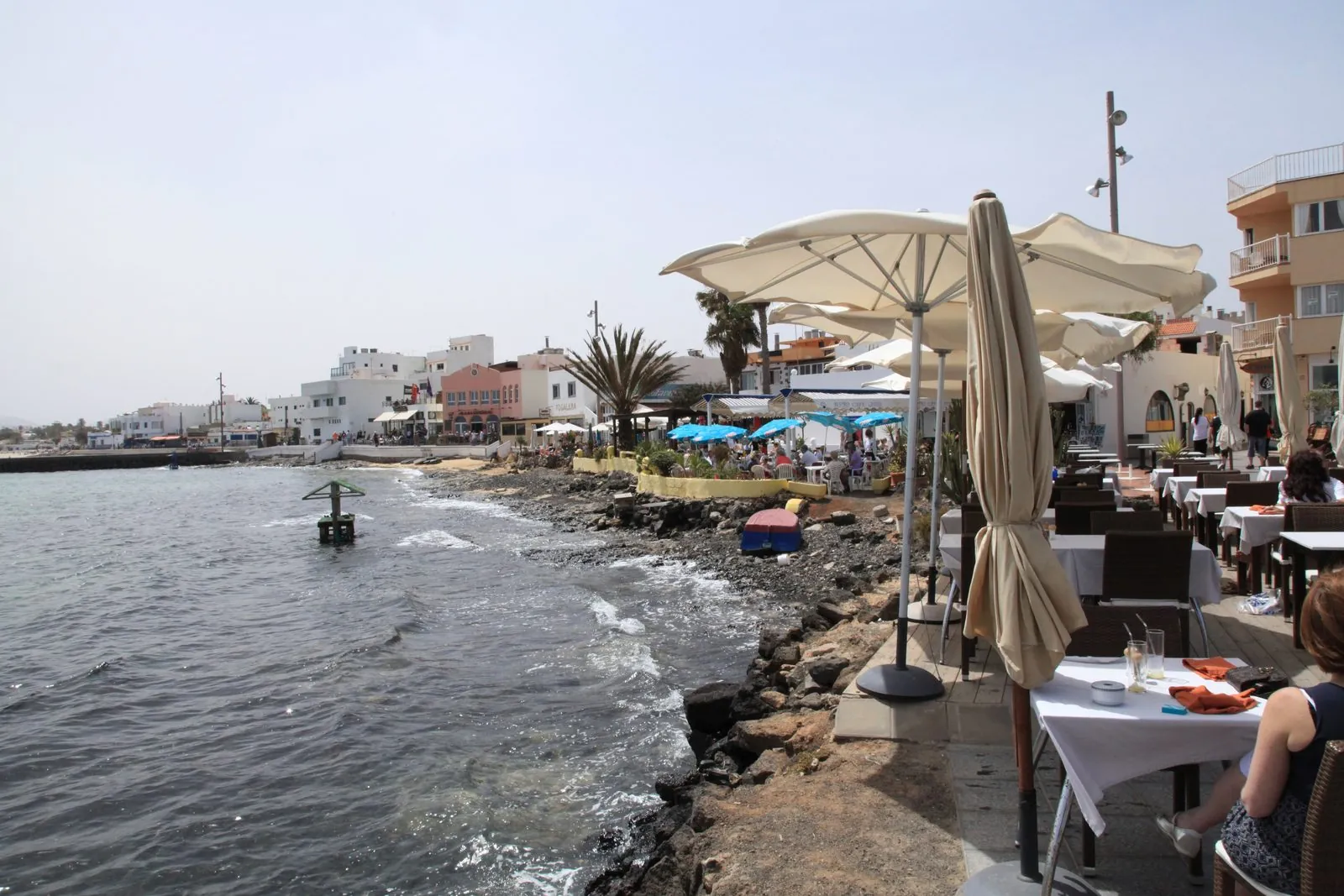
Photo: Frank Vincentz · CC BY-SA 3.0 · Wikimedia Commons · scaled
Lobos: the island across the channel
From the beach in Corralejo you can see Lobos all day: a low brown islet with one small volcano, just across a channel of very clear water. Boats leave from Corralejo harbour through the day, and the crossing is short enough that you are ashore before you have settled into your seat. On the island there are no roads and no cars, only a network of marked paths, the lagoon and fishermen's huts at El Puertito, the Caldera cone and the lighthouse at the northern tip.
What to see and how long each walk takes is on our page about Isla de Lobos. What matters for planning is the permit. Visits to the natural park need a free authorisation from the Cabildo de Fuerteventura, issued online through its LobosPass site, and the island's management plan sets a limit of about 200 people at a time. Several ticket sellers say plainly that a boat ticket does not include it, so apply yourself unless the operator confirms in writing that it has done it for you.
The rules have not always been enforced. Canarian Weekly reported in August 2025 that environmental groups had counted far more than 200 visitors on summer days and complained that nobody checked. In September 2026 the Cabildo approved funding for a new service to watch over public use of the park, rtvc.es reported, so it is sensible to assume that permits will be asked for.
Take the morning boat and walk the long path first. The track to the lighthouse is flat but completely shadeless, and by early afternoon the heat reflected off the lava is fierce. Do the walk while it is cool, then spend the rest of your time in the lagoon at El Puertito, which is shallow, sheltered and ideal for children with a mask.
Lanzarote: a second island in half an hour
Three companies sail between Corralejo and Playa Blanca, and together they offer well over a dozen crossings a day. Fred. Olsen Express gives 25 or 35 minutes depending on the vessel, Líneas Romero runs fast passenger boats in about half an hour, and the conventional ferry that used to carry the Naviera Armas name now sails for Baleària, which took control of the Armas business in the Canaries in May 2026. Baleària said its refurbished Volcán de Tindaya would make seven return trips a day in summer 2026. Operators, crossing times and rules for vehicles on every inter-island route are gathered on the Viamo overview of Canary Islands ferries.
Playa Blanca, where you land, is Lanzarote's southern resort, and the most obvious target from the harbour is the string of Papagayo beaches a few kilometres east, golden coves under low cliffs. They are reached by a dirt track or by boat from the marina, not on foot from the port in any comfort.
The bigger prize is Timanfaya, the national park of the Fire Mountains, about half an hour's drive north. You cannot drive the volcano route yourself: the ticket, €30 for adults in 2026 and free for under-7s, includes a 35-minute coach tour of the craters and the geothermal demonstrations at Islote de Hilario. Since June 2026 it is sold online only, for a set date and time slot, and nothing is sold at the gate. The last coaches leave at about 15:45, so book a late-morning slot before you sail and leave the beach for the afternoon.
Bringing a car, or hiring one in Playa Blanca
Fred. Olsen and Baleària carry cars; Romero's fast boats generally take foot passengers only. The question is whether your rental agreement lets you take the car off Fuerteventura. Many do not, and others allow it only with the company's written permission. If you cross without it, any damage or breakdown on Lanzarote may not be covered, and the excess policy you bought at home may not save you either: our page on car hire excess insurance explains why the small print matters.
For most people the cleaner answer is to cross on foot and hire a car for the day in Playa Blanca, which several firms offer near the port. Without a car, you can still have a good day: walk the seafront promenade, take a boat to Papagayo from the marina, and eat by the harbour before the return sailing. If you want the fuller Lanzarote picture, from La Graciosa to the northern caves, our companion page on day trips from Lanzarote covers the island from the other side.
The far south: Cofete and the end of the road
South of Morro Jable the tarmac gives out and a gravel track climbs over the Jandía massif. On the far side lies Cofete, a beach of pale sand that runs for kilometres under a wall of mountains, with a tiny hamlet, one restaurant and the mysterious Villa Winter on the slope behind. Continue west on the track instead and you reach the lighthouse at Punta de Jandía and the fishing hamlet of Puertito de la Cruz, whose fish restaurants are the reason many people make the drive; our page on Punta de Jandía and Puertito de la Cruz describes the run.
There are three ways over. Organised 4x4 excursions leave from the southern resorts most days. The island bus company, Tiadhe, runs a special service, line 111, from Morro Jable over the track to Cofete with a small four-wheel-drive bus; it has typically run only a couple of times a day in each direction, with gaps on public holidays, so check Tiadhe's current timetable before you plan around it. Or you can drive, in which case read the next paragraph first.
The Cofete track is where hire-car cover ends. Most rental agreements on the island exclude unpaved roads, so a cracked sump or a torn tyre on the way to Cofete is yours to pay for, whatever the counter staff said about "everyone does it". The track is narrow, with long drops on the mountain section; drive it slowly, in daylight, and not after heavy rain.
Do not swim at Cofete. The beach faces the open Atlantic, the currents are strong and there are no lifeguards. It is a place for walking and for the view back along the coast, and it is at its most dramatic in late afternoon, when the light comes round onto the mountains.
The interior: Betancuria and the old island
The day most visitors never take is the one inland, and it shows a Fuerteventura the resorts hide. Betancuria, the island's first capital, sits in a green valley among bare hills, with a fortified church and a handful of cafés. South of it the road winds down through Vega de Río Palmas, with its palms and small sanctuary, towards the coast at Ajuy, where a path leads to sea caves in some of the oldest rock in the Canaries.
North of Betancuria, the windmills of the plains, the restored farmhouses of the Ecomuseo La Alcogida at Tefía and the sacred mountain of Tindaya can all be strung together on the way back to Corralejo. For children, Oasis Wildlife at La Lajita, between Costa Calma and Tarajalejo, makes an easy half-day on the road to or from the south.
None of this works well by bus: the villages see few services, as our page on Fuerteventura's buses explains. A day's car hire is the way to do it, and the roads are quiet, well surfaced and easy.
What is new, and what is too far
In June 2026 Baleària said it was bringing back a sea link between Morro Jable and Las Palmas de Gran Canaria, with three sailings a day. If the timetable allows a morning out and an evening back, it would make Gran Canaria a possible day from the south of the island, but check crossing times and return sailings carefully before you count on it.
La Graciosa, on the other hand, is not a sensible day trip from Fuerteventura. You would need the ferry to Playa Blanca, a drive the length of Lanzarote to Órzola and another boat, then all of it in reverse. Tenerife is further still. Save them for a night or two on another island, or for another holiday.
Practical points before you set off
- Book the ferry online in high season. The Corralejo–Playa Blanca boats rarely sell out completely, but the time you want may, especially at Easter and in August.
- Apply for the Lobos permit early. It is free; the cap is the problem.
- Carry ID. Ferry staff can ask for it, and you will need a passport or ID card and your licence to hire a car on Lanzarote.
- Water and shade. Lobos, Cofete and the Papagayo coves have little or none of either. Take more water than seems necessary.
- Wind. Fuerteventura's trade winds can make the afternoon crossing lively and occasionally cancel the small Lobos boats. If one day is calm, use it for the boats.
Where to spend your day off the beach
If you are staying in Corralejo, do Lobos first: it is the trip you cannot do anywhere else, and it is ten minutes from your door. Lanzarote is the next best, ideally with a hire car from Playa Blanca and Timanfaya before lunch. From the south of the island, Cofete is the day to give up, by 4x4 tour or the line 111 bus rather than a hire car you are not insured to take. And on whichever day the wind blows hardest, drive inland to Betancuria, where the valley is sheltered and the island's long history is easiest to see.