Rising alone from the flat plains of northern Fuerteventura, Montaña Tindaya is far more than a photogenic peak — it is the island's sacred mountain, a place the ancient Majos held holy long before Europeans arrived. Its pale, pyramid-like flanks are etched with mysterious foot-shaped carvings left by the island's first people, wrapped in legend and, more recently, at the centre of one of Spain's most controversial art projects. For anyone curious about the deeper story of Fuerteventura — its indigenous past, its myths and its landscapes — Tindaya is one of the most fascinating spots on the island.
A mountain the Guanches held holy
Long before tourism, Fuerteventura was home to the Majos, the island's branch of the aboriginal Guanche peoples who inhabited the Canaries for many centuries before the Castilian conquest. To them, Tindaya was a magic mountain, a sacred place bound up with ritual and belief. Standing beneath its distinctive silhouette, isolated on the open plain, it's easy to understand why: the mountain has a presence that sets it apart from the low, wind-scoured land around it, and it catches the light in a way that seems to change through the day.
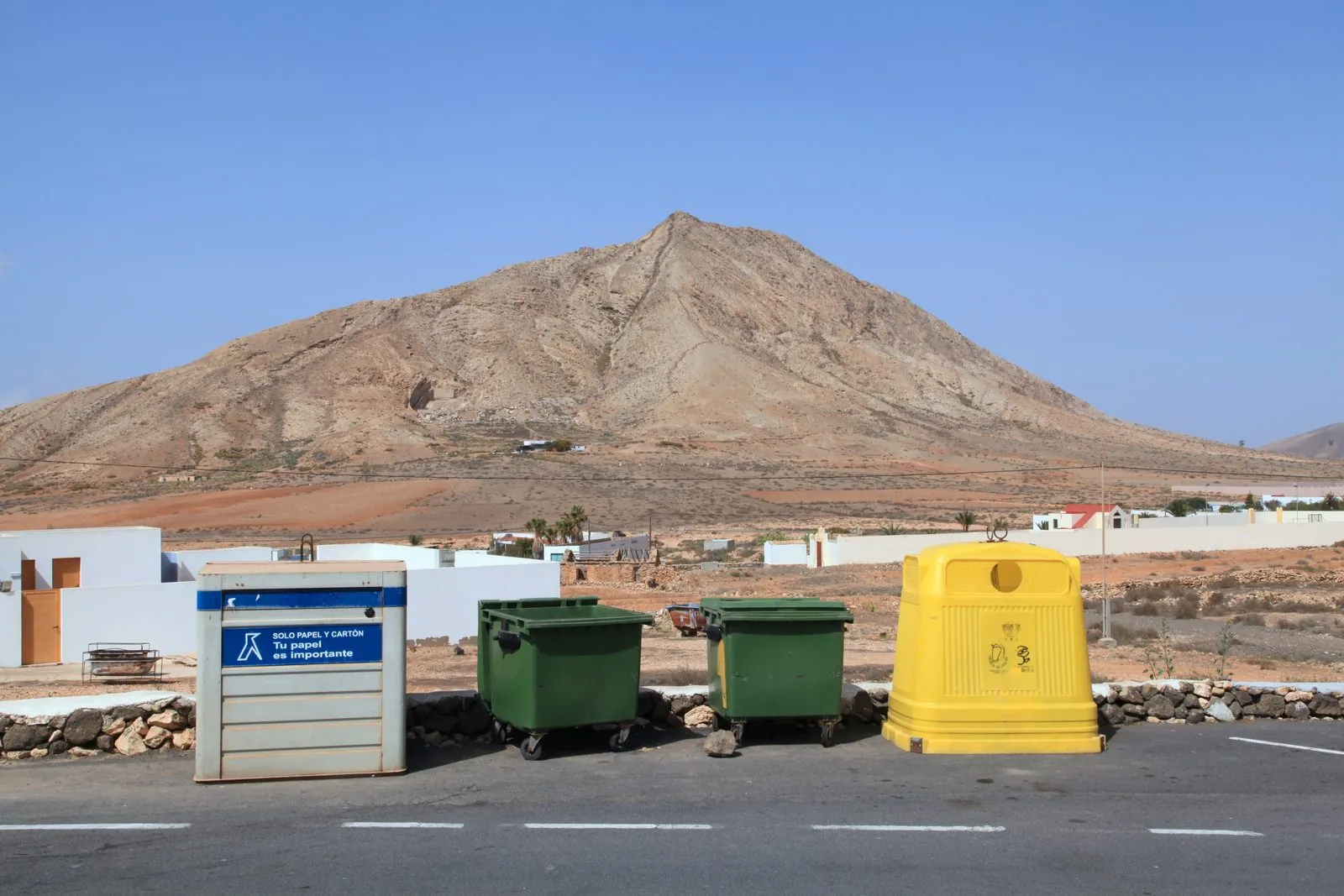
Photo: Frank Vincentz · CC BY-SA 3.0 · Wikimedia Commons · scaled
The mysterious foot engravings
Tindaya's greatest treasure is hidden on its upper slopes: a remarkable collection of podomorphs — engravings in the shape of human feet, carved into the rock by the island's ancient inhabitants. It's one of the largest concentrations of such carvings anywhere, and their meaning is still debated. Many point away towards the horizon and the sacred island of Lobos or the distant peaks, and archaeologists think they were connected to ritual, astronomy or worship rather than everyday life. Whatever their purpose, they are a moving, tangible link to the people who lived here long before the resorts and windmills.
Understand it before you visit. The carvings and the mountain's story mean far more once you know a little of the island's aboriginal past — it's worth reading up on the Guanches first. A guided visit or a stop at a local interpretation point turns a bare hillside into one of the most atmospheric places on Fuerteventura.
Myth and legend
Few Canarian landmarks carry as much folklore as Tindaya. Local legend links it to witches said to gather on the mountain, and its aura as a place of power has never quite faded. Whether or not you put any stock in the stories, they add to the sense that this is somewhere special — a mountain that has meant something to the island's people for thousands of years, right up to the present day.
The controversial Chillida project
In the late 20th century the celebrated Basque sculptor Eduardo Chillida dreamed up an extraordinary and hugely divisive plan: to hollow out a vast cubic chamber deep inside Montaña Tindaya, open to the sky and sea through great shafts, so that visitors could stand within the mountain itself contemplating light, space and the horizon. The idea captured imaginations worldwide but sparked fierce opposition from those who saw it as a desecration of a sacred, protected site, and as an environmental and archaeological risk. Decades on, the monument has never been built, tangled in legal, financial and ethical disputes — and Tindaya remains as it has always been, its story now including this modern chapter of ambition and controversy.
A sacred mountain carved with ancient footprints, steeped in legend and nearly hollowed out for a giant work of art — Tindaya holds more history than almost anywhere on Fuerteventura.
Access notes — look, don't climb
The mountain is protected, and free access is restricted. Montaña Tindaya is a designated natural monument and an important archaeological site, so climbing it and visiting the engravings are limited to protect both the fragile carvings and the rare plants on its slopes. Casual hikers are generally not free to wander up to the podomorphs; where visits are permitted they're usually by arrangement or with an authorised guide. Check locally for the current rules, and never touch or make rubbings of the carvings.
Even without climbing it, the mountain is a striking sight from the surrounding roads and the nearby village that shares its name, and simply seeing it in its stark setting is worthwhile. The plains around Tindaya, dotted with old windmills and traditional hamlets, give a glimpse of the rural, agricultural Fuerteventura that most beach visitors never see.
Combine it with the old heart of the island
Tindaya sits in the north-west, within easy reach of Fuerteventura's most historic corner. Pair it with a visit to Betancuria, the island's beautiful former capital tucked among the mountains, for a day that swaps the beaches for history, legend and landscape. A hire car makes this inland exploring easy, and the drive across the open plains and hills is a scenic pleasure in itself. Together they reveal a slower, deeper Fuerteventura — the island of the ancient Majos, not just of sun and sand. For more ideas, see our full guide to Fuerteventura.