Long before Spanish sails appeared on the horizon, the Canary Islands were home to the Guanches — an aboriginal people of North African Berber stock who lived here for perhaps two thousand years in near-total isolation. They herded goats on the high pastures, sheltered in volcanic caves, moulded hand-built pottery, mummified their dead and carved mysterious symbols into the rock. Their world was overturned by the 15th-century conquest, yet they never truly vanished: you meet them still in the islands' place names, in local faces, and in the DNA of Canarians today.
Understanding the Guanches is the key to understanding the Canaries. Their story runs underneath everything — the caves in the barrancos, the festivals, the wrestling, even the words on road signs. Here's who they were and how to trace them on a modern holiday.
Who were the Guanches?
Strictly, "Guanche" refers to the aboriginal people of Tenerife, but the word is now used loosely for all the pre-Hispanic islanders across the archipelago. They are believed to have arrived from North Africa, most likely from Berber (Amazigh) peoples of what is now Morocco and Algeria, from around the first millennium BC onwards. Exactly how they crossed the sea — and why they seemingly lost the art of seafaring afterwards — remains one of the archipelago's great puzzles.
Crucially, they were not one unified nation. Each island developed its own society, ruler and even dialect, cut off from the others by open ocean. Tenerife was divided into rival menceyatos (kingdoms) led by chiefs called menceyes; Gran Canaria had its own guanartemes; the other islands their own leaders. This island-by-island isolation shaped a patchwork of related but distinct cultures.
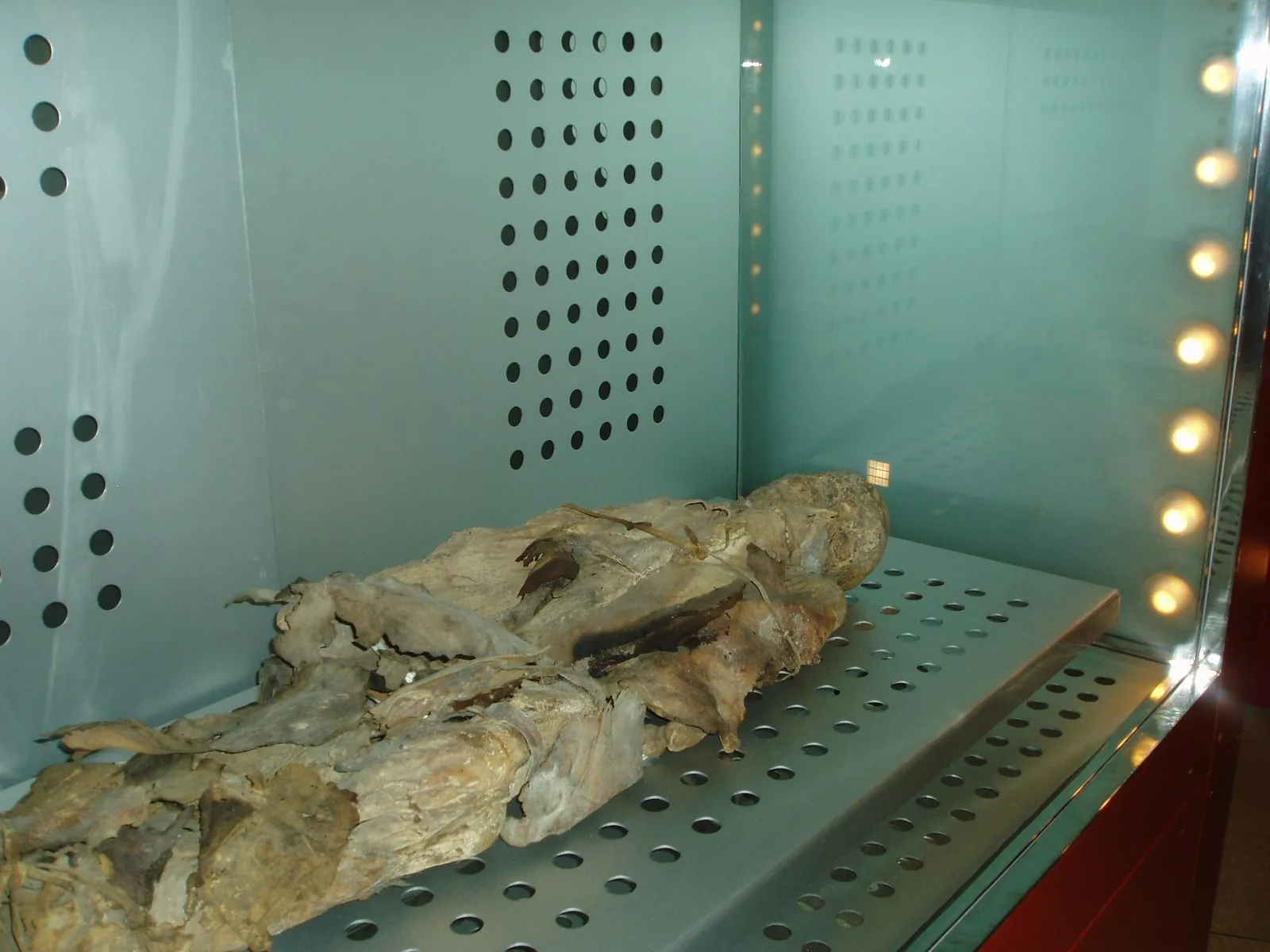
Photo: Cardenasg · CC BY 2.5 · Wikimedia Commons · scaled
How they lived
The Guanches were a Neolithic, largely pastoral people. Without metal tools, they worked stone, bone, wood and obsidian, yet built a resilient way of life suited to a dry, volcanic land.
- Caves and stone dwellings. Many lived in natural and hand-cut caves in the ravines — cool in summer, sheltered in winter. Whole cave settlements survive, and some, like the granary complex at Cenobio de Valerón on Gran Canaria, show remarkable communal organisation.
- Herding and simple farming. Goats, sheep and pigs were the mainstay, giving milk, meat and hides. They also grew barley and gathered wild produce. Toasted, ground grain — the ancestor of today's gofio — was a staple then as now.
- Pottery and craft. They made hand-built, unglazed pottery (no potter's wheel), along with decorated clay figures, leather garments and reed matting. Painted clay pintaderas (seal-stamps) are among their most distinctive objects.
Mummies and the world of the dead
One of the most striking Guanche practices was mummification, best documented on Tenerife and Gran Canaria. Bodies of the elite were embalmed with plant resins, herbs and animal fat, dried, wrapped in hides and laid in remote burial caves. The care taken shows a strong belief in an afterlife and a deep reverence for ancestors.
Today the finest collections are in the islands' archaeology museums — above all the Museo de la Naturaleza y Arqueología in Santa Cruz de Tenerife and the Museo Canario in Las Palmas — where mummies, skulls, tools and pottery are displayed with proper context. They are the single best way to grasp how sophisticated this culture really was.
If you want the Guanche story brought to life in the open air, the recreated aboriginal village at Mundo Aborigen above Maspalomas stages daily life, dwellings and customs in a spectacular ravine setting — an easy, family-friendly introduction before you tackle the museums.
Rock engravings and sacred places
Across the islands, the Guanches left engravings and painted symbols on rock: spirals, geometric patterns and, most intriguingly, Libyco-Berber inscriptions that link them directly to the mainland Amazigh world. Sites are scattered through the barrancos, and many hilltops and caves clearly held ritual importance.
The stepped stone structures at the Pirámides de Güímar on Tenerife are the most famous — and most debated — monuments associated (rightly or not) with the island's past. Whatever their exact origin, the ethnographic park around them is an absorbing place to think about pre-Hispanic life and how it endured on the land.
The conquest and its aftermath
The Castilian conquest of the Canaries unfolded across most of the 15th century, island by island, finishing with Tenerife in 1496. Lanzarote and Fuerteventura fell early; Gran Canaria, La Palma and Tenerife resisted longest, the last Tenerife menceyes defeated only after fierce fighting and the ravages of European disease.
The consequences were severe. Guanche resistance collapsed, many islanders were killed, enslaved or shipped abroad, and survivors were pressured to convert to Christianity and adopt Castilian ways. The distinct island cultures were dismantled within a few generations, and the spoken languages died out. It is a hard chapter, and one worth remembering as you enjoy the islands today — the fuller version is in our short history of the Canary Islands.
The legacy that survives
For all that, the Guanches were never fully erased. They intermarried with settlers and their bloodline lives on: genetic studies consistently find a strong aboriginal maternal inheritance in the modern Canarian population, alongside Iberian and African ancestry. In a real sense, today's islanders are partly their descendants.
Their fingerprints are everywhere:
- Place names. Countless towns, valleys and peaks keep aboriginal names — Tacoronte, Güímar, Gáldar, Teror, Tejeda, Timanfaya and the giant volcano Teide itself.
- Language. Words such as gofio, baifo (kid goat) and guanche survive in Canarian Spanish.
- Living traditions. Canarian wrestling, stick-fighting and the shepherd's leap all have roots in this pastoral past — see our guide to traditional Canarian sports.
- Identity. Many Canarians take real pride in their Guanche heritage, and it features prominently in art, festivals and island symbolism.
Treat archaeological sites, caves and engravings with care. Never touch or remove artefacts or scratch at rock art — these are fragile, protected remains, and many are among the oldest human traces on the islands.
Following the Guanche trail
You can build a rewarding day or two around the aboriginal past on almost any island. Start with an archaeology museum for context, add a cave settlement or engraving site, then walk one of the barrancos where the Guanches actually lived. On Gran Canaria, pair Cenobio de Valerón with Mundo Aborigen; on Tenerife, the Güímar pyramids with the Santa Cruz museum. Do that, and the islands stop being merely a beach holiday — they become one of the most fascinating meeting points of Africa, Europe and the deep human past anywhere in the Atlantic.