The Canary Islands have been a crossroads of the Atlantic for thousands of years — a stepping stone between Africa, Europe and the Americas, fought over, farmed and finally fallen in love with by millions of holidaymakers. Their history runs from an aboriginal Berber people living in volcanic caves, through a long Castilian conquest, Columbus's famous stopovers, boom-and-bust crops of sugar, wine and bananas, the Franco years and modern autonomy, to today's year-round tourism. Knowing the outline makes every town, castle and church you pass far more interesting.
Here is the whole sweep in one readable guide — the people, the turning points and the crops and conflicts that shaped the islands you're visiting.
Before the conquest: the Guanches
The first islanders were the Guanches, an aboriginal people of North African Berber origin who settled the archipelago from around the first millennium BC. Living island by island in isolation, they herded goats, built cave dwellings, made pottery, mummified their dead and carved symbols into the rock. Each island had its own chiefs and dialect, and for many centuries they had the Atlantic almost entirely to themselves.
Ancient Mediterranean peoples knew of the islands — the Romans called them the "Fortunate Isles" — but sustained European contact only resumed in the late Middle Ages, with the arrival of Genoese, Mallorcan and Portuguese sailors probing the Atlantic.
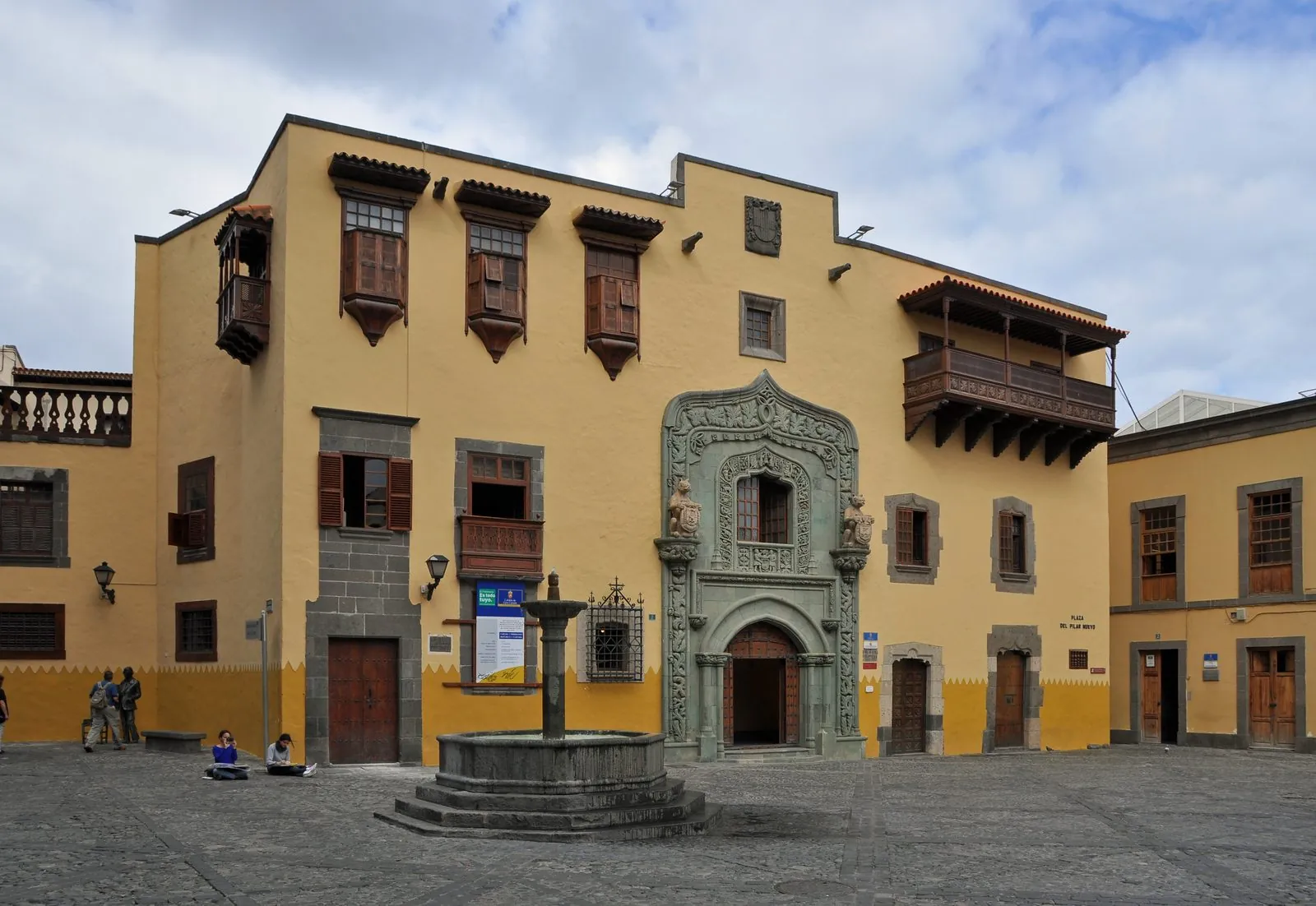
Photo: Marc Ryckaert (MJJR) · CC BY-SA 3.0 · Wikimedia Commons · scaled
The Castilian conquest (15th century)
The conquest began in 1402, when the Norman adventurer Jean de Béthencourt, in the service of the Crown of Castile, landed on Lanzarote. Over the following decades the smaller, lower islands — Lanzarote, Fuerteventura, El Hierro and La Gomera — were subdued relatively quickly. The larger islands resisted far longer: Gran Canaria was not taken until 1483, La Palma in 1493, and Tenerife, the last to fall, only in 1496 after fierce battles against the island's menceyes.
By the close of the 15th century the whole archipelago was under the Crown of Castile, laying the foundations of a Spanish, Christian, Castilian-speaking society. San Sebastián de La Gomera, where you can still visit early colonial buildings, became one of the key springboards for what came next — you can explore it from our guide to San Sebastián de La Gomera.
Columbus and the gateway to the Americas
The Canaries' position — the last provisioning stop before the open Atlantic — made them pivotal to the Age of Discovery. Christopher Columbus called at the islands on his voyages to the New World, famously stopping at La Gomera to take on water, food and supplies (and, legend has it, to visit Beatriz de Bobadilla). He also put in at Gran Canaria for ship repairs.
That heritage is celebrated at the Casa de Colón in Las Palmas, a handsome museum in the old quarter devoted to Columbus, his voyages and the islands' Atlantic role. For three centuries the Canaries thrived as a hinge between Europe and the Americas, and emigration and trade forged deep, lasting ties with the New World.
Boom crops: sugar, wine and cochineal
The colonial economy was built on a succession of export crops, each with its own boom and bust:
- Sugar cane was the first great money-maker, planted from the late 15th century using enslaved and imported labour — until cheaper Caribbean and Brazilian sugar undercut it.
- Wine came next. From the 16th century the islands exported prized sweet Malmsey (Malvasía) — the "Canary sack" praised by Shakespeare — to England and beyond. Discover the modern revival in our guide to Canary wine.
- Cochineal, the crimson dye made from insects farmed on cactus, boomed in the 19th century before synthetic dyes collapsed the trade.
Each cycle brought wealth to some islands and hardship when prices crashed, driving repeated waves of emigration, especially to Cuba and Venezuela.
Bananas and the green north
From the late 19th century a new crop reshaped the islands: the banana. British trading companies helped establish the plantations that still carpet the wetter northern coasts and valleys, and the small, sweet plátano de Canarias became a defining export to mainland Spain. The plantations transformed landscapes, water use and rural life — a story we tell in full in our guide to the bananas of the Canary Islands.
Free-port status, granted in the 19th century to boost trade, also turned ports like Las Palmas and Santa Cruz into busy coaling and shipping hubs, cementing the islands' outward-looking, trading character.
The 20th century: Franco, division and autonomy
The Canaries played an unexpected role in modern Spanish history: it was from Tenerife, where he had been posted, that General Francisco Franco flew to Morocco in July 1936 to launch the uprising that began the Spanish Civil War. The subsequent decades of dictatorship were hard, and emigration to Latin America continued.
Everything changed after Franco's death in 1975. With Spain's return to democracy, the Canary Islands became an autonomous community in 1982, with its own regional government and — unusually — two capitals shared between Las Palmas de Gran Canaria and Santa Cruz de Tenerife. Spain's entry into the European Community in 1986 brought the islands into Europe while preserving their special low-tax status.
That special status is why you pay the low local IGIC sales tax rather than mainland Spain's higher IVA, making many goods a little cheaper. We unpack exactly where the islands sit today in are the Canary Islands in Spain or Africa?
The tourism boom
The reliable, sunny winter climate proved to be the islands' greatest resource of all. From the 1960s, and accelerating with cheap air travel, mass tourism transformed the southern coasts of Gran Canaria, Tenerife, Lanzarote and Fuerteventura. Fishing villages grew into resorts, airports expanded, and the Canaries became one of Europe's favourite year-round sun destinations, drawing millions of visitors — a great many from the UK and Ireland.
Today the islands balance that tourism with agriculture, renewable energy and a fierce pride in local identity. Understanding how the archipelago rose from the sea to begin with adds one more layer — see how the Canary Islands were formed.
A history you can still see
The remarkable thing is how visible all of this remains. You can walk through Guanche cave settlements, colonial old towns, Columbus's harbour, banana plantations and 1960s resorts, sometimes within a single day. Keep this timeline in mind as you travel, and the Canaries reveal themselves as far more than a beach — they are one of the Atlantic's great historical crossroads.