It's the question almost everyone asks on the way to the airport: are the Canary Islands in Spain, or in Africa? The honest answer is both — geographically African, politically Spanish and European. The archipelago sits in the Atlantic just off the coast of Morocco and Western Sahara, far closer to Africa than to mainland Spain, yet it is a full autonomous community of Spain, part of the European Union, uses the euro and speaks Spanish. For a traveller, that unusual double identity has some very practical upsides. Here's exactly where the islands stand, and what it means for your holiday.
Geographically: firmly off Africa
Look at a map and the geography is clear. The Canaries lie in the Atlantic Ocean off the northwest coast of Africa, with the easternmost islands — Fuerteventura and Lanzarote — only around 100 kilometres from the Moroccan and Western Saharan shore. Mainland Spain, by contrast, is well over 1,000 kilometres to the north. On any physical-geography measure, the islands are an African archipelago.
That African setting shapes the whole experience: a warm, dry, subtropical climate, occasional dust hazes (the calima) blown over from the Sahara, and a landscape of volcanic peaks and desert-like plains quite unlike northern Europe. The islands are volcanic in origin, born from the ocean floor rather than broken off any continent — the full story is in how the Canary Islands were formed.
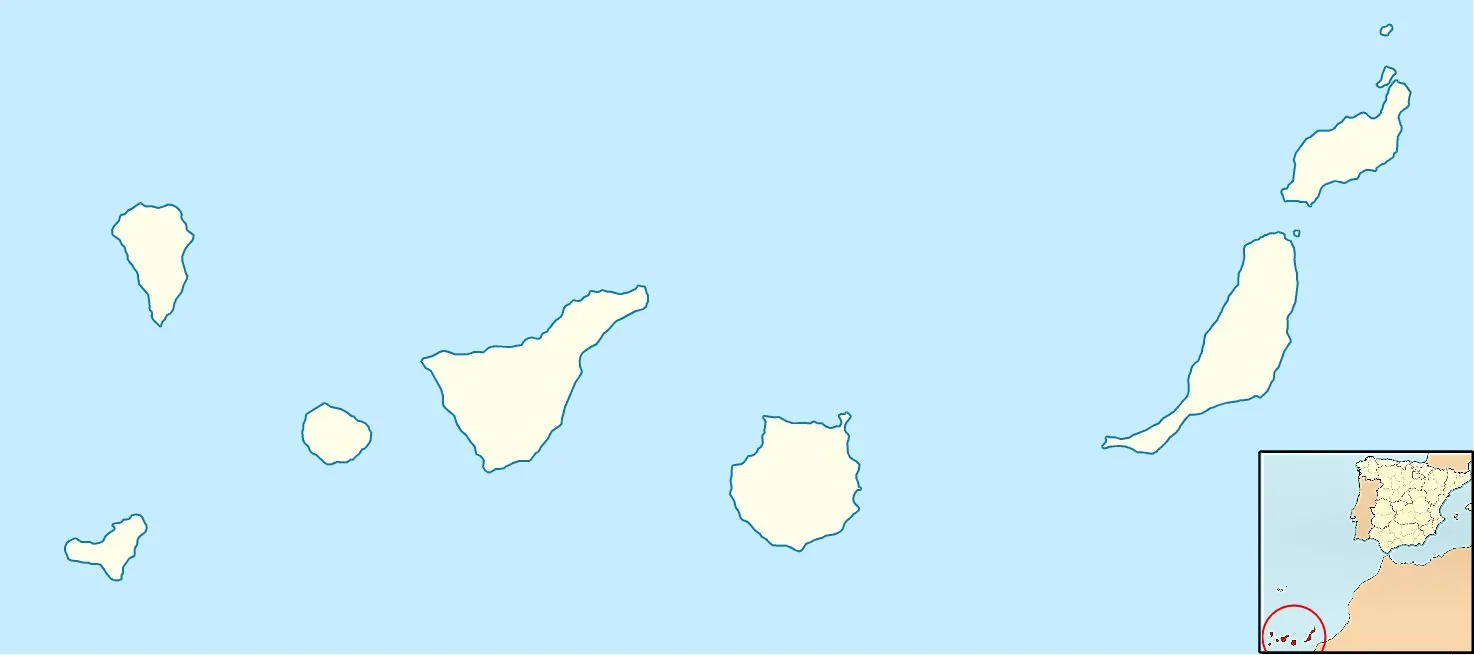
Photo: NordNordWest · CC BY-SA 3.0 · Wikimedia Commons · converted
Politically: Spanish and European
Politically and culturally, though, the Canaries are unmistakably Spanish. They have been part of Spain since the Castilian conquest completed in 1496, and today form one of Spain's 17 autonomous communities, with their own regional government and two shared capitals, Las Palmas de Gran Canaria and Santa Cruz de Tenerife. The language, the food, the fiestas and the legal system are all Spanish, layered over the islands' deeper aboriginal Guanche heritage. For the long version, see our short history of the Canary Islands.
They are also part of the European Union and the Schengen Area, though with a special status that sets them slightly apart from the mainland — most visibly in tax.
The special status: low tax and outside VAT
Here's the quirk that matters most to your wallet. The Canaries are an EU "outermost region" but sit outside the EU's VAT area and customs union. Instead of mainland Spain's 21% IVA, you pay the local IGIC sales tax, with a general rate of just 7% in 2026 (and lower or zero rates on some essentials).
In practice that means many goods — electronics, perfume, cosmetics, spirits, tobacco — are noticeably cheaper here, which is why the islands have long enjoyed a "duty-free" reputation. The flip side is that carrying purchases back into the rest of the EU or the UK counts as an import, subject to the usual allowance limits. For the full breakdown, see our guide to costs and money.
Being outside the EU VAT zone is why a bottle of spirits or a camera can be a bargain here — but keep within your home country's duty-free allowance on the way back, and keep your receipts.
Money, time and language
- Currency: the euro (€). Same as mainland Spain and most of the EU. Cards are widely accepted; carry a little cash for markets and small bars.
- Time zone: WET (GMT/UTC+0 in winter, GMT+1 in summer). That's the same time as the UK, Ireland and Portugal, and one hour behind mainland Spain — handy for British visitors, who don't need to change their watches.
- Language: Spanish. English is widely spoken in the resorts and tourist areas; a few Spanish phrases are always appreciated away from the coast.
What it means for you in practice
The islands' status affects real, day-to-day parts of your trip:
| Aspect | What applies in the Canaries |
|---|---|
| Passports / entry | Same as mainland Spain — part of Schengen; non-EU visitors follow Spain's entry rules |
| Flights | Flights from EU/UK are international by distance but domestic within Spain; long-haul feel, mostly 4–5 hrs from the UK |
| Mobile roaming | EU "roam like at home" applies for EU SIMs; UK travellers should check their operator, as some now charge |
| Shopping / tax | Low IGIC instead of VAT; customs allowances apply on the way home |
| Health cover | EHIC/GHIC and Spanish public healthcare rules apply, as on the mainland |
Getting there: because they're part of Spain and the EU, the islands are extremely well connected, with direct flights from across the UK, Ireland and Europe — see getting to the Canary Islands.
Post-Brexit, UK travellers are treated as non-EU visitors for passport and entry purposes (watch validity and stay-length rules), and roaming is no longer guaranteed free — check your mobile provider before you fly. More on staying online in our guide to staying connected: SIM and wi-fi.
Schengen, borders and travel onward
Because the Canaries are within the Schengen Area, there are no border checks when you fly in from other Schengen countries, and travel between the seven main islands is as simple as domestic hopping by plane or ferry. Trips to nearby Africa (a Morocco excursion, say) are a different matter and require the usual passport and possibly visa checks — treat them as international travel, not a day out.
The best of both worlds
So, Spain or Africa? The Canaries genuinely straddle the two — an African archipelago with a European passport. For visitors that combination is close to ideal: African sunshine and dramatic volcanic scenery, paired with the euro, EU consumer protections, familiar Spanish comforts, UK-friendly time and famously low taxes. It's a big part of why the islands work so brilliantly as a year-round escape. Plan the practical side with our guides to costs and money and getting to the Canary Islands, and you're set.