The Canary Islands have their own sports — rugged, ancient contests born of the aboriginal world and the islands' pastoral, seafaring life, and still fiercely alive today. Muscular wrestlers grapple in a sand circle, shepherds vault down cliffs on a long wooden pole, fighters spar with sticks, and elegant lateen-rigged boats race across the bay off Las Palmas. These juegos autóctonos (native games) are one of the most authentic things you can witness on the islands — proof that Canarian identity runs far deeper than the beach resorts suggest.
Here are the four great traditional sports, what makes each one special, and where you can actually see them.
Lucha canaria: Canarian wrestling
The islands' national sport, lucha canaria, has roots reaching back to the Guanches and is still hugely popular. Two wrestlers face off in a sand-floored circle called the terrero, gripping each other by rolled trouser-legs, and try to force any part of the opponent's body other than the feet to touch the ground. It's a contest of leverage, timing and technique rather than brute aggression, governed by a strong code of respect and clean play.
Wrestlers compete in teams, sending out man against man in a series of bouts, and the atmosphere at a good match is warm and family-friendly. Villages and islands field their own clubs, and rivalries can be intense.
Lucha canaria is one of the easiest traditional sports to catch: matches are held regularly in municipal terreros across Gran Canaria and Tenerife, often on weekend evenings, and admission is usually cheap or free. Ask at a tourist office for the local fixture list.
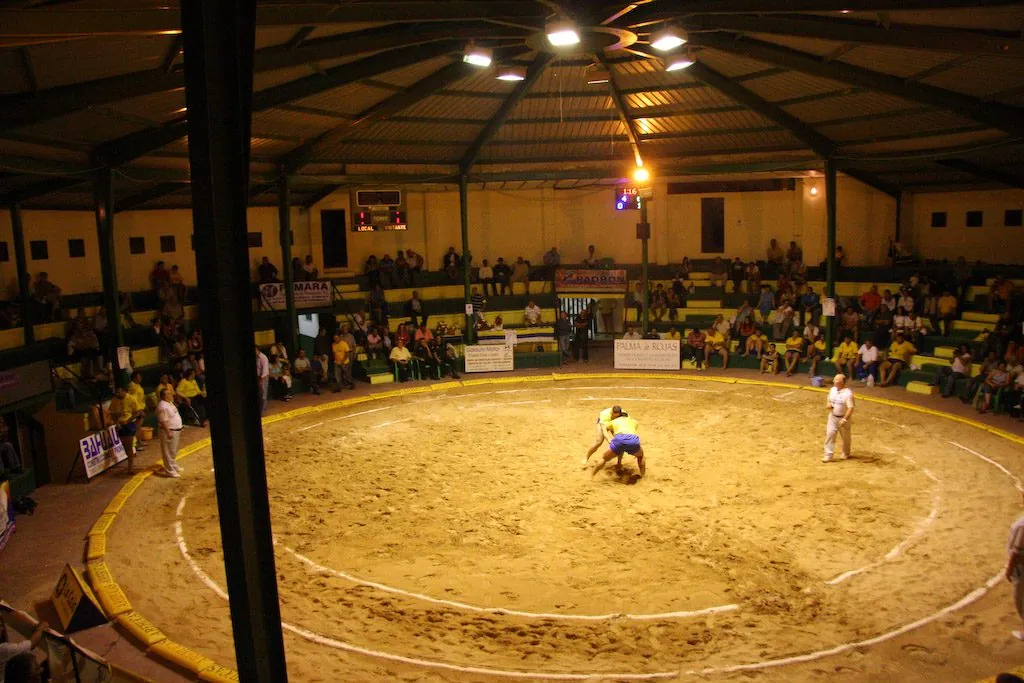
Photo: Lexthoonen · CC BY-SA 3.0 · Wikimedia Commons · converted
Juego del palo: Canarian stick fighting
The juego del palo ("game of the stick") is a martial art descended from the fighting and herding skills of the aboriginal islanders, who used long staffs both to defend themselves and to leap across rough ground. Two players armed with wooden staves attack and defend with fast, precise strikes and parries, the aim being to touch the opponent while avoiding being touched — footwork stays remarkably still, the action all in the hands and arms.
Today it survives as a disciplined, stylised art with several regional schools, each preserving its own techniques. You're most likely to see it demonstrated at cultural festivals, folklore events and heritage centres rather than in casual competition, but it's a striking thing to watch — controlled, quick and quietly dangerous.
Salto del pastor: the shepherd's leap
Perhaps the most spectacular of all is the salto del pastor canario — the shepherd's leap. In the islands' steep barrancos, herders needed to move fast across near-vertical terrain, so they used a long wooden pole tipped with a metal point (the lanza or garrote) to vault down cliffs and ravines, planting the pole below and sliding controlled down its length. What began as a practical mountain skill is now practised as a sport and heritage activity by dedicated clubs (jurrias).
Watching a skilled jumper drop down a rock face on a single pole is genuinely jaw-dropping. It fits naturally with the islands' wider walking and mountain culture — if the high ground appeals, pair it with our guide to hiking in the Canary Islands.
Never try the shepherd's leap yourself. It looks simple and is extremely dangerous without training and the correct pole — leave it to the experts and enjoy it as a spectator.
Vela latina: lateen-sail boat racing
Down on the water, vela latina canaria is the islands' traditional sailing sport, most closely associated with the bay of Las Palmas on Gran Canaria. The boats are open, wooden and rigged with a single enormous triangular lateen sail — strikingly large for the size of the hull — crewed by teams who hike out and shift their weight constantly to keep the craft upright and fast. Races are a summer fixture, and the sight of the big white sails leaning across the water off the capital is a classic Canarian scene.
It's a demanding, tactical sport with deep local following and its own leagues. The season generally runs through the warmer months; catch a race from the seafront and you'll understand why islanders are so devoted to it.
Where and when to see them
| Sport | Best island(s) | Where to catch it |
|---|---|---|
| Lucha canaria (wrestling) | Gran Canaria, Tenerife | Municipal terreros; weekend matches, fiestas |
| Juego del palo (stick fighting) | Tenerife, La Palma, Gran Canaria | Cultural festivals, folklore events, demos |
| Salto del pastor (shepherd's leap) | All islands, esp. mountainous ones | Heritage events, club demonstrations |
| Vela latina (boat racing) | Gran Canaria | Bay of Las Palmas, summer season |
The reliable bet is a fiesta or romería: local festivals frequently bundle wrestling bouts, stick-fighting displays and folk music into a single afternoon. That's also the best way to see these sports in their proper setting, surrounded by costume, food and celebration.
Part of a living culture
What ties these games together is that none of them was invented for tourists. They grew out of the real demands of island life — herding on cliffs, wrestling for honour in the village square, sailing the Atlantic swell — and they survive because Canarians choose to keep them alive. They belong to the same living heritage as the islands' folk music and dance, so it's well worth reading our companion guide to Canarian music and folklore to see the fuller picture.
Making it part of your trip
You won't stumble on all four in a fortnight, but with a little planning you can easily see one or two. Check the local fiesta calendar, ask your accommodation or the tourist office about upcoming wrestling matches, and — if you're on Gran Canaria in summer — keep an eye out for the lateen sails off Las Palmas. Swap an afternoon by the pool for a terrero packed with local families, and you'll come home with a story far better than another sunburn.