Carved into a sheer cliff on the north coast of Gran Canaria, the Cenobio de Valerón is one of the most astonishing sights the island's aboriginal people left behind — a honeycomb of more than 300 caves stacked and tunnelled into the rock beneath a great natural arch. For years it was romantically imagined as a convent of "sacred virgins", but it was really a communal grain store, an ingenious granary where whole communities kept their harvest safe. It is an easy, jaw-dropping stop near the town of Guía, and a highlight of the greener, less-touristy north of Gran Canaria.
What you are looking at
The site is a cliff face riddled with small chambers, silos and passages — hundreds of them — dug out and adapted by the ancient Canarians using stone tools, then sealed with wooden or stone doors. Sheltered beneath an overhanging arch of volcanic tuff, the whole complex looks almost like a natural apartment block. The soft rock made it possible to excavate this warren by hand, and the result is one of the largest and best-preserved collective granaries anywhere in the Canaries.
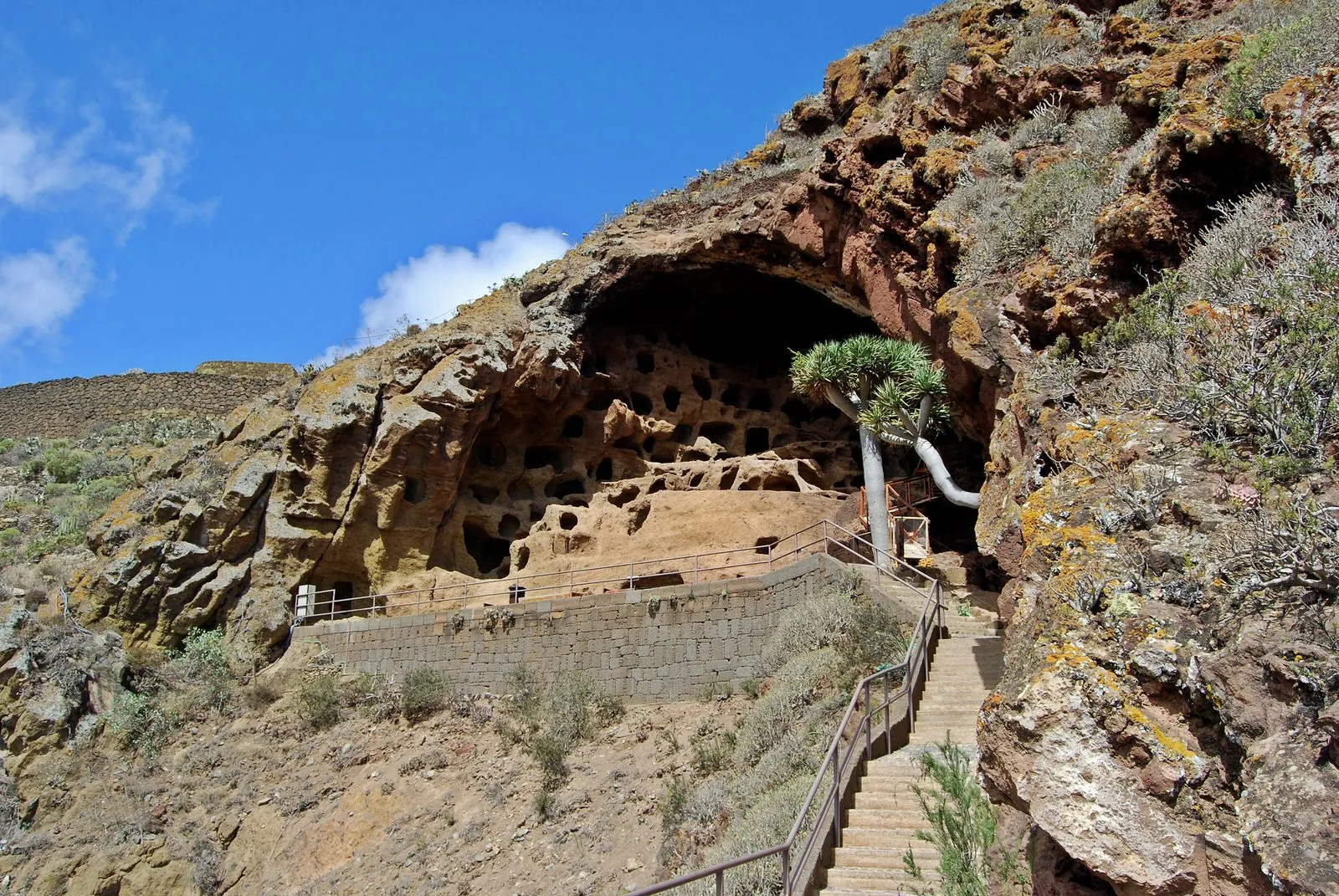
Photo: Felix König · CC BY 3.0 · Wikimedia Commons · scaled
A granary, not a convent
The old name — cenobio, meaning a monastery or convent — is a misunderstanding. Early Spanish observers, struck by the honeycomb of cells, imagined it must have housed cloistered young women. In reality the caves were a fortified communal granary: each family or clan stored its grain, and the whole was guarded and managed together, protected by its height and its difficult access. Storing the harvest collectively in a defensible spot was a smart answer to lean years and raids, and it tells you a great deal about how organised these communities were.
Read the panels before you climb. The small visitor area at the foot of the site explains the history and how the granary worked, which makes the caves far more meaningful once you are up among them. It only takes a few minutes and is well worth the pause.
Visiting the site
From the entrance a stepped path climbs up to and around the cave complex, letting you look into the chambers and appreciate the scale of the excavation close up. It is a compact site — you can see it properly in around 30 to 45 minutes — but a genuinely memorable one, and the views out over the north-coast countryside and the Atlantic are a bonus. There is a modest entrance fee; as of 2026 it is only a few euros, with concessions, but opening days and prices can change, so check locally before you travel. It is typically closed on certain days of the week, so plan around that.
There are steps and uneven ground. Reaching the caves involves climbing a flight of steps and walking on natural rock, so wear sensible shoes and take care in the wet. The upper levels are not suitable for wheelchairs or anyone with limited mobility, though you can still appreciate the cliff from below.
Getting there
The Cenobio de Valerón sits just off the main GC-2 coast road in the municipality of Santa María de Guía, in the island's north-west. It is easiest to reach with a hire car — roughly 30 minutes west of Las Palmas along the motorway — and there is a small car park at the entrance. Buses running along the north coast between the capital and Gáldar also pass nearby.
Make a day of the north-west
This quiet, fertile corner of the island rewards a full day's pottering. Guía itself is known for its famous queso de flor flower cheese, worth seeking out if you enjoy Canary cheese, while neighbouring Gáldar holds the extraordinary Painted Cave, a decorated aboriginal dwelling that pairs beautifully with Valerón for a day of pre-Hispanic history. A little further on lies the pretty fishing harbour of Puerto de las Nieves at Agaete, ideal for a seafood lunch by the water.
For more of the same living history, cross the island to the cave-dwelling Barranco de Guayadeque, or head up into the hills to the handsome pilgrimage town of Teror. Together they sketch a Gran Canaria of ancient granaries, cave homes and mountain villages that feels a world away from the southern beaches.
Three hundred caves cut by hand into a cliff to keep a community's grain safe — Cenobio de Valerón is Gran Canaria's most extraordinary reminder of the people who came first.
Set aside an hour, come on an open day, and let the sheer ingenuity of the place sink in. For more ideas across the island, browse our full list of things to do.