Las Playitas is a small fishing village on Fuerteventura's east coast, about six kilometres from Gran Tarajal, with a big sports resort on the slopes beside it: a quiet, low-key base that suits active holidays, triathletes, golfers and anyone who wants a real village rather than a resort strip. It has a dark-sand beach, a handful of fish restaurants, a lighthouse on the cliffs to the south and very little nightlife. If you want bars and a long golden beach outside your door, look at Corralejo or the Jandía peninsula instead.
The name covers two quite different places. The old village is a cluster of white houses with blue window frames tumbling down a hillside to the sea, still home to a fishing fleet and to families from the rest of the municipality of Tuineje who come for the weekend. Next to it, on the long volcanic shore to the north, is Playitas Resort, a large hotel, apartment and villa complex built around sport, with an Olympic-size pool and its own golf course.
This page explains what each side is like, what the beaches are like for swimming, the walk or drive up to the Entallada lighthouse, and who will be happy staying here. If you are still choosing between bases on the island, our overview of where to stay in Fuerteventura compares Las Playitas with the bigger resorts.
Two places sharing one name
Visitors who book "Las Playitas" are, in most cases, booking the resort. It sits a short walk north of the village along the seafront, and many guests spend their week inside it: training in the pool, cycling the island's roads, playing golf and eating in the resort restaurants. The village itself, by contrast, is where people from Gran Tarajal and Tuineje come to eat fish on a Sunday, and where the boats are pulled up by the slipway.
The two coexist without much friction. Resort guests walk down to the village for dinner and a change of scene; the village gets the custom without being swamped by high-rise hotels. What Las Playitas does not have is the infrastructure of a proper resort town. There is no strip of bars, no big shopping centre and only a few small shops. For a pharmacy, a supermarket of any size or a bank, you go to Gran Tarajal, ten minutes away by car.
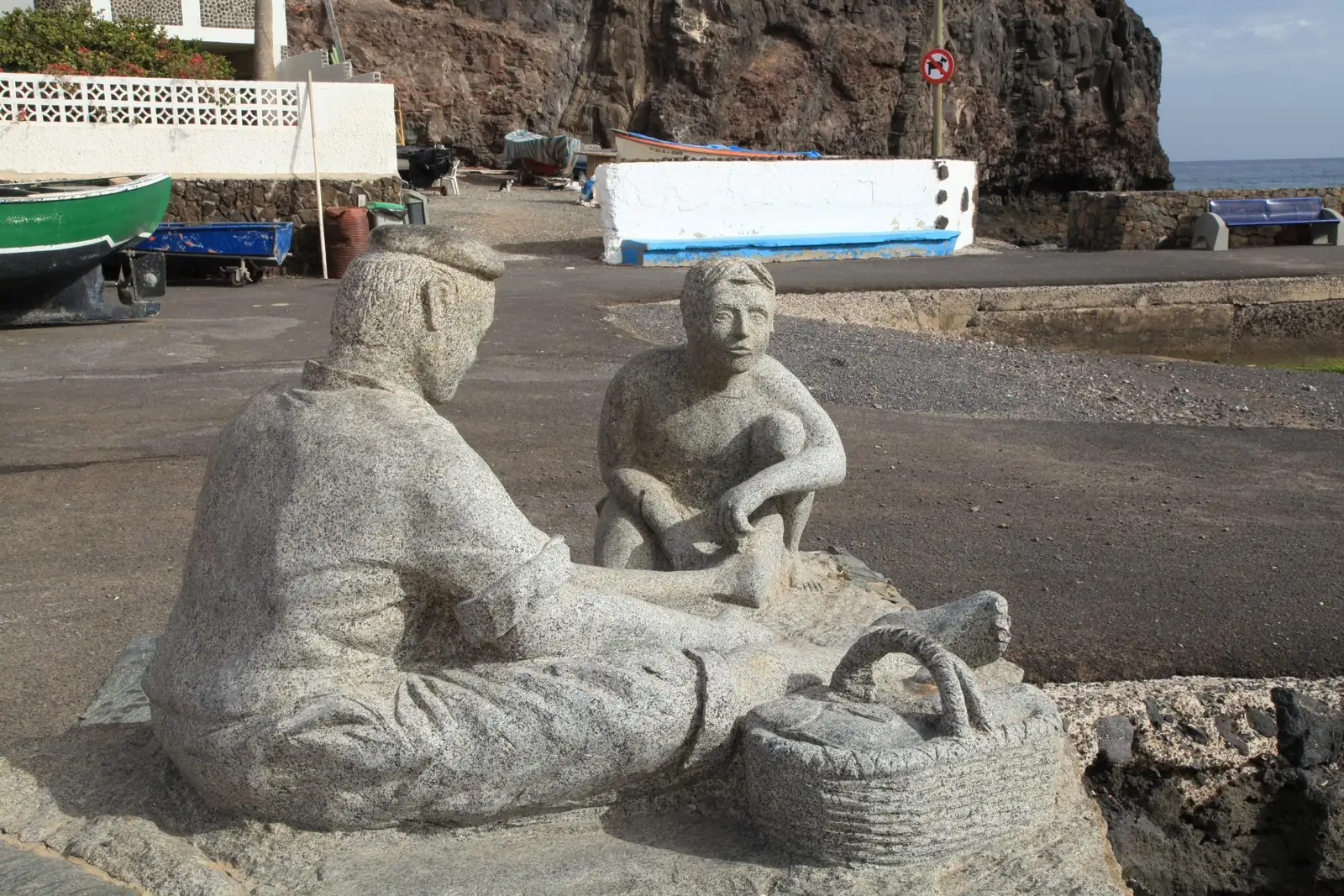
Photo: Frank Vincentz · CC BY-SA 3.0 · Wikimedia Commons · scaled
The village: boats, whitewash and San Pedro
The old village still looks and feels like a fishing settlement. The houses climb in tiers from the shore, painted white with blue trim, and the seafront promenade runs past the slipway where small boats are hauled out. The patron saint is San Pedro, Saint Peter the fisherman, and his fiesta around 29 June is the high point of the village year. Recent editions have stretched over a week or two, with a bonfire and fireworks on the eve and, on the day itself, a procession that carries the saint along the coast on decorated boats.
Outside fiesta time the rhythm is slow. Mornings belong to walkers and cyclists heading out, lunchtimes to the restaurants on the front, and the evenings to a stroll along the promenade as the lights come on across the bay towards Gran Tarajal. The village also has a small church, a cultural centre and, a little surprisingly, a skate park next to them in the old centre.
The beaches: dark sand and pebbles
The village beach runs for roughly 700 metres in front of the houses, according to Barceló's island guide, and it is not the pale, powdery sand of the brochures. It is dark volcanic sand mixed with small rounded pebbles, generally clean and with shallow water that is calm on most days, because this stretch of the east coast is partly sheltered from the strongest winds. Sunbeds, umbrellas and showers are available, and there is step-free access from the promenade.
North of the village, in front of the resort, the shore continues as a longer, wilder strip of volcanic sand used for windsurfing, swimming training and diving. It catches more wind and swell than the village beach. Anyone who wants long white beaches will need to drive: the big Jandía beaches are roughly 45 minutes to an hour south, and the full spread is covered in our guide to the best beaches in Fuerteventura.
Bring shoes for the water. The pebbles at the waterline at Las Playitas are smooth but hard on soft feet, especially when the waves roll them about. A cheap pair of water shoes from a Gran Tarajal shop makes getting in and out far more comfortable, particularly for children.
Playitas Resort and the sporting crowd
The resort is the reason most international visitors come. It is owned by the tourism division of Germany's REWE group, DERTOUR, and combines a hotel, an aparthotel and a small number of villas: the resort lists 167 double rooms, 52 junior suites and 4 pool suites in the hotel, 210 studios and apartments in the aparthotel, and 24 villas. The sports facilities are on a scale few hotels anywhere can match.
- Pool: an eight-lane, 50-metre Olympic pool, heated to about 25–26 °C all year, which attracts swimming clubs and triathlon squads in the northern winter.
- Golf: an 18-hole, par 67 course on the hillside, short by modern standards but hilly and full of water hazards; a buggy is a good idea. It appears in our wider guide to golf in the Canary Islands.
- Cycling: a large rental fleet of road and mountain bikes, available to resort guests, with the quiet roads of the south-east on the doorstep. The routes and the headwinds are described in cycling in the Canary Islands.
- Everything else: running routes, a climbing wall, fitness classes and a children's sports academy.
Las Playitas also hosts Challenge Fuerteventura, a middle-distance triathlon of roughly 2 km swimming, 90 km cycling and 21 km running, which draws athletes from around Europe. In race week the village is busier than at any other time except the San Pedro fiesta, and accommodation fills early.
Up to the Entallada lighthouse
South of the village, a road climbs through a protected landscape of long lava ridges, the Cuchillos de Vigán natural monument, to the Faro de la Entallada, perched on cliffs almost 200 metres above the sea. It is one of the most striking lighthouses in the islands: built in the mid-1950s to a design by the architect Carlos Alcón, with Moorish touches, three square towers facing the sea and a glass lantern on the central one, all in coloured stone. Sources differ on whether it was completed in 1954 or 1955.
Two details make it more than a pretty building. The headland is often described as the closest point in the Canaries to Africa, roughly 100 kilometres away; on an exceptionally clear day some people claim to see the coast. And during the Ifni conflict of the late 1950s, the lighthouse also served as an aerial beacon guiding aircraft from Gando airfield on Gran Canaria towards the Spanish Sahara. The light is still active, run by the Las Palmas port authority.
The road is paved but steep and narrow near the top, so drive it slowly and use the car park by the viewpoint. Barceló's guide mentions a small display on maritime signalling inside; the views from the terrace are the reason to go either way. Walkers can do the round trip from the village on foot, roughly 14 kilometres with about 260 metres of climbing according to route planners, which is best started early before the heat and the afternoon wind. The Cuchillos de Vigán ridges have more walks, several of them described in hiking on Fuerteventura.
Hold on to your hat at the lighthouse. The terrace sits on the edge of a high cliff and the wind there can be far stronger than in the village below. Keep children close, do not climb the walls for photos and open car doors carefully into the wind.
Wind, sun and when to come
Las Playitas has Fuerteventura's typical climate: dry, sunny and mild all year, with the north-east trade wind blowing for much of the time and strongest in summer. The village is somewhat more sheltered than the exposed west coast, but you will still notice the breeze, which keeps the heat bearable and makes afternoons on the beach cooler than the thermometer suggests. How strong it gets, and when, is set out in is it windy in the Canary Islands?
For sport, winter and spring are the busy seasons, when athletes from northern Europe come to train in the warmth. For a quiet beach holiday, late spring and autumn are the sweet spot: warm sea, fewer squads in the pool and calmer evenings. July and August bring Spanish families and the fiesta, and the village beach is at its liveliest.
Eating in the village
Fish is the reason to eat in the old village rather than the resort. The restaurants along the front serve the catch of the day grilled or fried, usually sold by weight, alongside wrinkled potatoes with mojo and local goat's cheese. The setting is simple, with tables on the promenade and the boats a few metres away. Prices are generally fair for the quality, in line with village restaurants elsewhere on the island rather than resort prices. Menus change with what has been landed, so ask what is fresh that day.
Restaurants come and go and opening days vary, especially out of season, so check before you set your heart on one; Sunday lunch is the busiest service, when local families fill the tables.
Airport, buses and the case for a hire car
Las Playitas is roughly 40 to 45 minutes' drive south of Fuerteventura airport, down the east-coast road towards Gran Tarajal and then a short turn-off on the FV-512. Many resort packages include a transfer; otherwise the options are compared on our page about Fuerteventura airport transfers.
Public buses do serve the area, with connections towards Puerto del Rosario and Morro Jable via Gran Tarajal, but services to the village itself are infrequent and Barceló's guide describes the connections as poor. Unless you plan to stay inside the resort all week, a hire car makes far more sense here than in the big resorts: it puts the lighthouse, the southern beaches and the interior villages within easy reach. If you want to try without one, the timetables and fares for buses in Fuerteventura are the place to start.
Is Las Playitas your kind of base?
Las Playitas is ideal if you are coming to train, cycle, swim or play golf, or if you want a quiet week in a real fishing village with a sports resort's facilities next door. It also suits couples and families who prefer a promenade and a fish supper to bars and entertainment. It is a poor fit for anyone who wants nightlife, a long pale beach on the doorstep or a car-free holiday exploring the island.
Think of it as Fuerteventura's quiet east-coast workout: dark sand, white houses, a lighthouse on the cliff and a pool where serious athletes swim lengths at dawn. For the island as a whole, start with our Fuerteventura overview.