The best sunsets in the Canary Islands are on the west-facing coasts and on the high summits: El Golfo on Lanzarote, La Pared and El Cotillo on Fuerteventura, the Mirador del Balcón and Las Canteras on Gran Canaria, Los Gigantes and the edge of Teide National Park on Tenerife, Roque de los Muchachos on La Palma, Valle Gran Rey on La Gomera and Playa del Verodal on El Hierro. Each island has at least one place where the sun drops straight into the Atlantic, and several have a mountain from which you can watch it go down above the clouds.
Three things decide how good a sunset is here. The first is direction: you want an open view to the west, and the exact point on the horizon moves a long way through the year. The second is cloud. The trade winds pile a layer of cloud against the northern slopes of the high islands, which can hide the sun from the coast but turns into a white sea below you if you are high enough. The third is the drive back, which on several of these spots means mountain hairpins in the dark.
Below you will find what time the sun actually sets, a couple of tricks of geometry that most visitors never notice, and then the best places island by island.
When the sun goes down, and where
The Canaries keep the same clock as the UK, but they sit far to the south, so winter evenings are much longer. By our calculation, sunset on Tenerife falls at roughly 18:10–18:15 in December, when London is already dark before 16:00, and at about 21:05 around midsummer. Lanzarote, further east, sees the sun go about a quarter of an hour earlier than El Hierro, the most westerly island. Check a sunset app for the exact time on your date.
The point where the sun sets swings with the seasons. In midwinter it goes down well to the south of west, and in June well to the north. That matters more than people expect: a beach that faces north-west, such as Las Canteras in Las Palmas, is superb in summer but in winter sees the sun go down behind the island's own hills, while south-west-facing coasts such as Costa Adeje on Tenerife are at their best in the winter months.
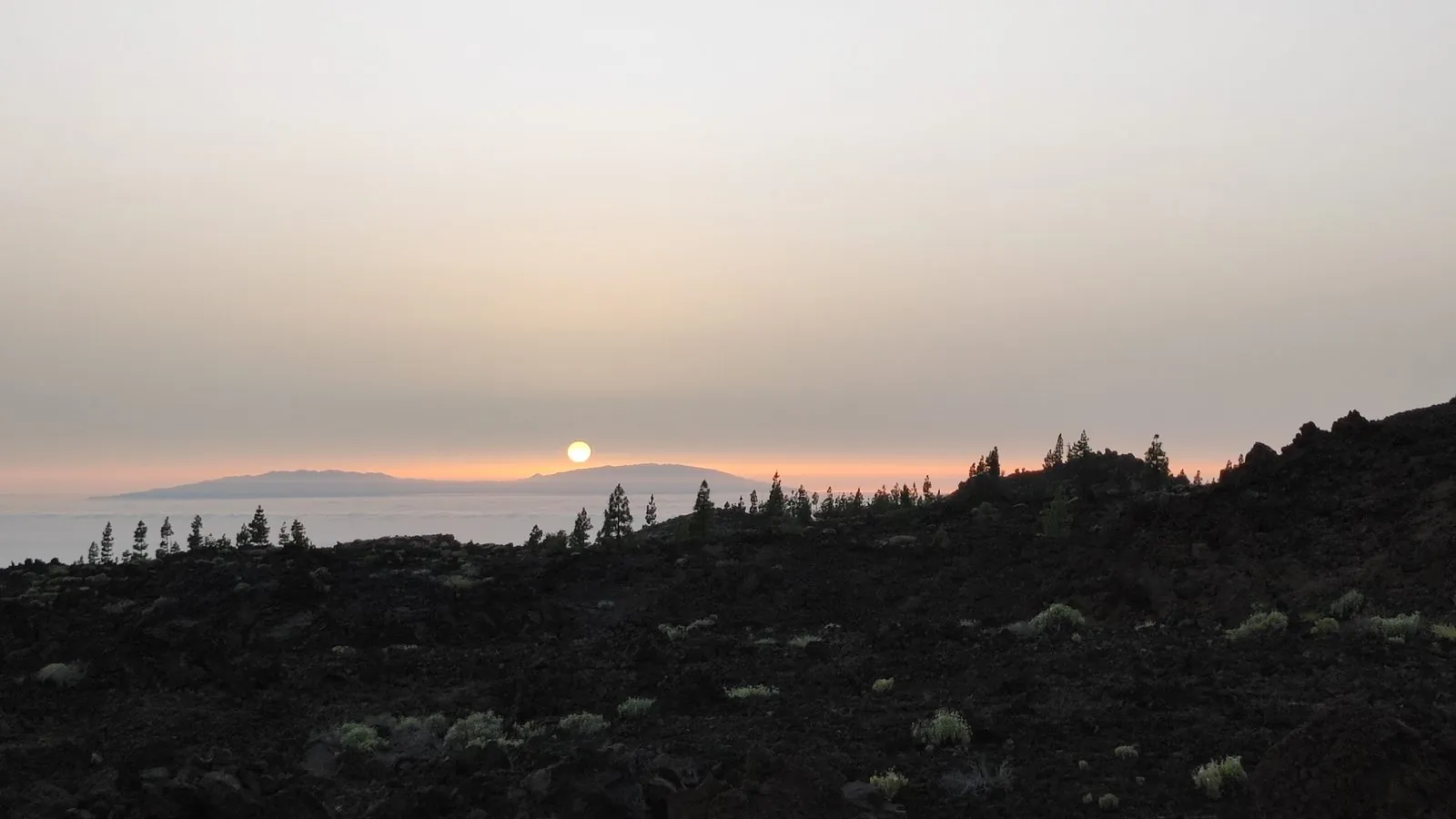
Photo: Ivan.diepa101 · CC BY-SA 4.0 · Wikimedia Commons · scaled
Two sunsets that depend on the calendar
From the beaches of Costa Adeje, La Gomera lies about 40 to 50 kilometres to the west. Working from the compass bearings, the sun sets behind the island from roughly late February to late April, and again from about mid-August to late October; in midwinter it goes down over open sea to the left of La Gomera, in midsummer to the right. When it drops behind the island, the sun actually disappears several minutes before the official sunset time, because Garajonay's ridge is about 1,500 metres high and sits above the horizon.
The other is on Gran Canaria. On clear evenings Teide's cone stands on the horizon from Las Canteras, more than 100 kilometres away across the sea, and the promenade near the Alfredo Kraus auditorium at the southern end is where Las Palmas comes to watch the sun go. By the same arithmetic, the sun sets close to Teide itself for a few days in the first half of April and again in early September. These dates are our own reckoning from the map rather than a published timetable, so give them a few days either way.
Tenerife: cliffs, a lighthouse and a volcano
On the coast, the obvious choice is Los Gigantes, where the cliffs turn copper in the last light and, in winter, the sun drops towards La Gomera; the beach at Playa de la Arena in Puerto de Santiago next door has the more open view. Further north, Punta de Teno and its lighthouse face straight out to the west. Access is the catch: private cars are often barred from the cliff road during the day and a shuttle runs from Buenavista del Norte instead, so check whether you can drive out in the evening before relying on it.
The most famous sunset on the island is up on the mountain. The regular Teide cable car stops running long before dusk, but the operator sells a sunset service outside normal hours, limited to 90 people and only as part of its own packages. From the top, if the sky is clear, you see the volcano throw a huge triangular shadow east across the sea of cloud, stretching away to the horizon. The shadow looks like a perfect pyramid whatever the real shape of the mountain, a trick of perspective, and it is the detail people remember.
Without the cable car you can still drive up into the national park and watch from the roadside viewpoints around the Roques de García and the caldera floor. Bring a warm layer: at well over 2,000 metres the temperature falls quickly once the sun has gone.
Gran Canaria: the wild west and the summit
The far west coast of Gran Canaria is empty of resorts and faces the sunset head on. The Mirador del Balcón is a platform jutting out over sheer cliffs on the GC-200, with Teide often visible on the horizon. Plan the drive back before you go: whichever way you return, it is a long, winding road, and fuel stations are few out here.
Up in the middle of the island, the viewpoint on Pico de las Nieves is reached by road almost to the top, with parking close by. At sunset the rock pinnacles of Roque Nublo and Roque Bentayga stand in silhouette and Teide sits on the horizon. You can also walk up to Roque Nublo late in the day, since the free advance booking applies only to starts between 09:00 and 17:00, but there is no longer a car park at the trailhead and the bus does not run into the night, so a sunset there means a walk back in the dark with a head torch.
In the south, the lighthouse promenade at Maspalomas and the beach at Meloneras give an easy, flat sunset with a drink in hand.
Lanzarote: lava, salt and surf
Lanzarote's west coast is the place to be. El Golfo, with its half-crater and green lagoon, faces west, and the little fishing village has restaurants on the water where you can order fish as the sun goes. Just to the south, the Salinas de Janubio turn the low light into a mirror: the shallow salt pans reflect the sky in bands of pink, white and gold, and there is a viewpoint beside the road above them.
On the north-west coast, Playa de Famara is a long surf beach under the Famara cliffs, with the islands of La Graciosa and the Chinijo archipelago out to the north. In summer the sun sets over the water here; in winter the cliffs block it earlier. Note that Lanzarote's showpiece viewpoint, the Mirador del Río, closes in the late afternoon, and Timanfaya shuts well before dusk too, so neither is a sunset option.
Fuerteventura: west-coast beaches
Most of Fuerteventura's resorts face east, which makes them good for sunrise and poor for sunset. Drive across instead. Playa de la Pared, where the island narrows towards Jandía, faces due west and draws a crowd of surfers and watchers every clear evening. In the north, El Cotillo has west-facing beaches south of the village and an old tower above the harbour, a natural place to sit with a drink.
The truly wild option is Cofete on the far side of Jandía, but it is reached only by a long dirt track that many hire-car contracts do not cover. Driving it back in the dark is a poor idea; see it in daylight instead.
La Palma: above the clouds
On La Palma the drive to Roque de los Muchachos, at about 2,400 metres on the rim of the Caldera de Taburiente, ends in one of the great sunsets in Europe. Most evenings you stand above the cloud, watch the sun go down beyond the observatory domes and, on clear days, see Tenerife, La Gomera and El Hierro floating in the distance. Then the stars come out. Stay for them, but allow plenty of time for the long, winding descent, and know that the summit road can close in snow, ice or high wind.
Plan Roque de los Muchachos as an evening, not a stop. Drive up in daylight so you learn the road, and pack a coat, gloves and a hat even in summer. If you would rather not drive down in the dark, guided stargazing trips include the transport.
At sea level, the beach and harbour at Tazacorte on the west coast face the sunset across open water, and the restaurants along the front make it an easy evening.
La Gomera and El Hierro
In Valle Gran Rey, the sunset is a social occasion. Visitors and long-stayers gather on the seafront and the beach each evening to watch the sun drop into the sea, sometimes to the sound of drums, a habit that goes back to the hippie travellers who came to the valley decades ago. Higher up, the viewpoint above the valley gives a broader view of the terraces turning gold.
On El Hierro, the red cliffs and rust-coloured sand of Playa del Verodal face due west and glow at sunset. Further south lies the Faro de Orchilla, near the point through which mapmakers once drew the prime meridian; it is about as far west as you can watch the sun set in Spain. In summer, when the sun goes down further north, the Mirador de la Peña looks over the El Golfo valley and the sea beyond.
Pick your coast, then pick your season
There is no single best sunset in the islands, but there is a best one for the night you have free. In winter choose a south-west coast: Costa Adeje with La Gomera on the horizon, Valle Gran Rey or El Golfo on Lanzarote. In summer, head for the north-west: Las Canteras, Famara or the Mirador de la Peña. On a cloudy evening, drive up instead of down, to Teide, Pico de las Nieves or Roque de los Muchachos, and watch the sun set above the weather. Wherever you go, arrive half an hour early and bring a layer, because the light keeps changing for twenty minutes after the sun has gone.