The Canary Islands have some of the clearest, darkest night skies on the planet — and stargazing here is not a happy accident but something the islands actively protect. High volcanic peaks rise above the clouds into stable, dry air, far from the light pollution of big cities, and a special law shields the darkness from encroaching glare. The result is that La Palma and Tenerife host two of the world's most important professional observatories — and offer visitors a genuine chance to see the Milky Way blazing overhead in a way most people never will at home.
You don't need a telescope or any expertise to be blown away. On a clear, moonless night at altitude the sheer number of stars is startling, and a good guided tour or a quiet roadside viewpoint can turn an ordinary evening into a holiday highlight.
Why the skies are so good
Three things line up. First, altitude: the observatories sit above 2,000 m, often above the sea of cloud that the trade winds pile against the islands, so the air overhead is calm and clear. Second, stable air: the ocean around the islands keeps temperatures even, giving the steady "seeing" that astronomers prize. Third, protected darkness.
The Sky Law and Starlight Reserves. Since 1988 a pioneering "Sky Law" has protected the skies over the islands' observatories — limiting light pollution, air traffic and even radio interference. La Palma was named the world's first UNESCO Starlight Reserve, and much of the island is a certified dark-sky destination. It's why the stars here stay so bright while so many places lose theirs.
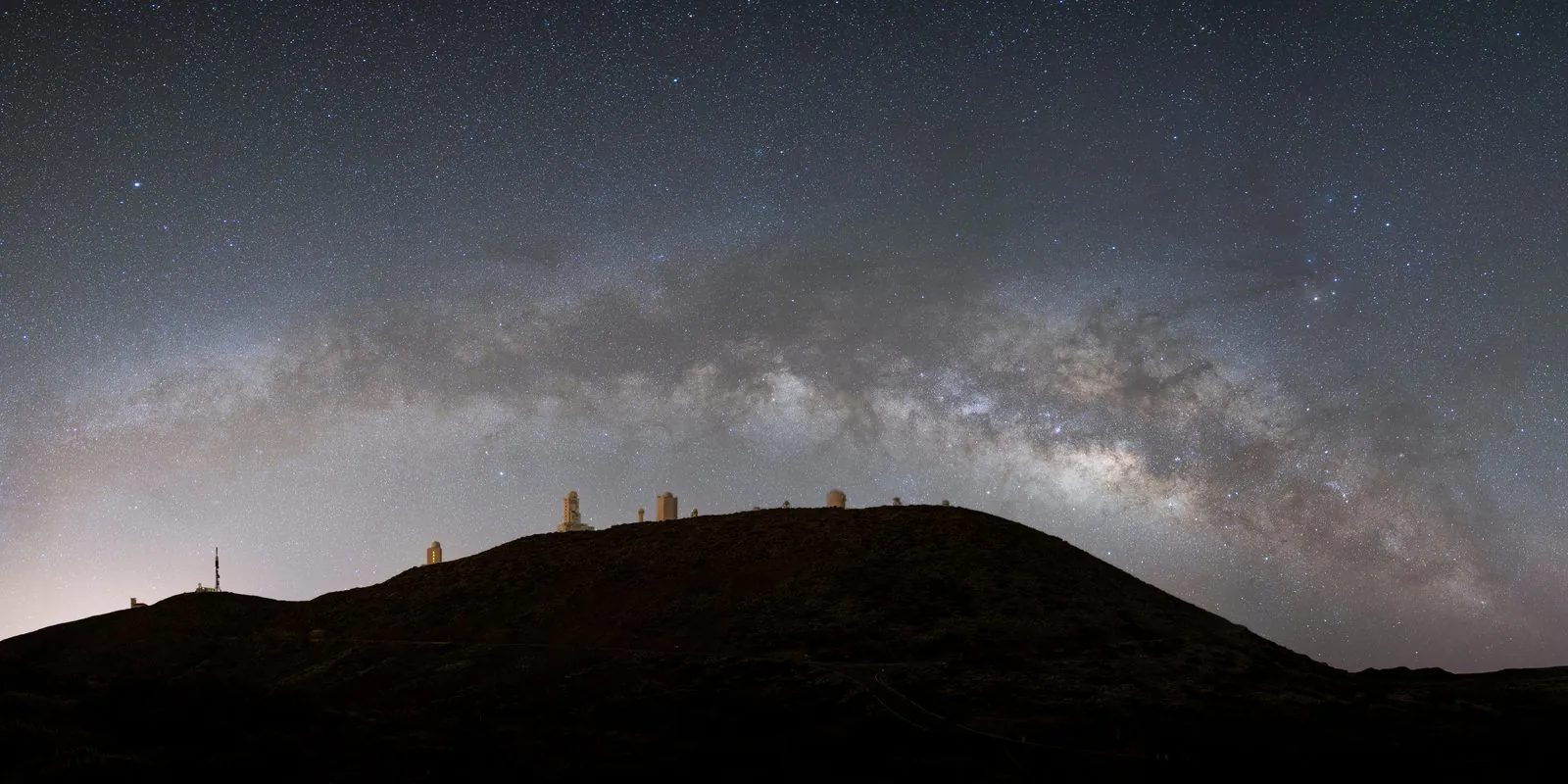
Photo: Curd-Christian Tengeler · CC BY 4.0 · Wikimedia Commons · scaled
The observatories
Roque de los Muchachos, La Palma
Perched on La Palma's highest point at around 2,400 m, the Roque de los Muchachos Observatory is one of the northern hemisphere's premier astronomy sites, home to a cluster of international telescopes including the Gran Telescopio Canarias, one of the largest single-aperture optical telescopes in the world. The mountain-top setting is spectacular in daylight too, often floating above a blanket of cloud on the rim of the Caldera de Taburiente. Daytime guided visits to the site are usually possible — book ahead and check current arrangements, as access is managed.
Teide Observatory, Tenerife
On the flanks of Mount Teide, this solar and night observatory sits in the national park's high, clear air. The Teide area is the most popular place in the Canaries for visitor stargazing, thanks to easy access from the southern resorts, the cable car, and a thriving scene of evening astronomy tours. Daytime guided tours of the observatory itself run seasonally — again, book in advance.
Stargazing tours and viewpoints
You don't have to visit an observatory to enjoy the sky. Two easy options:
- Guided astronomy tours — evening trips, usually up on Teide or in the La Palma highlands, where a guide sets up telescopes, points out constellations, planets and deep-sky objects with a laser, and often includes hotel pick-up. The best add a sunset over the sea of cloud before the stars come out.
- Go it alone — drive up to a high, dark viewpoint away from resort lights, bring warm layers and a red torch, let your eyes adjust for 20 minutes, and simply look up. La Palma has marked stargazing viewpoints (miradores) built for exactly this.
It's cold and dark up top. Even when the coast is warm, the observatories sit at 2,000 m-plus and temperatures drop sharply after sunset, so bring proper warm clothing, a head torch (ideally with a red setting to protect night vision), and drive carefully on winding mountain roads in the dark. A hire car gives you the freedom to reach the viewpoints, but if you're nervous about mountain driving at night, a guided tour with transport is the easier choice.
Best conditions
Aim for the nights around a new moon — a bright full moon washes out the faint stars and the Milky Way. Clear, dry nights are common at altitude even when the coast is cloudy, but check the forecast for the mountain, not the beach. Summer nights offer the brightest core of the Milky Way; winter brings Orion and crisp, steady skies. Whatever the season, give your eyes time to adapt and keep phone screens off.
Above the clouds, on a moonless night, the Canary sky doesn't just have more stars — it has a whole different sky.
World-class, legally protected and surprisingly easy to reach, the night skies of La Palma and Tenerife are one of the islands' quiet wonders. Combine a stargazing evening with a daytime trip to Mount Teide or the Caldera de Taburiente, and pick a clear, dark night — you'll remember it long after the tan has faded. For more ideas, see all our things to do.