Playa de Famara is Lanzarote at its most breathtaking and untamed — a vast, wild sweep of golden sand running for kilometres beneath towering cliffs on the island's northwest coast, with the trade winds combing the Atlantic into perfect surf. This is a beach of huge horizons and huge skies, backed by the little whitewashed village of La Caleta de Famara and crowned by the sheer Famara massif. It's one of the most dramatic and beloved spots on Lanzarote — and one to respect.
How to get there
Famara lies on the northwest coast, reached by road from the island's centre down to the village of La Caleta de Famara, which sits at one end of the beach. It's an easy drive from Teguise and the northern resorts, and there's parking in and around the village, though it fills up on good surf days and sunny weekends. The beach itself stretches away from the village towards the base of the cliffs, so you can walk far along the sand to find your own space.
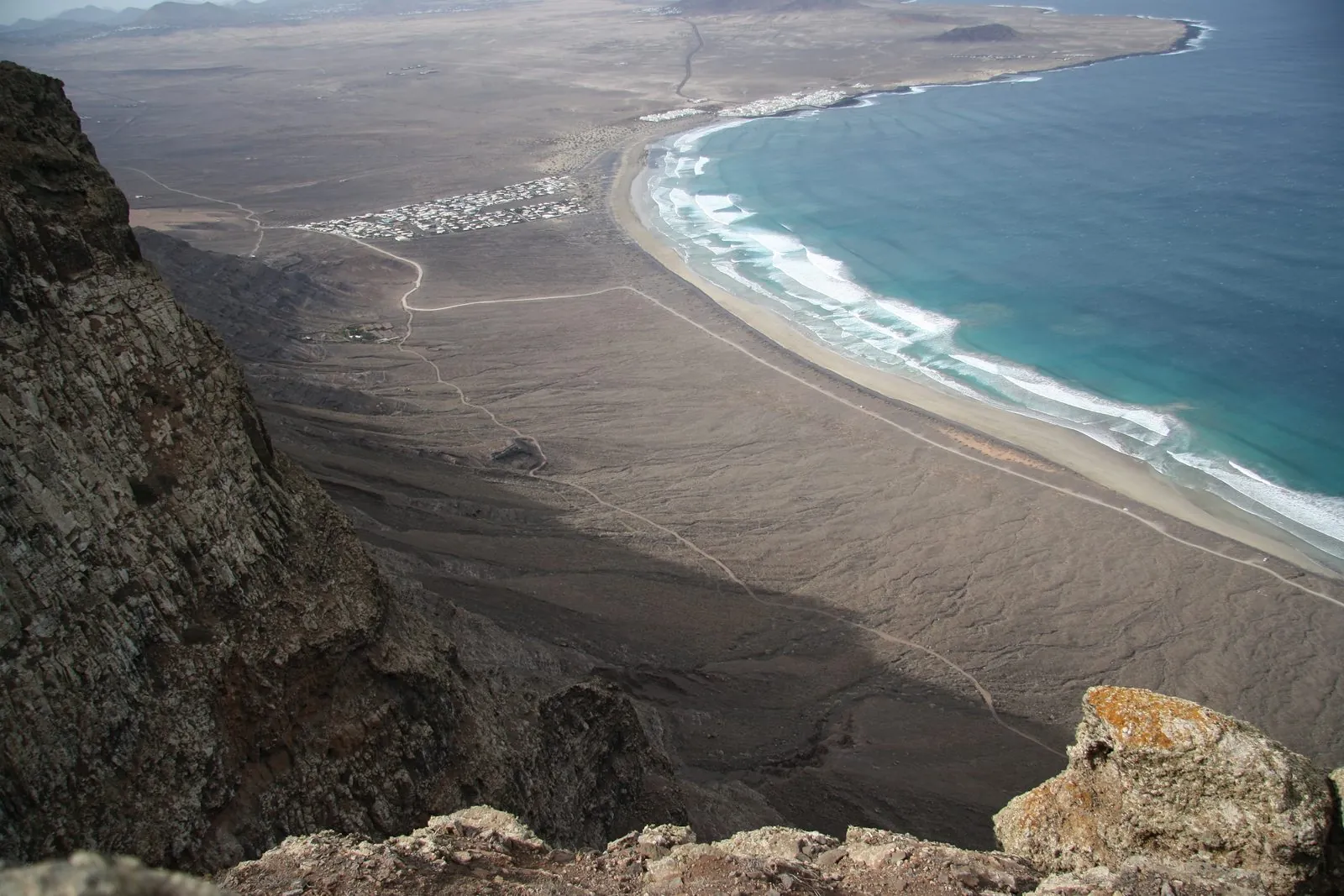
Photo: GerritR · CC BY-SA 4.0 · Wikimedia Commons · scaled
What it's like
The scale here is extraordinary. Golden sand runs in a great arc beneath the Risco de Famara, cliffs that rise hundreds of metres straight from the shore, with the island of La Graciosa often visible offshore. The wind is near-constant, which is exactly why surfers, windsurfers and kitesurfers adore it, and the light and cloud shifting over the cliffs give the beach a wild, cinematic beauty. The village has a bohemian, surfy feel, with laid-back cafés and surf schools. This landscape shaped the artist César Manrique, who grew up spending summers here — his love of Lanzarote's raw nature was born on this coast.
Few beaches in the Canaries feel as vast, elemental and free as Famara.
Swimming and safety
This is the crucial part. Famara is a superb surf beach precisely because it's exposed to the full Atlantic swell, which means strong waves, powerful rip currents and a big tidal range that dramatically changes the shoreline. For surfers with the right skills it's a dream; for casual swimmers it can be genuinely dangerous, and lifeguard cover is limited. Never assume a calm-looking moment is safe.
Take the sea seriously. Playa de Famara has strong Atlantic surf, powerful rip currents and a large tidal range, with limited lifeguard cover. It's a beach for experienced surfers and strong swimmers, not for relaxed bathing — keep children well away from the water on rough days, never swim alone, and check the tide, which comes in fast across the flat sand. If you want a lesson, go with a reputable local surf school.
Facilities
Famara is a natural beach beside a small village, so facilities are modest but real. In La Caleta de Famara you'll find casual cafés, restaurants and surf schools offering lessons and board hire, plus basic services. Out along the vast open sand, though, there's little infrastructure and almost no shade, so bring water, sun protection and anything else you'll need for a long day. Come for the wide-open beauty rather than beach-club comforts.
Best for whom
Famara is for surfers, windsurfers and kitesurfers, walkers, photographers and anyone who loves wild, wide-open coast over manicured resorts. It suits confident, active travellers and those chasing dramatic sunsets against the cliffs. It is not the place for safe family paddling or fully serviced sunbathing — for calm swimming, choose a sheltered south-coast cove like Papagayo instead. To learn a watersport here, see our guide to boat trips and watersports.
Nearby
Just inland stands the historic old capital of Teguise, famous for its lively Sunday market, and the whole artistic legacy of César Manrique is woven across this part of the island. Offshore lies the tiny eighth Canary Island, La Graciosa, reached by ferry from Órzola in the north. For where to stay and the best of the island, see our full guide to Lanzarote.