At 2,426 metres, the Roque de los Muchachos is the rooftop of La Palma — the highest point on the island and one of the great viewpoints of the whole archipelago. Up here you stand on the very rim of a vast volcanic amphitheatre, with the green depths of the Caldera de Taburiente falling away at your feet and, on a clear day, the neighbouring islands and even the summit of Mount Teide floating on a sea of cloud. Add one of the world's finest astronomical observatories perched along the ridge and skies so dark they're protected by law, and it's easy to see why this windswept summit is the single sight most visitors to La Palma want to tick off.
Standing on the rim of the Caldera
The Roque de los Muchachos — "the rock of the lads", named after a cluster of weathered boulders near the top — sits on the northern edge of the Caldera de Taburiente, the huge eroded crater at the island's heart. From the summit lookouts the view plunges thousands of metres into a bowl of pine forest and ravines, ringed by jagged peaks. It is a genuinely dramatic panorama, the kind that makes people fall quiet. Look outward instead and the horizon opens up: El Hierro, La Gomera and Tenerife often ride above the clouds, with Teide's cone unmistakable in the distance.
Because you're so high, the weather up here is a world away from the coast. You can leave a warm beach in shorts and arrive at the top to find biting wind, cloud pouring over the rim like a slow waterfall — the famous mar de nubes, or sea of clouds — or brilliant sunshine and cold, thin air. That contrast is part of the magic, but it catches people out.
It's high, cold and thin up there. At almost 2,500 m the temperature can be 15°C or more below the coast, the wind is fierce, and the sun burns fast. Bring a warm layer, a windproof jacket and proper shoes even in summer, plus water and sun cream. Some visitors feel the altitude a little — take it slowly and don't be surprised if you're a bit breathless on the short walks.
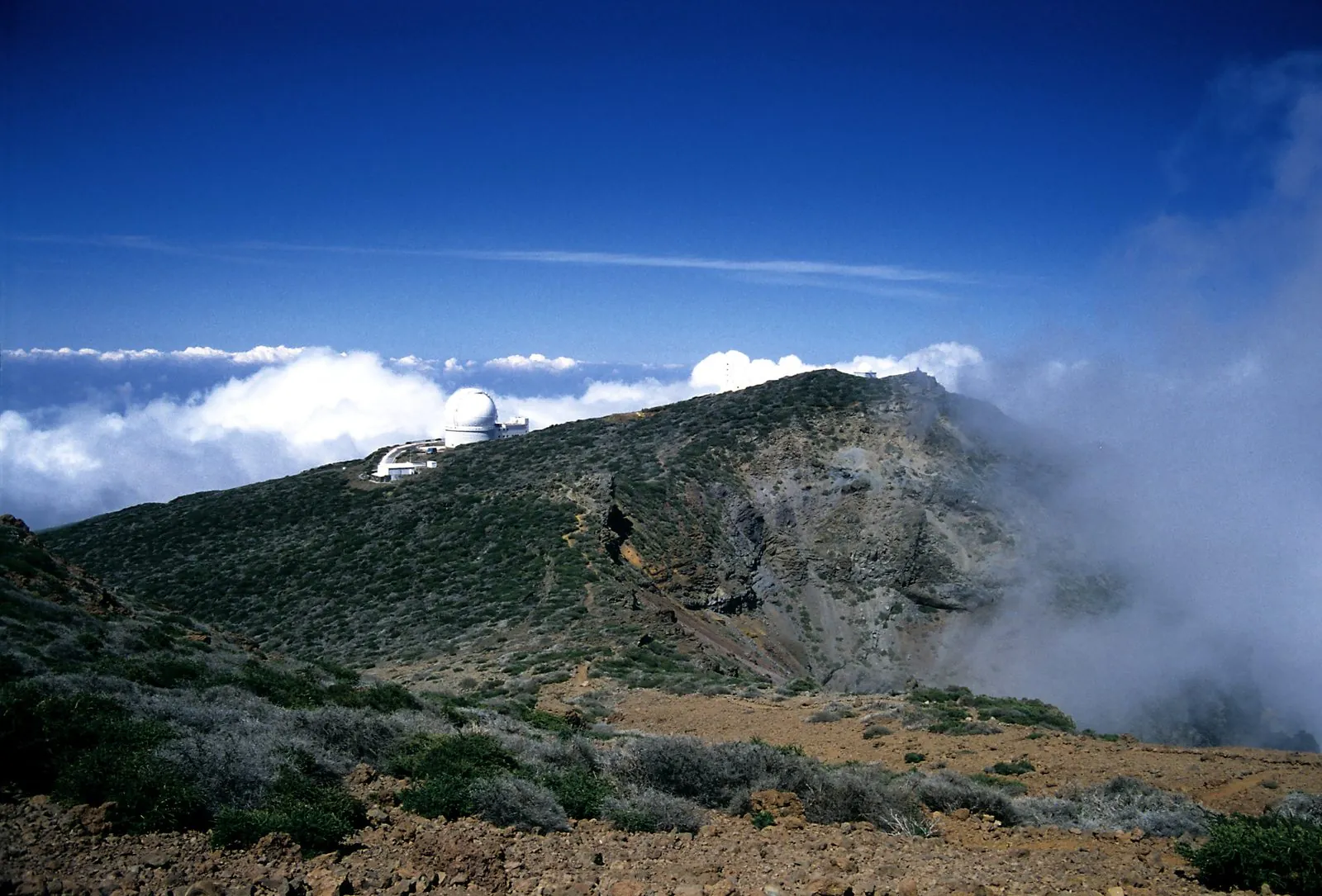
Photo: Falk2 · CC BY-SA 4.0 · Wikimedia Commons · scaled
The observatory on the ridge
Strung along the ridgeline near the summit is the Roque de los Muchachos Observatory, one of the most important stargazing sites on Earth. Its white domes house telescopes from institutions across the world, including one of the largest optical telescopes anywhere. La Palma's night skies are exceptionally clear, stable and dark — the island was the world's first to be certified a Starlight Reserve, and light pollution is strictly controlled by law — which is exactly why the astronomers came.
The telescopes themselves are working scientific instruments, not a theme park, but you can admire the cluster of domes from the road and public viewpoints, and guided visits to parts of the site are run at certain times by arrangement. If you're curious about the science, book ahead through the official channels rather than turning up expecting to walk in.
Come for sunset, stay for the stars. The summit is a spectacular spot to watch the sun sink into the sea of clouds, and once darkness falls the sky here is astonishing — the Milky Way stretched from horizon to horizon. If you want to make the most of it, plenty of operators run guided stargazing trips up the mountain, which saves you the drive back down a twisting road in the dark.
The drive up
Getting to the top is an experience in itself. The road climbs from sea level through banana country, laurel forest and finally bare volcanic ridges in a long series of hairpin bends. It's well surfaced but slow and winding, and the last stretch runs along the exposed crater rim with big drops beside you. Allow a good deal longer than the distance suggests — well over an hour from most parts of the island — and take it steadily.
A hire car is by far the easiest way up, as public transport to the summit is minimal. Fill up with fuel before you start, check your brakes are happy on the long descent, and don't attempt it if thick cloud or ice is forecast up top. If you'd rather not drive, guided excursions and astronomy tours will take you up and back in comfort.
Check conditions before you set off. The summit road can close in snow, ice or high wind, and low cloud can wipe out the view entirely — frustrating after a long climb. A clear morning is often your best bet, as cloud tends to build against the rim later in the day. If the forecast is poor, save it for another day.
Walks along the summit
Most visitors simply drive to the top and enjoy the roadside viewpoints, which is reward enough. But the Roque is also the trailhead for some of the finest walking on the island. Serious hikers tackle the long, spectacular route right around or down into the Caldera de Taburiente, while gentler options follow the rim for shorter distances with the same jaw-dropping views. If you fancy stretching your legs, read up first on hiking in the Canaries and carry plenty of water — there's no shade and no shop up here.
For an easier taste of the Caldera without the altitude, the viewpoint at La Cumbrecita on the southern rim gives another grand angle into the crater from a far shorter drive.
Make a day of it on La Palma
The Roque pairs naturally with the rest of the island's green north. On the way up or down you can detour to the luxuriant laurel forest and springs of Los Tilos, or base yourself in the handsome capital, Santa Cruz de la Palma, with its cobbled streets and painted balconies. La Palma is nicknamed La Isla Bonita, the pretty island, and a day that starts with the summit and ends with dinner in town shows you exactly why.
Stand on the rim at sunset, watch the clouds pour into the Caldera, then wait for the darkest sky in Europe to fill with stars — few places on the islands feel quite this special.