Half a crater, a lagoon the colour of bottle glass, and a black-sand beach hissing under the Atlantic — El Golfo is one of Lanzarote's most photographed spots for good reason. On the island's wild west coast, an old volcano was sliced clean in two by the sea, leaving a towering wall of rust-red and ochre rock curving around a small green lagoon. Add a whitewashed fishing village famous for its seafood and you have a short, easy stop that packs in colour, geology and a genuinely good lunch. It's a natural pairing with the rest of Lanzarote's volcanic sights.
The green lagoon: Charco de los Clicos
The star is the Charco de los Clicos (sometimes called Charco Verde, the "green pool"), a small lagoon trapped between the eroded crater wall and a bank of black volcanic sand. Its startling emerald-green colour comes from microscopic algae thriving in the mineral-rich, super-salty water — a vivid contrast against the red cliffs behind and the dark beach in front. Cut off from the open sea, it's a little ecosystem all of its own, and one of those sights that genuinely lives up to the postcards.
Look, don't touch. The lagoon and its shore are protected, and swimming or paddling in the Charco is not allowed — the water is fragile and the algae easily disturbed. You view it from a fenced viewpoint reached by a short walk, so bring your camera rather than your swimsuit. Wear proper shoes: the path crosses loose volcanic gravel.
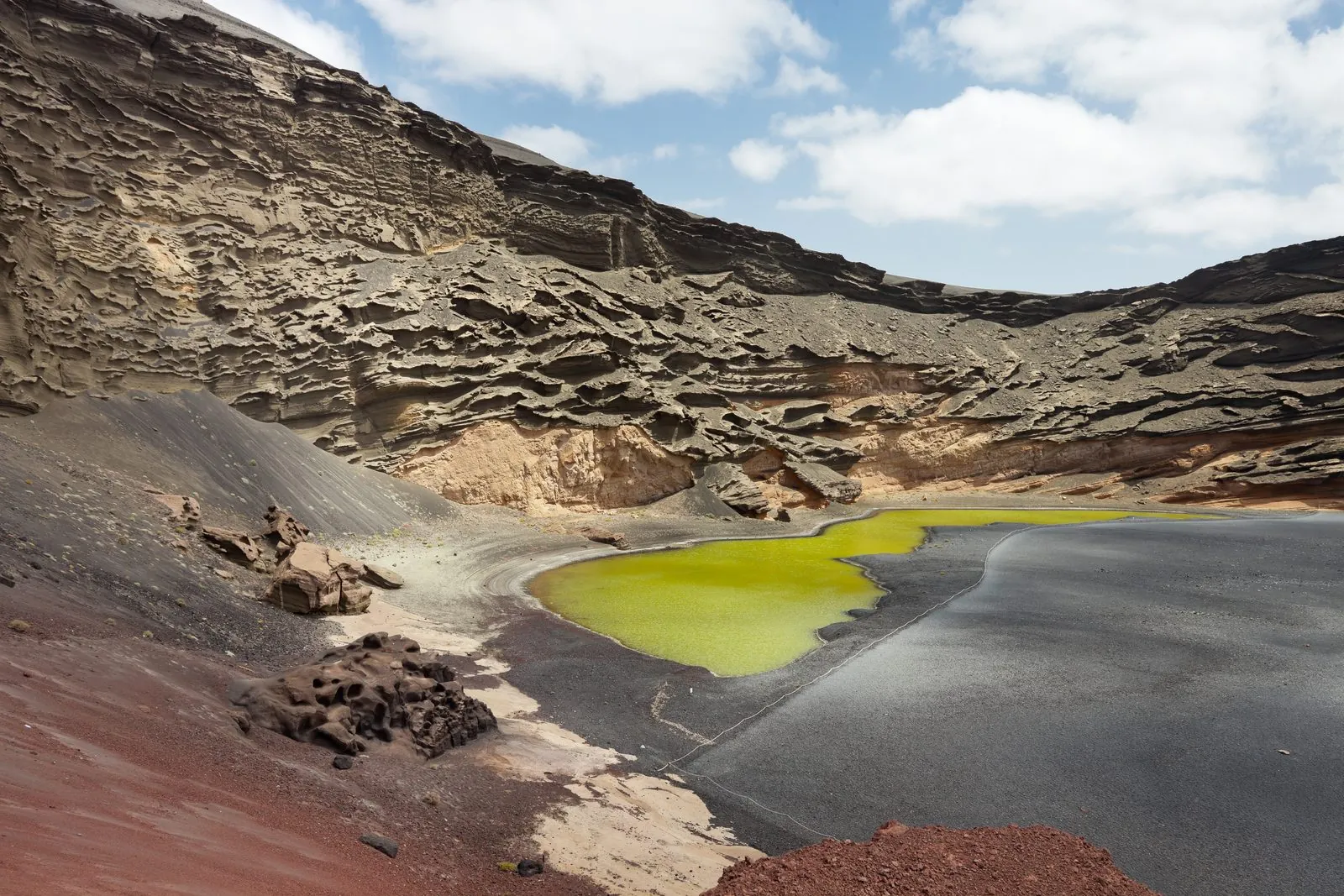
Photo: Luis Miguel Bugallo Sánchez (Lmbuga) · CC BY-SA 3.0 · Wikimedia Commons · scaled
The eroded crater and the black beach
El Golfo is really the surviving half of a volcanic cone. Over thousands of years the Atlantic has gnawed away the seaward side, exposing a cross-section of the volcano's insides: bands of red, orange, black and mustard-yellow rock stacked in dramatic layers, streaked with minerals. It's raw geology laid bare, and the colours glow most intensely in the low light of early morning or late afternoon.
Below the viewpoint stretches a curve of coal-black sand pounded by big Atlantic swells. It's a beautiful, brooding place for a walk and a photo, but not a swimming beach — the currents and surf here are strong. For a proper swim you're better off heading down the coast to the calm, family-friendly waters of Playa Blanca in the island's sheltered south.
The fishing village and its seafood
The village of El Golfo itself is a tidy line of low white houses strung along the shore, many of them turned into restaurants with terraces looking straight out over the water. This is one of the best places on Lanzarote to eat fresh fish and seafood: grilled catch of the day, garlicky prawns, limpets with green mojo, and of course the island staple of papas arrugadas with mojo. Prices are what you'd expect for a scenic spot on the tourist trail, but the setting — waves crashing a few metres from your plate as the sun drops — is hard to beat.
Time it for sunset. El Golfo faces west, so it's one of the finest sunset perches on the island. Aim to reach the lagoon viewpoint in the golden hour when the red cliffs blaze, then walk back to the village for dinner as the sky turns. Book a terrace table ahead in high season — the good ones fill fast.
What else to see nearby
El Golfo sits on the same stretch of coast as several of Lanzarote's other volcanic wonders, so it's easy to build a memorable day around it. Just inland lies Timanfaya National Park, the astonishing "Mountains of Fire" left by the great eruptions of the 1730s — El Golfo's red rock is part of the same fiery story. Between the two you'll pass strange coastal features like Los Hervideros, where the sea booms through lava caverns, and the pink-and-white pools of the Salinas de Janubio salt pans. String them together and you have a classic west-coast circuit.
Getting there and practicalities
El Golfo is on the southwest coast, roughly a 20-minute drive from Playa Blanca and around 30–40 minutes from Puerto del Carmen or the capital Arrecife. A hire car is much the easiest way to visit, letting you combine it with Timanfaya and the coast road at your own pace; there's free parking in and around the village. Public buses to this quiet corner are limited, so without a car most people come as part of an organised island tour.
The site itself is free to visit — there's no ticket for the lagoon viewpoint or the beach — which makes it an easy add-on to a bigger day out. Allow around an hour to walk to the viewpoint, take your photos and stroll the black sand, plus longer if you're staying for a meal. Bring sun cover and water; the west coast is exposed and can be breezy even when the rest of the island is calm. It's the kind of short, scenic, no-fuss stop that makes Lanzarote's volcanic landscape feel close enough to touch.
Red cliffs, a green pool and a black beach in a single frame — El Golfo is Lanzarote's colour wheel, carved by the sea.