The best way to spend a week in Tenerife is to split it between two bases: three nights in the sunny south for Teide, the whales and a beach day, then four in the green north for Masca, Garachico, La Orotava, La Laguna and the Anaga mountains. Tenerife is far bigger than it looks on a map, and the motorway between the two coasts runs through Santa Cruz, so day trips from a single southern hotel to the north-east cost two to three hours of driving for every day out. Moving once, halfway through, saves most of that.
Tenerife really is two places. The south and west are dry, bright and built for holidays, with the big resorts of Costa Adeje and Los Cristianos. The north catches the trade-wind cloud, which makes it greener, cooler and older, with colonial towns, banana terraces and laurel forest. Teide sits between them, and the roads over its shoulders link the two halves.
This plan follows that geography: the south first, a moving day that crosses the Teno mountains via Masca, then the north. It assumes a hire car and a flight in and out of Tenerife South, which is what most visitors from the UK and Ireland use.
Two bases, and when one is enough
For the south, Costa Adeje or Los Cristianos are the obvious choices: both are about 20 minutes from Tenerife South airport, both have calm beaches, and both are where the whale-watching boats leave from. For the north, Puerto de la Cruz is the most practical: a real town with a seafront, plenty of hotels, and roughly half an hour from La Laguna, 45 minutes from the cable car and an hour from the far end of Anaga. Our guide on where to stay in Tenerife covers the alternatives, including the quieter north-west around Garachico.
A single base works if you are happy to see less of the north. From Costa Adeje, Teide, Masca and the whale trips are all easy, but La Laguna and Anaga mean a long day with rush-hour traffic around Santa Cruz at both ends. If you stay in the south all week, keep the north to one long day, cut Anaga, and accept that you will have seen half of the island properly. If you stay in the north all week, budget for some cloudy mornings and drive south for the beach day.
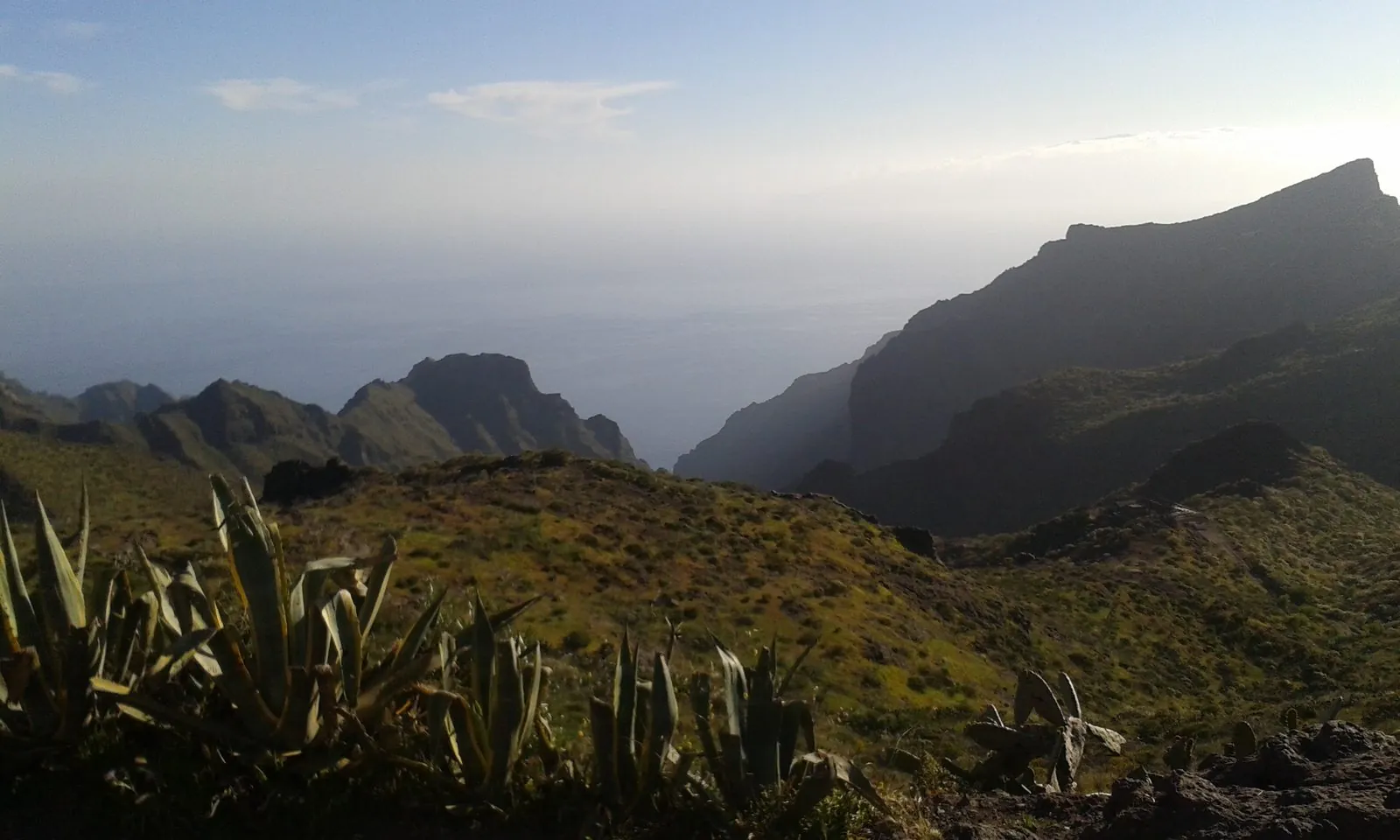
Photo: Axel Cotón Gutiérrez · CC BY-SA 4.0 · Wikimedia Commons · scaled
Seven days on one page
| Day | Base | Plan | Driving (approx.) |
|---|---|---|---|
| 1 | South | Arrive, settle in | 20 min from the airport |
| 2 | South | Teide: cable car, summit or crater walks | 1 hour each way |
| 3 | South | Whale trip in the morning, beach afternoon | Minimal |
| 4 | Move north | Masca, Buenavista, Garachico, Icod | 3 hours with stops |
| 5 | North | La Orotava and Puerto de la Cruz | Under 30 min |
| 6 | North | La Laguna and the Anaga mountains | 2 to 2.5 hours in total |
| 7 | Departure | Back over Teide to the south airport | About 2 hours |
Days 1 and 2: the south and Mount Teide
Use the first afternoon to settle in, walk the seafront promenade that links Los Cristianos to Costa Adeje, and confirm your bookings for the next day. Teide goes on day 2 because the weather at altitude is the least predictable thing on the island, and an early slot leaves room to try again later in the week.
From Costa Adeje the drive to the cable car base takes about an hour, climbing through Vilaflor and the pine forest on the TF-21, then across the Las Cañadas caldera. The Teide cable car rises to La Rambleta at around 3,555 metres in a few minutes, and from there two short trails lead to viewpoints over the caldera and, on clear days, the other western islands. Recent reports put a return adult ticket at a little over €40 for non-residents in 2026; the official site shows the current figure, and buying online for a fixed time is the only sensible way to do it in season.
Standing on the true summit at 3,715 metres is a separate matter. Since 19 January 2026, non-residents pay to walk the last stretch, the Telesforo Bravo trail (Sendero 10), and it is booked through Tenerife ON, not with the cable car. According to Diario de Avisos in October 2026, the fee is €15 for visitors from outside the Canaries, €6 for residents of the other islands, and free for Tenerife residents and under-14s, with time slots shortened to 90 minutes. Our step-by-step guide to the Teide summit permit explains how to book it.
Book the cable car to fit the permit, not the other way round. Your summit slot is fixed, the trail from La Rambleta to the crater takes most people around 40 minutes of slow walking at altitude, and you have to get down again before the slot ends. Choose a cable car time that puts you at the top station well before your permit starts, and if wind closes the cable car that morning, the permit does not move with it.
Do not go up on your first morning after a late flight, and take the thin air seriously: headaches and breathlessness are common at the top station, and the temperature can be 15°C or more below the coast. Come down the other side of the park on the TF-38 past Chío, so the return to Costa Adeje does not repeat the morning's road.
Day 3: whales in the morning, the beach in the afternoon
Between Tenerife and La Gomera lies a strait that holds resident pilot whales and several species of dolphin all year, and the boats leave from Puerto Colón in Costa Adeje, from Los Cristianos and from Los Gigantes, under its sheer cliffs. Pick a morning trip, when the sea is usually calmer, and choose a boat licensed under the Canarian government's whale-watching rules, which set how close vessels may go and for how long. Our page on whale and dolphin watching compares the trip lengths.
Afternoon brings the easy half-day of the week. Spend it on Playa del Duque, the cleanest and calmest of the Costa Adeje beaches, with golden sand and a promenade lined with smart hotels, or on any of the sheltered beaches between it and Los Cristianos. Do nothing more strenuous than move your sunbed, and have dinner close to the hotel, because day 4 starts early.
Day 4: over the Teno mountains via Masca
The moving day is the most scenic drive of the week. Check out early and head north-west to Santiago del Teide, then take the TF-436 over the Teno massif. It is a narrow, single-lane road in places, with tight hairpins, sheer drops and buses coming the other way; drive it slowly and in the morning, before the traffic builds. Masca clings to a ridge halfway along, with a couple of bars and terraces for a coffee above the gorge.
Walking the Masca gorge itself is a different undertaking. Access is controlled through an official booking system, helmets are issued at the start, the route is walked downhill only, and walkers return by boat to Los Gigantes, which is on the wrong side of the mountain from your car and your new hotel. The trail also closes at short notice for weather and wildfire risk, and access was restricted during a fire alert in summer 2026. On a moving day with luggage in the boot, it is far simpler to enjoy the village and the viewpoints and save the gorge for a separate trip from the south, if it is open and you are fit for a steep descent of around four hours.
From Masca the road drops to Buenavista del Norte, and the coast road runs east to Garachico, a small port rebuilt after a lava flow filled its harbour in 1706. Have lunch there and, if the sea is calm, swim in El Caletón, the natural pools formed by that same lava. Stop at Icod de los Vinos on the way to Puerto de la Cruz to see the great dragon tree, then check in for the next four nights.
Day 5: La Orotava and Puerto de la Cruz
After three days in the car, day 5 stays close to base. In the morning drive up to La Orotava, about 15 minutes inland, and walk the steep old streets of carved wooden balconies, the Casa de los Balcones and the terraced gardens of the Hijuela del Botánico. Park at the top of the old town and walk down; the streets are steep enough that climbing back up is the hard part.
Spend the afternoon in Puerto de la Cruz itself: the old fishing quarter around the harbour, the Botanical Garden on the edge of town, which dates back to the late eighteenth century, and the seawater pools of Lago Martiánez. The beaches here are black sand and the sea is often rough, which is why the pools exist. Families may prefer to give the day to Loro Parque instead, which is on the western side of town.
Day 6: La Laguna and Anaga
The north-east is the reason for staying in the north. Leave around nine to reach San Cristóbal de La Laguna, about half an hour away, and walk the grid of colonial streets that became a UNESCO World Heritage Site in 1999. Its plan, laid out without walls in the late fifteenth century, became a model for colonial towns across Spanish America. Coffee in one of the cafés around the cathedral, and a look into the courtyards of the old mansions, takes a relaxed couple of hours.
From La Laguna the TF-12 climbs into the Anaga Rural Park, a ridge of laurel forest that is often wrapped in cloud and dripping even when the coast is sunny. Stop at Cruz del Carmen for the visitor centre and the short forest trail, then take the road down to Taganana and the black beaches of Almáciga and Benijo, where the restaurants serve the day's fish. The roads are twisty and slow, so allow at least an hour from La Laguna to the coast with stops. Drive back before dark: the mountain roads have little lighting and the cloud can come down quickly.
Day 7: the last crossing
The final day turns the drive to the airport into one more look at the volcano. From Puerto de la Cruz, the TF-21 climbs through La Orotava and the pine forest into Teide National Park, crosses the caldera and descends through Vilaflor towards the south. It takes about two hours without stops, and the alternative motorway route via Santa Cruz is barely faster in traffic.
This is your fallback day for Teide. If the cable car was closed by wind on day 2, or the summit was in cloud, you pass the base station again, and an early return flight is the only reason not to try once more. If your flight leaves in the afternoon, you can still stop at the Roques de García viewpoint and have a last lunch in Vilaflor, one of the highest villages in Spain. Leave the car with a full tank and an hour to spare at the airport.
Bookings to make at home
- The summit permit: as early as you can, since slots for popular dates go well ahead; it is separate from the cable car.
- The cable car: online, for a specific time that suits your permit, ideally first thing in the morning.
- The Masca gorge: only if you are planning the walk; check the official booking site for open days and the boat back to Los Gigantes.
- The car: one hire for the whole week, picked up and dropped off at Tenerife South.
- The whale trip: bookable a day or two ahead outside school holidays.
Making the week fit you
This plan gives you both halves of Tenerife without a single day of doubling back. If you want more beach time, drop La Orotava or fold it into day 6. If you want to walk, the Anaga forest trails and the routes on the Teno massif will easily take a second day each. If the weather turns, the north is where it turns first, so swap days freely and keep Teide for the clearest morning you get.
The one mistake to avoid is treating Tenerife as a small island. From a single southern hotel, the green north is a long day trip that most visitors never quite get round to. Split the week, move once over the mountains, and you will go home having seen both of its very different coasts.