The best snorkelling in the Canary Islands is in sheltered, rocky coves on the south and east coasts and in the waters around the marine reserves: Playa Chica in Puerto del Carmen on Lanzarote, the lagoon on Isla de Lobos off Fuerteventura, the reef at Las Canteras in Las Palmas, and the calm Mar de las Calmas off La Restinga on El Hierro are the stand-outs. You will not find coral reefs or the colours of the Red Sea. What you find instead is clear Atlantic water over black lava, shoals of bream and parrotfish, octopus in the cracks, rays on the sand and, with luck, a turtle.
The islands are volcanic peaks rising straight out of deep ocean, so the sea is open, often lively and cooler than many people expect. The trick is to choose a cove that faces away from the swell and to get in on a morning before the wind gets up. Do that and the snorkelling is genuinely good, often a few metres from your towel.
This page goes island by island, explains the three marine reserves and what you may and may not do in them, and spends some time on the part most guides skip: getting in and out of the water safely over rock. If you would rather swim in a sea-filled rock basin, the tidal lagoons have their own page on the natural pools of the Canaries; if you want to go deeper with a tank, the diving guide covers the dive sites and schools.
What lives on the rock, and why so much of it is bare
The Canaries sit where tropical and temperate waters meet, and the mix shows. Over the rock you will see ornate wrasse, damselfish, the Canarian parrotfish (the vieja, red in the females and grey in the males, also a menu staple), trumpetfish hanging near the bottom and moray eels watching from holes. Over sand, look for small rays and, in a few protected bays, the angel shark, buried with only its eyes showing.
Snorkel over almost any rocky bottom in the islands and you will also notice large areas of pale, scraped stone with very little seaweed, dotted with black urchins whose spines can be longer than your finger. Canarian marine scientists call these patches blanquizales, "white grounds". They are made by the long-spined sea urchin Diadema africanum, which grazes young algae faster than it can grow. Where fishing has removed the big predatory fish and the larger wrasse that eat young urchins, the urchins boom and the algae disappear.
That is what makes the marine reserves worth the trip: inside them the fish are larger and more numerous, and the rock carries more life. It also matters for your feet. The spines are brittle, break off in the skin and are hard to remove, so never stand on a rocky bottom or put your hand on a rock you cannot see clearly.
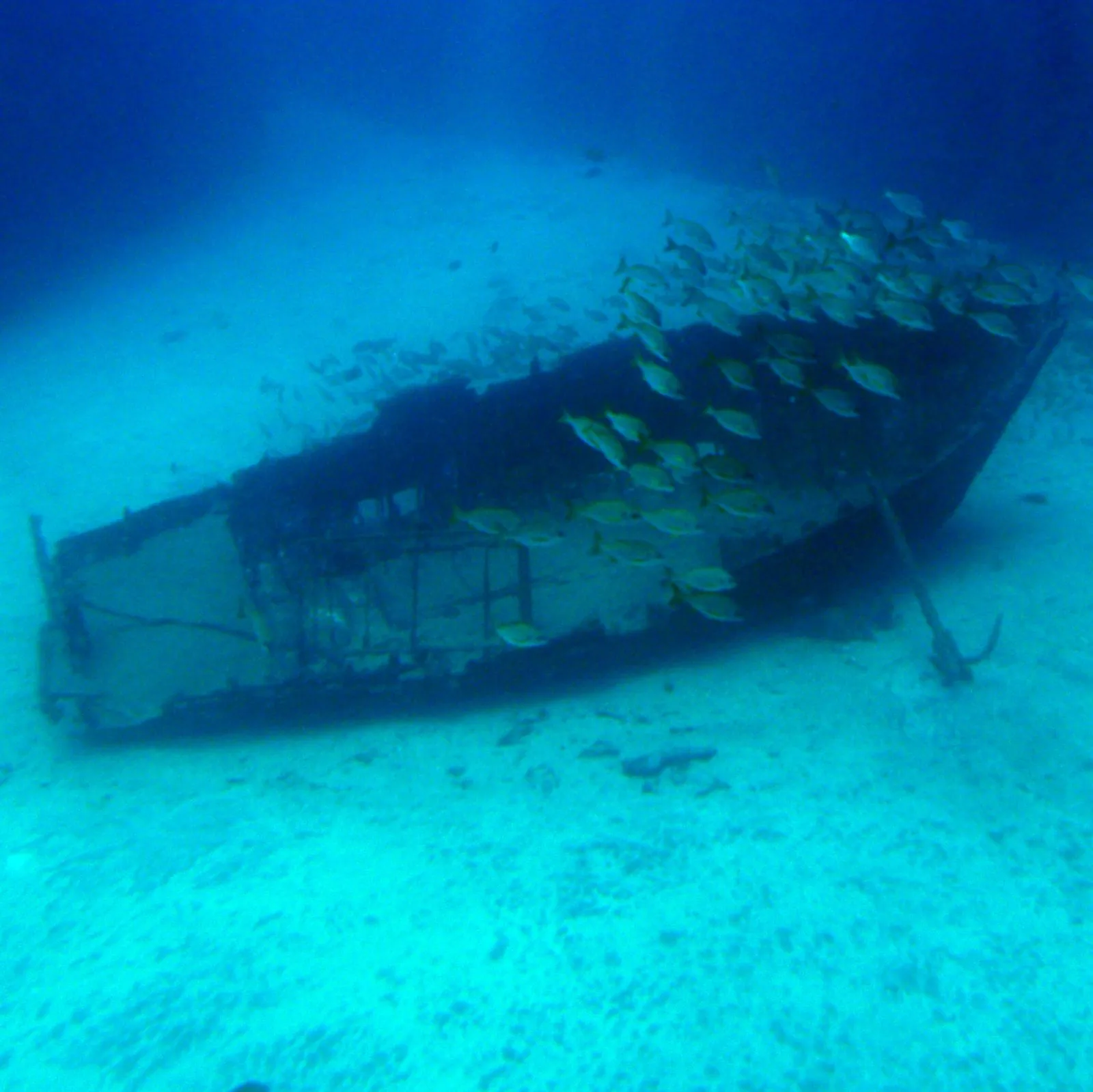
Photo: Николай Максимович · CC BY 3.0 · Wikimedia Commons · scaled
Lanzarote and La Graciosa
On Lanzarote the classic shore entry is Playa Chica in Puerto del Carmen, a small cove between the resort's main beaches where a gentle sand slope leads out to volcanic reef. It is also the island's busiest dive-training spot, so go early and keep clear of the dive groups' flags. On the south coast, the coves of Papagayo have sheltered, clear water over sand and rock, with the best snorkelling along the headlands between the beaches.
For children and nervous swimmers, the shallow lagoons at Caletón Blanco near Órzola are the gentlest water on the island, with small fish in knee-deep water at low tide. Across the strait, La Graciosa and the islets north of Lanzarote form the Canaries' largest marine reserve. Its sandy coves are excellent on a calm day, but the north and west beaches face the open Atlantic with strong currents and no lifeguards, so stick to the sheltered southern shore unless the sea is flat.
Fuerteventura and Isla de Lobos
Fuerteventura is a wind and surf island, and much of its coast is too exposed for comfortable snorkelling. The great exception is the little island of Isla de Lobos, a short boat ride from Corralejo, where the lagoon at El Puertito is shallow, sheltered and clear. Lobos is a protected natural park and you need a free advance permit to land (ferry operators usually arrange it as part of the ticket), so plan it rather than turning up.
On the main island, the shallow lagoons north of El Cotillo are calm at low tide and good for a first look with a mask. Further south, the harbour beach at Caleta de Fuste works on a still morning, but the afternoon trade wind soon chops the surface, and chop means poor visibility and a tiring swim.
Tenerife
Tenerife's south-west coast, between Costa Adeje and Los Gigantes, is where most snorkelling trips go, mainly for the turtles. The best-known spot is the bay at El Puertito, north of Costa Adeje, where green turtles have long been seen close to shore. Two warnings: in June 2025 the beach was briefly closed to bathing after high levels of faecal bacteria were found, reopening once tests were clean (Canarian Weekly reported both), and by midday the bay fills with tour boats. Watch the turtles; do not touch, chase or feed them. Our page on the islands' sea turtles explains why feeding them does harm.
Elsewhere, the rocky coves of Costa del Silencio near Montaña Amarilla are rewarding on a flat day. In the north the sea is usually too rough for snorkelling.
Gran Canaria
The single best snorkelling beach on Gran Canaria is in the capital. Las Canteras is protected by La Barra, a natural rock reef that runs parallel to the shore, and inside it the water is calm, clear and full of small fish over rock and seagrass. The central and northern stretch is most sheltered; never cross the reef, where the full swell breaks.
In the north-west, Playa de Sardina at Sardina del Norte is a small, sheltered beach with rocky sides that local divers use for training, good for snorkelling when the north swell is down. On the east coast near Arinaga, the bay of El Cabrón is a protected area (a Special Area of Conservation under EU rules) and one of the island's richest dive sites; snorkellers enjoy the shallows, but go early, before the wind.
El Hierro, La Palma and La Gomera
The finest snorkelling in the archipelago is probably off the south coast of El Hierro, in the Mar de las Calmas, the "sea of calm" sheltered from the trade winds. The village of La Restinga sits at the heart of the marine reserve declared there in 1996, and a few kilometres up the coast the lava cove of Tacorón is calm, clear and full of fish.
On La Palma, the sheltered coves at Los Cancajos near Santa Cruz are the easiest snorkelling on the island, with lava reefs breaking the swell. The island's own marine reserve lies off the south-west coast near Fuencaliente. On La Gomera, Playa de la Caleta near Hermigua is calm on summer days, and Valle Gran Rey is the reliable choice the rest of the year.
The marine reserves: what is and is not allowed
The Canaries have three official marine reserves set up to protect fish stocks: La Graciosa and the northern islets, Punta de La Restinga–Mar de las Calmas on El Hierro, and the reserve off La Palma. Each has zones with different rules.
- The integral zone is closed to almost everything. At La Restinga it lies in front of the Bahía de Naos and is marked with buoys.
- Scuba diving in the reserves needs an authorisation and is done from a boat at marked points, usually with a local dive centre.
- Fishing is heavily restricted; at La Restinga recreational fishing is allowed only with a rod from the shore, outside the protected zones.
- Snorkelling from the public beaches and harbours outside the integral zones is how most visitors enjoy the reserves. Rules can change, so ask at the reserve's visitor centre in La Restinga or at a dive centre before swimming anywhere unfamiliar.
Getting in and out over rock
Most accidents happen at the edge, not in the water. Many of the best spots have no sand, only a lava shelf, a slipway or a ladder, and the swell arrives in sets: several larger waves, then a lull. Watch for five minutes before you get in, so you know where the sets break and how long the lulls last.
- Pick your exit before you get in, and make it the same place, or a sheltered one you have looked at from land.
- Wear reef shoes or thin booties. Lava is sharp and the urchins are everywhere.
- Put your fins on in the water, holding a ladder or sitting at the edge; walking on rock in fins is how ankles break.
- Go in and come out in a lull, never as a set arrives. On the way out, let a wave lift you to the ledge, then grab and climb before the next one.
- Use ladders and slipways where they exist; green, slimy rock near the waterline is far more slippery than it looks.
A flat beach can turn in an hour. In the islands the swell often comes from storms far out in the Atlantic, so a calm morning can bring bigger waves by lunchtime with no change in the wind. If the water is breaking over the ledge you came in from, swim to a sheltered spot and get out there.
Also avoid the bearded fireworm, a pinkish bristly worm whose white bristles sting badly. Jellyfish and Portuguese men-of-war appear now and then; our page on jellyfish in the Canaries explains what to do. On lifeguarded beaches, the flag system on beach flags and swimming safety applies to snorkellers too.
Kit, water temperature and timing
The sea ranges from about 18–19°C in late winter to around 23–24°C in late summer, typical figures covered on our page on sea temperature and swimming. You chill quickly floating face down, so a thin wetsuit or long-sleeved rash vest helps between November and May and saves your back from sunburn all year. Resort shops sell masks, but a cheap one that leaks will spoil the day; bring a decent one from home.
Mornings are better almost everywhere: the trade wind usually builds after midday and roughens the surface. A low tide often helps in lagoons and inside reefs, while ledge entries can be easier near high tide, when the water covers the slippery lower rock. Never snorkel alone, and in a busy harbour or bay tow a bright float so boats can see you.
Where to begin, island by island
If you only snorkel once, make it Playa Chica on Lanzarote or Las Canteras in Las Palmas: both are sheltered, easy to reach and rewarding close to the beach. For something more memorable, the Lobos lagoon and the coves of the Mar de las Calmas are the best the islands offer, and the reserve waters show you what this coast looks like when the fish are left alone. Wherever you go, choose a sheltered cove, go in the morning, watch the sets and keep your feet off the bottom.