They call Gran Canaria a "continent in miniature", and nowhere proves it like the trails of the interior. Leave the southern beaches behind and within an hour you're climbing through pine forest, ravines full of palms and cave houses, and a jagged crown of volcanic peaks where the air is cool and the views run all the way to Teide. Most sun-seekers never see it — which is exactly why walkers who make the effort fall for the island's wild green heart.
This is the island detail behind our wider guide to hiking in the Canary Islands. Here are Gran Canaria's finest walking areas, from a short summit scramble to deep palm-filled ravines.
Roque Nublo — the island's icon
The obvious first walk is to Roque Nublo, the great volcanic monolith that stands like a fist on the roof of the island. The trail up from the La Goleta car park is short and popular — perhaps three-quarters of an hour each way — but steep in places and gloriously exposed at the top, with huge views over the central peaks and, on clear days, Teide floating above the clouds on Tenerife. It's the single best introduction to the highlands.
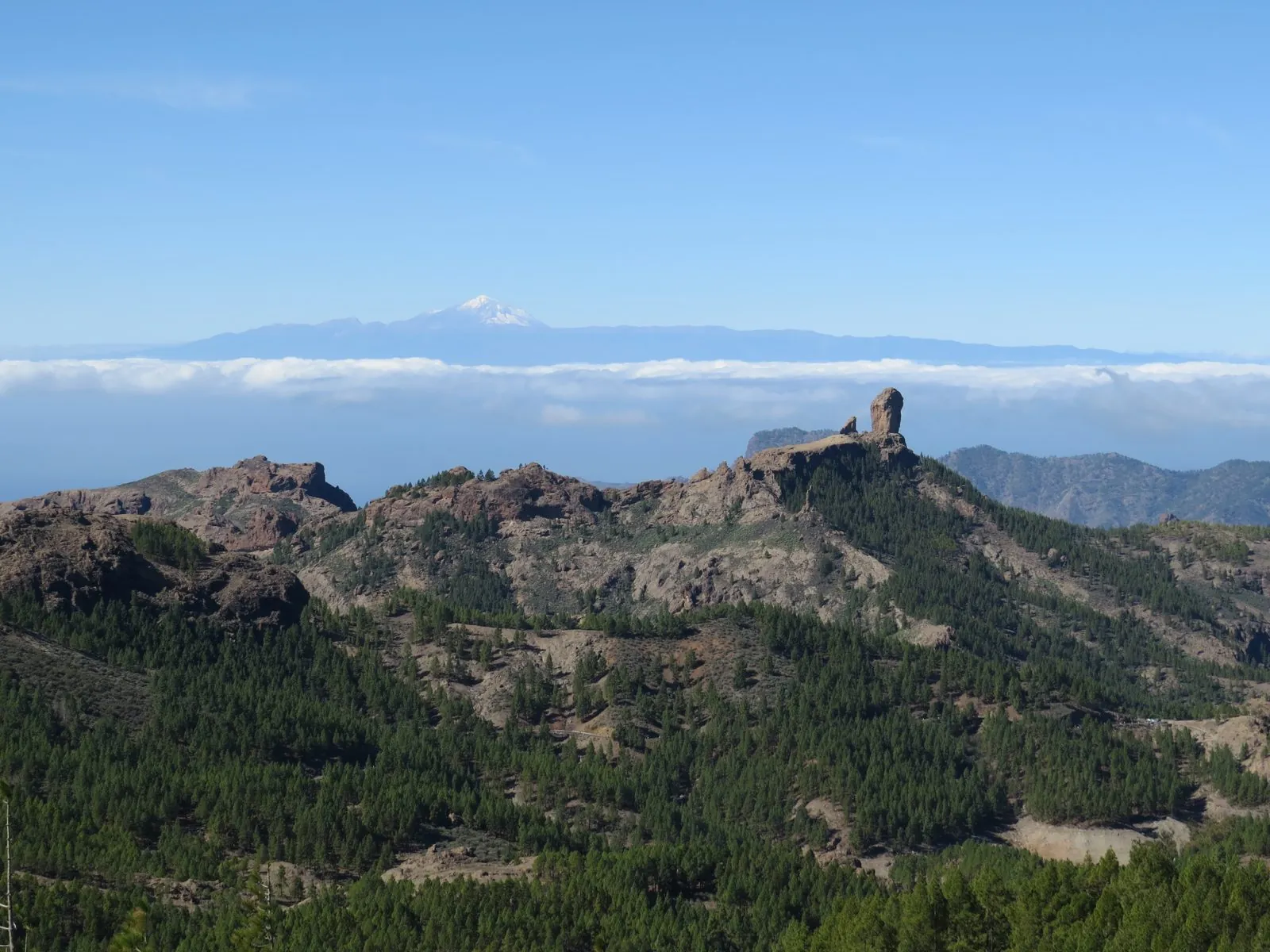
Photo: Basotxerri · CC BY-SA 4.0 · Wikimedia Commons · scaled
Pico de las Nieves and the peaks
Nearby, Pico de las Nieves is the island's highest point, a viewpoint you can drive to but also link on ridge walks through the summits. This whole central massif — Roque Nublo, Pico de las Nieves, the Roque Bentayga — is a knot of volcanic drama, and the trails between them offer some of the finest high-level walking in the Canaries, cool and pine-scented well above the coastal heat.
Cruz de Tejeda — the hub of the trails
The mountain pass of Cruz de Tejeda, above the whitewashed village of Tejeda, is the classic starting knot for the interior. Old cobbled royal paths (caminos reales) radiate out in every direction — down to villages like Artenara, across to Roque Nublo, or on long traverses through the peaks. It's the natural base for a walking day, with a couple of places to eat when you're done.
Tamadaba pine forest
In the north-west, the Tamadaba natural park is a magnificent stand of Canary pine clinging to cliffs high above the ocean. The loop trails through the forest are moderate and blissfully shady, ending at dizzying miradors that plunge straight down to the sea near Agaete. The scent of warm pine and the sound of the wind in the needles make this many walkers' favourite corner of the island.
Barranco de Guayadeque and Fataga
For a completely different feel, drop into the ravines. The Barranco de Guayadeque is a spectacular palm-filled gorge dotted with ancient cave dwellings — some still lived in, others turned into cave restaurants — with easy valley walks and a strong sense of the island's aboriginal past. Further south, the Barranco de Fataga, the so-called "valley of a thousand palms", threads down towards the coast past the pretty village of Fataga, an old caravan route now walked for its palms, terraces and huge rock walls.
Guayadeque and Fataga are far gentler than the peaks and make lovely half-days — ideal if you're based around Maspalomas or Playa del Inglés and want a taste of the interior without a big climb. Reward yourself with lunch in one of Guayadeque's cave restaurants.
Both ravines have a rich sense of history — Guayadeque was home to the island's aboriginal inhabitants, whose cave granaries and burial sites are still visible in the cliffs, while Fataga's terraces have been farmed for centuries. Walking them, you're following paths that islanders trod long before the resorts existed. A third ravine, the Barranco de los Cernicalos above Telde, is greener still: a rare year-round stream, willow woodland and small waterfalls on an easy there-and-back walk.
Guided or self-guided?
Gran Canaria's marked trails — Roque Nublo, the Tamadaba loops, the valley walks — are well suited to self-guided walking with a decent map or app. The network of old caminos reales around Cruz de Tejeda is more of a maze, though, and a local guide is worth it for the longer peak traverses, where transport back to your start and route-finding across the summits both add complexity. Guides also unlock the island's geology and aboriginal history, which turns a good walk into a memorable one.
Difficulty and when to go
| Route / area | Difficulty | Best for |
|---|---|---|
| Barranco de Guayadeque | Easy | Palms, cave houses, easy family walk |
| Tamadaba forest loops | Easy–moderate | Shady pines and clifftop miradors |
| Roque Nublo | Moderate (short, steep) | The classic first summit |
| Fataga valley | Moderate | Palm ravine, half to full day |
| Cruz de Tejeda peak traverses | Moderate–hard | Long ridge days in the summits |
You can walk year-round, but the highlands are cool and can be cloudy or windy while the south bakes — layers matter up top. Spring brings almond blossom and wildflowers around Tejeda; autumn is warm and settled. See our best time to visit guide for more, and note that the interior is genuinely chilly on winter mornings at altitude.
The sun and volcanic terrain are unforgiving. Carry plenty of water — refill points are scarce on the trail — wear a hat and strong sun cream, and start early. Proper boots with grip are essential on loose scree and rock; the short climb up Roque Nublo has real drop-offs at the top. Cloud can roll over the peaks quickly, so check the weather and tell someone your route.
A hire car is almost essential — most trailheads sit high in the mountains where buses barely reach. The winding GC-60 up to Tejeda is a beautiful, if slow, drive.
Gran Canaria really does pack a continent of landscapes into one small island, and the best of them are on foot. Go prepared, respect the sun and the rock, and browse more things to do to round out your trip.