Living in Tenerife means choosing between two very different lives on one island: the greener, cooler, Spanish-speaking north around Santa Cruz, La Laguna and Puerto de la Cruz, and the dry, sunny, international south around Adeje, Arona and Los Cristianos. A motorway joins them and the drive takes about an hour, but residents tend to settle firmly on one side, and the choice shapes everything from the weather on your terrace to the language you speak at the bakery.
Tenerife is the most populous of the Canary Islands, with a capital city, a university, two airports and a large settled foreign population, so most of what a household needs is on the island. What it does not have is cheap housing, empty roads or the seasons you grew up with. This page is about settling and day-to-day life; for choosing a hotel or apartment for a holiday, our page on where to stay in Tenerife is the one you want.
The residency paperwork itself (visas, the NIE, the padrón, health cover and the rest) is the same on every island and is set out step by step in our hub on moving to the Canary Islands. Here the question is a different one: once the papers are sorted, where on Tenerife will you be happy?
Two climates, two kinds of day
The island's spine, rising to Teide, splits the trade winds. On the north side the moist air piles up against the slopes and forms the cloud bank locals call the mar de nubes, the sea of clouds. Mornings in La Laguna can be grey and fresh even in summer, the hills are green with laurel and vines, and a jumper in the evening is normal for half the year. On the south side the same air has dropped its moisture, and the coast from Los Cristianos to Costa Adeje gets sun on most days of the year, with summer afternoons that are properly hot.
Newcomers usually think they want the south's weather and then discover what comes with it: a landscape of dry ravines, resort strips built for visitors, and much less shade. The north offers proper towns with markets, plazas and evening life that exists for locals, at the cost of more cloud and rain from November to March. Plenty of people live in one and spend their weekends in the other, which is easier than it sounds on an island this size.
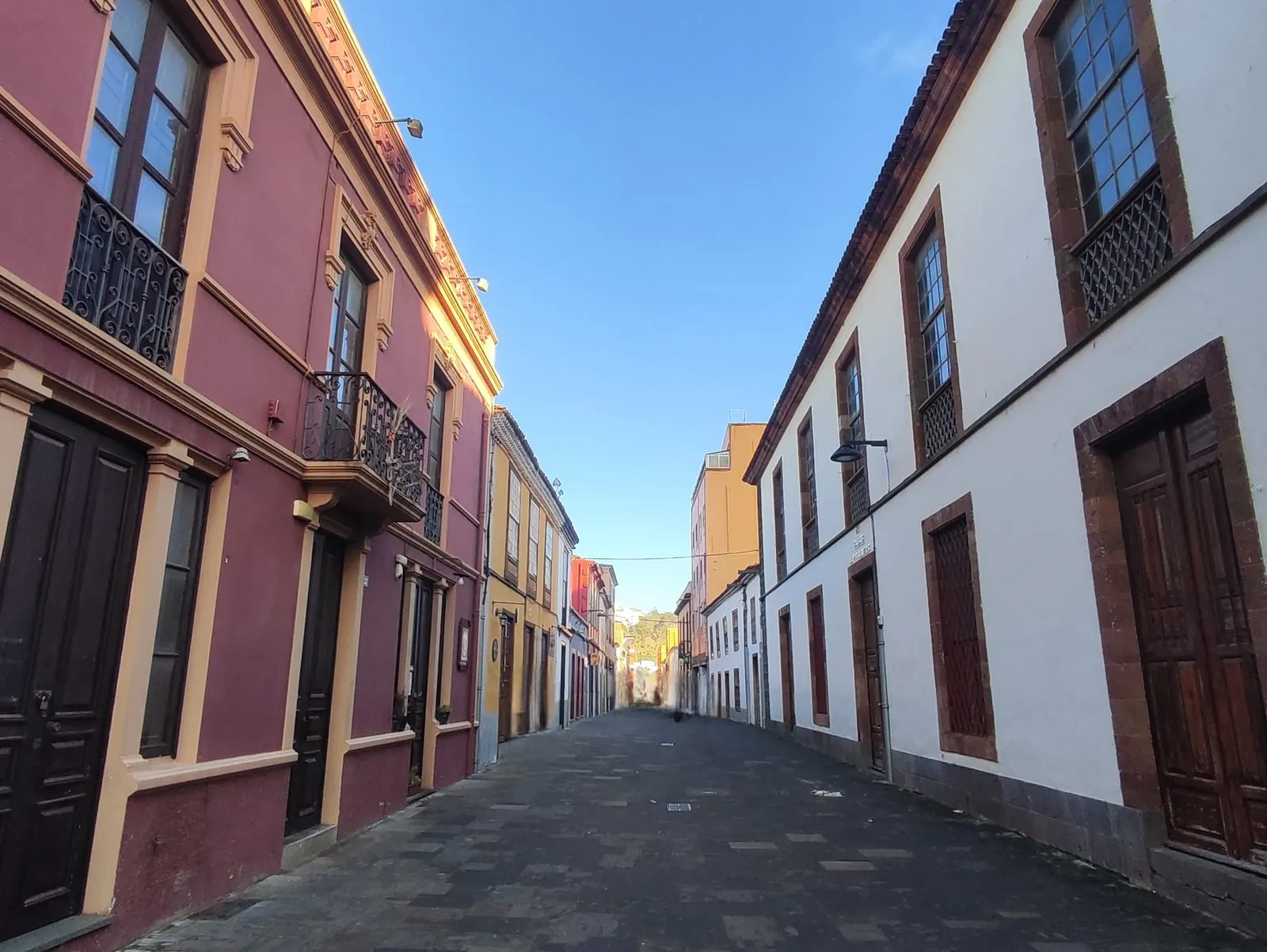
Photo: Mentxuwiki · CC BY-SA 4.0 · Wikimedia Commons · scaled
Where foreign residents actually live
The south-west is where the foreign population is concentrated. According to the Canary Islands statistics institute, ISTAC, as reported by Canarian Weekly in March 2025, residents born outside Spain made up 56.5 per cent of the population of Adeje on 1 January 2024, 51.8 per cent in Arona and 51.5 per cent in Santiago del Teide, which includes Los Gigantes and Puerto de Santiago. Across the island as a whole the figure was just under a quarter.
The British community is smaller than many people think, and shrinking. An EFE analysis of ISTAC figures, published by La Voz de Lanzarote in August 2026, found that Britons living in the Canaries fell from 28,995 in 2021 to 25,740 in 2025, dropping from the second-largest foreign group to the fifth. About half of them live in Tenerife, close to 40 per cent are over 65, and Adeje and Arona each lost several hundred British residents over those four years. Italians are now the largest foreign community in the archipelago, and in the south you will hear Italian in the cafés as often as English. The post-Brexit rules on residence, which turned UK nationals into third-country nationals from 2021, go a long way to explain the shift.
The north: cities, university towns and the Orotava valley
Santa Cruz, the capital, is a working port city with government offices, a seafront promenade, the big Carnival in February and the long sandy beach of Las Teresitas a short drive away. Next door, up the hill, San Cristóbal de La Laguna is a UNESCO-listed old town with the University of La Laguna, a student population and the island's liveliest bar scene on weekday nights. The tram between the two is the closest thing on the island to a city commute without a car.
Further west, Puerto de la Cruz was the north's original resort and still has an older British and German community, a compact, walkable centre and good bus links. Above it, La Orotava and Los Realejos are Canarian towns first and foremost, with banana terraces, steep streets and neighbours who will expect you to try your Spanish. Rents in the north are lower: the Fotocasa index reported by Diario de Avisos in July 2026 put asking rents in La Laguna at around €12.70 per square metre per month, against close to €20 in Adeje and Arona.
The south: sunshine, services and a resort economy
Most foreign residents in the south live between Los Cristianos and Costa Adeje, or in the quieter developments to the east such as Palm-Mar, Costa del Silencio, Golf del Sur and the windsurfing town of El Médano. Here you can run your life in English if you choose: estate agents, dentists, lawyers and builders advertise in it, and there are British and Irish pubs, shops and clubs. That is a comfort for some and a trap for others, because people who never need Spanish often never feel at home.
The south is where the jobs are, too, almost all of them in tourism, which means shifts, weekends and wages that are low by British standards. It is also where the housing squeeze bites hardest. Our page on renting long-term in the Canaries explains why year-round lets are so scarce in the resort municipalities and how the 2026 changes to Spanish tenancy law affect you.
Getting around
A car is close to essential outside Santa Cruz and La Laguna. The TF-1 motorway along the south and east coast and the TF-5 in the north carry most of the island's traffic, and the stretch into Santa Cruz and La Laguna at rush hour is famous for queues. Residents who commute from the south to the capital plan their day around it. If you move here with a UK licence, gov.uk's Living in Spain guidance says you can drive on it for six months after becoming resident and should apply to exchange it before that period is over; our page on driving in the Canaries covers the roads themselves.
The public network is better than its reputation. TITSA's green buses and the tram take the same ten+ card, as our page on buses in Tenerife explains, and residents have been able to travel free on certain multi-trip passes, funded by the Spanish state. Diario de Avisos reported in October 2026 that the scheme was guaranteed until 31 December 2026 but that no extension for 2027 had been confirmed, so check with TITSA before you plan your budget around it. The island has two airports: Tenerife South for most UK flights, and Tenerife North at Los Rodeos for inter-island and mainland routes.
Healthcare and the hospitals
Public healthcare in the islands is run by the Servicio Canario de la Salud. gov.uk's guidance on healthcare in Spain explains that once you are covered, through work, a UK-funded S1 for state pensioners, or the paid convenio especial after a year on the padrón, you register at your local health centre with your social security number and receive a health card. Your centro de salud is where you see a GP, and it is allocated by address, which is one more reason to register on the padrón promptly.
The island's two big public teaching hospitals, the Hospital Universitario de Canarias in La Laguna and the Hospital Universitario Nuestra Señora de Candelaria in Santa Cruz, are both in the north-east. Many southern residents, especially those with private insurance, use the private clinics and hospitals in the resort towns for everyday care. Pharmacies are everywhere and pharmacists give useful advice, as our page on pharmacies and medical care describes. Retirees will find the S1 and pension questions dealt with on our page about retiring to the Canaries.
Schools and family life
Children who move young usually settle fastest in the local state school, where lessons are in Spanish and follow the Canarian curriculum. Within a year most are fluent, often with the soft Canarian accent their parents never manage. Older children can find the jump harder, and families moving with teenagers often choose one of the private international schools on the island, several of which teach the British curriculum through to A levels. Fees vary widely. Before you commit, check that the school is recognised by the Spanish education authorities, and look for membership of the National Association of British Schools in Spain (NABSS), which inspects its members.
Family life outside school is outdoors. Weekends mean the beach, the pine forests above La Esperanza, the walking trails of Anaga Rural Park at the island's north-eastern tip, and, a few times a winter, a drive up to see snow on Teide.
Daily life and the rhythm of the week
Day-to-day shopping is at Mercadona, the Canarian chain HiperDino and the big supermarkets, with weekly farmers' markets for fruit and vegetables. Shops and offices still keep Spanish hours in many towns, closing in the afternoon and reopening in the evening, and public offices often work mornings only. Appointments for almost any official paperwork are made online through cita previa, and the slots fill up, so a good gestor is worth paying for.
The social calendar is local. Every town has its patron saint's fiesta, often with fireworks and a romería pilgrimage, and in the north the guachinches, informal wine-farm eateries open for a few months a year, are a weekend institution. Several times a year the calima, dust blown in from the Sahara, turns the sky orange and sends everyone indoors for a day or two. Learning Spanish changes all of this from scenery into life. Neighbours in the north will forgive any amount of bad grammar, but not silence.
What people love, and what they miss
Ask long-term residents what keeps them here and the answers are consistent: the climate, an outdoor life all year round, the sea, the mountains an hour away, and a pace of life that leaves room for an evening walk. Many say the island made them healthier. Flights home are frequent from Tenerife South, which makes the distance from family easier than it is from most places this warm.
What they miss is just as consistent. Family and grandchildren come first, followed by the change of seasons, a choice of well-paid work, and the ease of a bureaucracy in your own language. Some find that an island, even a big one, starts to feel small after a few years. The rising cost of housing has added a new item to the list, and it is the main reason some people who arrived ten years ago are now leaving, and our page on the cost of living in the Canaries puts numbers on the rest of a household budget.
Choosing your side of the island
If you want guaranteed sun, an English-speaking network and easy access to the airport most UK flights use, the south-west between Los Cristianos and Adeje is the obvious choice, as long as you accept resort life and high rents. If you want a real Spanish town, cooler summers, cheaper rents and a city within reach, look at La Laguna, Santa Cruz, Puerto de la Cruz or the Orotava valley, and learn Spanish from the first week. The best advice from people who have done it is the same either way: rent for a year on the side you think you prefer, spend weekends on the other, and only then decide where on Tenerife you want to stay.