The best way to spend a week in Gran Canaria is to split it: three nights in Las Palmas in the north, four in the sunny south, with a hire car for the four middle days that take you along the north-west coast, over the summit to Roque Nublo and out to the empty west. That order puts the city and the mountains early, while you have energy, and leaves the beach and the dunes for the second half, when you want to slow down. No single drive in the plan is longer than about an hour and a quarter.
Most visitors never see half of this island. They land, take the motorway south, and spend the week between Playa del Inglés, Maspalomas and Puerto de Mogán, which is a perfectly good holiday but a narrow one. The north has a real Spanish city with a beach in the middle of it, the interior climbs to almost 2,000 metres, and the west coast is a road of cliffs and ravines with hardly a hotel on it. A week is just enough to see all of it without feeling hurried.
What follows is a day-by-day plan with honest driving times, one day set aside to do nothing but lie on a beach, and a list of what to book before you fly. One thing has changed recently that older guides miss: since February 2025 you need a reservation to walk to Roque Nublo during the day, and you can no longer park at the start of the path.
Two bases, one change of hotel
Changing hotel mid-week costs you a morning, but on Gran Canaria it saves far more than it costs. Las Palmas is the natural base for the north and the north-west: Vegueta, the Canteras beach, Teror, Arucas, Gáldar and Agaete are all within 45 minutes of the city. The south is the base for the dunes, the marinas and the west coast, and it has the sunshine, since the north is often under a layer of trade-wind cloud in the morning while the south is clear.
In the city, stay close to Las Canteras rather than in the old town. The beach district has the hotels, the restaurants that stay open late and the promenade, and the yellow city buses run from there down to Vegueta in about a quarter of an hour. In the south, Maspalomas and Meloneras suit couples and families who want to walk to the beach, while Puerto de Mogán is prettier and quieter but adds 25 minutes to every drive east. Our page on where to stay in Gran Canaria compares the resorts in more detail.
If you would rather not move at all, base yourself in the south and add 50 minutes each way to the two city and north-coast days. It works, but you will spend those evenings in a resort rather than in a city that actually comes alive after dark.
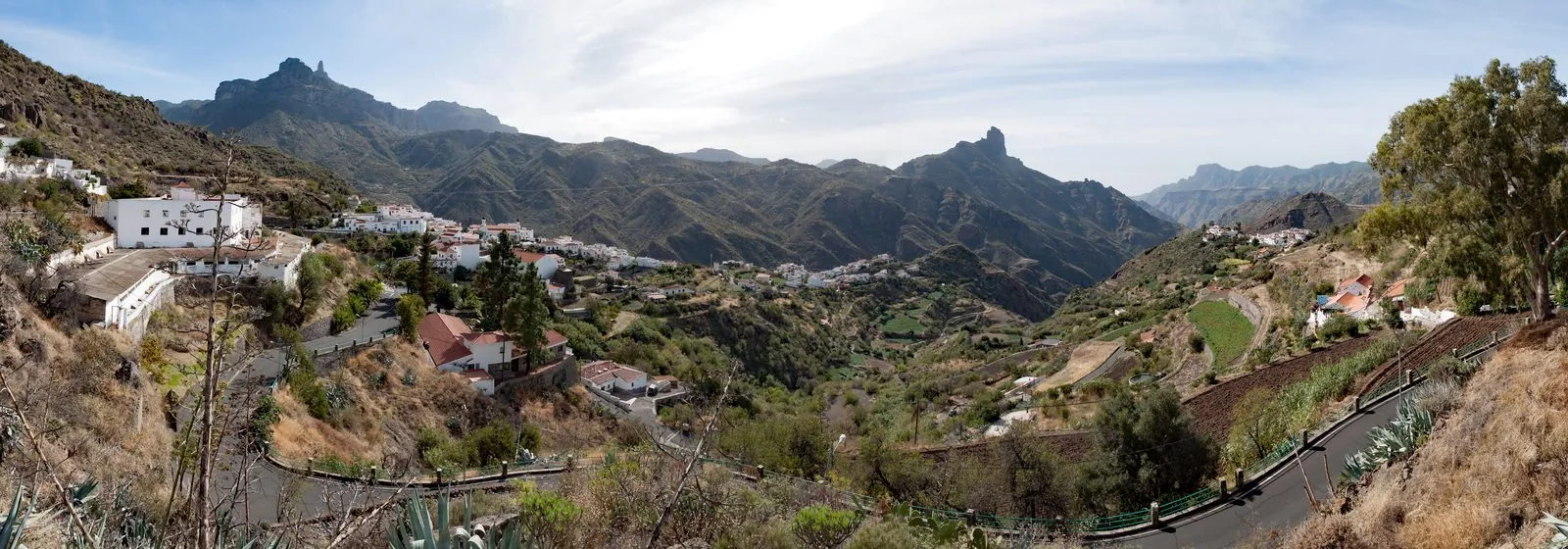
Photo: H. Zell · CC BY-SA 3.0 · Wikimedia Commons · scaled
Driving times you can trust
Gran Canaria is round and roughly 50 kilometres across, which makes it sound small. The motorways around the east side are fast, but anything that climbs into the centre is slow, twisting and often single-file behind a bus or a cyclist. These are typical times without stops, outside the weekday rush hour into Las Palmas.
| Route | Typical time | Road |
|---|---|---|
| Airport to Las Palmas (Canteras) | 20–30 min | GC-1 motorway |
| Airport to Maspalomas | 25–35 min | GC-1 motorway |
| Las Palmas to Maspalomas | 45–60 min | GC-1 motorway |
| Las Palmas to Agaete | 35–45 min | GC-2 coast road |
| Las Palmas to Teror | about 30 min | GC-21, winding |
| Teror to Cruz de Tejeda | 35–45 min | GC-21 and GC-15, mountain |
| Tejeda to Maspalomas via Fataga | about 1 hr 15 min | GC-60, mountain |
| Puerto de Mogán to La Aldea | about 1 hr | GC-200, mountain |
Add a third to any mountain time if you are not used to hairpins, and do not plan to cross the summit after dark on your first visit. Most hire firms on the island are honest and cheap, but read the fuel and excess terms before you sign; our page on hiring a car in the Canaries covers the traps.
Days 1 and 2: Las Palmas, the old town and the city beach
Day 1: arrive and walk the Canteras promenade
Take a taxi or the airport bus into the city and spend the first afternoon on foot. The promenade along Playa de las Canteras runs for about three kilometres, and a natural reef called La Barra lies a few hundred metres offshore, which is why the water inside it is so calm at low tide. Walk south towards the Auditorio Alfredo Kraus at sunset, when half the city seems to be out doing the same, and eat at one of the places at the quieter southern end.
Day 2: Vegueta and Triana
Spend the morning in the old quarter where the city was founded in 1478. The lanes of Vegueta hold the Cathedral of Santa Ana, whose tower you can go up for a view over the rooftops, the Casa de Colón with its story of Columbus's stopovers, and the Museo Canario's collection on the island's first inhabitants. Cross the dual carriageway into Triana for lunch and the pedestrian shopping street. Leave the car-free day as it is: you do not need a car in the city, and parking near Vegueta is scarce and metered. The city buses are covered on our page about getting around by Global and the city buses.
Collect the car on the morning of day 3, not at the airport. Several hire firms have desks in Las Palmas, and picking up in the city saves you two nights of hotel parking charges and the stress of finding a space near the beach. Return it at the airport on your last day.
Day 3: the north-west coast to Gáldar and Agaete
Drive west along the GC-2, which runs between the cliffs and the sea with banana plantations on the slopes above. Stop in Arucas if you want to see its oversized neo-Gothic church in dark volcanic stone, then continue to Gáldar, the old seat of the island's pre-Hispanic rulers. The Cueva Pintada archaeological park is the best single place on the island to understand who the ancient Canarians were: a painted chamber with geometric patterns in red, black and white, and the excavated remains of the village around it, seen on a guided visit.
Lunch belongs in Agaete and its harbour, Puerto de las Nieves, where the fish restaurants face the ferry quay and the cliffs of Tamadaba. The rock pillar called the Dedo de Dios, the Finger of God, stood off this coast until a storm in November 2005 snapped off its tip, and locals still talk about the coast "before Delta". After lunch, swim in the natural rock pools at the far end of the harbour, then finish the day at Sardina del Norte, a small cove a few minutes north of Gáldar that faces due west, so the sun sets straight into the sea. Back to Las Palmas takes about 40 minutes.
Day 4: over the summit to Roque Nublo
This is the big day, and the one where you change base. Check out early and drive up to Teror, half an hour inland, for its balconied main street and the basilica of the island's patron saint. If you are there on a Sunday, the market around the church is busy and worth the slower start. From Teror the road climbs through small farms and then pine forest to Cruz de Tejeda, a pass at about 1,500 metres where you look down into the great eroded basin of the Caldera de Tejeda, and on to Tejeda village itself for almond sweets and lunch with a view.
From there it is a short drive to the Cruz de los Llanos car park and the walk to Roque Nublo, the 80-metre basalt monolith that is the island's symbol. The path is about 1.5 kilometres each way and suits anyone reasonably fit. Afterwards, the highest point of the island, Pico de las Nieves at almost 1,950 metres, is ten minutes' drive away, and on a clear afternoon you can see Teide on Tenerife floating over the clouds. Then take the GC-60 down through Ayacata, San Bartolomé and the palm valley of Fataga to the south coast, arriving in time for dinner.
No reservation, no Roque Nublo between nine and five. Since 2 February 2025 the Cabildo has required a free advance booking for anyone entering the path at the Degollada de La Goleta during the day, with places released in groups of 60 per hour, and the parking at La Goleta has been removed for good, except a short-stay allowance for people with reduced mobility. You park at Cruz de los Llanos or in Tejeda and take Global's line 18 shuttle, about ten minutes from Cruz de los Llanos, or walk roughly an hour. Sources differ on the last daytime slot (elDiario.es gives 17:00, RTVC 16:00), so check the booking site before you go; in August 2026 RTVC reported some days selling out. Outside the controlled hours no booking is needed.
Do not leave suitcases visible in the car at a mountain car park on moving day. Put everything in the boot before you leave the hotel, not when you arrive.
Day 5: the easy day, dunes and nothing else
After two long drives, park the car and stay put. Get up early and walk into the Maspalomas dunes from the lighthouse end or from the Playa del Inglés side before nine, when the sand is cool and the ripples are unmarked by footprints. The dunes are a protected natural reserve, and you are asked to keep to the marked routes; the walk across to the sea takes about half an hour. Then spend the rest of the day on the beach itself, which runs for several kilometres from the lighthouse towards Playa del Inglés.
By early afternoon the sand inside the dunes is too hot to cross barefoot and the trade wind picks up, so stay by the water and take shelter behind a windbreak. In the evening, walk the promenade from the lighthouse to Meloneras. That is the whole day, and it is the one most people remember fondly.
Day 6: the wild west on the GC-200
From the south, drive to Puerto de Mogán for a coffee by the marina before the coach trips arrive, then take the GC-200 inland through Mogán village and north towards La Aldea de San Nicolás. This is one of the great drives of the Canaries: a narrow road that climbs over the ridges between deep ravines, with the Atlantic appearing and disappearing on the left. About halfway, look out for the Fuente de los Azulejos, a road cutting where hot water once altered the volcanic rock into bands of green, turquoise and ochre. Pull in only where there is a proper lay-by.
La Aldea is a farming town of tomatoes and greenhouses, and its harbour at the end of the valley has a pebble beach and a couple of fish restaurants for lunch. Drive back the same way in the afternoon, about an hour to Mogán, with the sun behind you. If the twisting road is not for you, spend the day on a boat trip from Puerto de Mogán instead.
Day 7: a slow last morning
Keep the final day local. Arguineguín, the old fishing town between Maspalomas and Mogán, is good for an early lunch of whatever the boats brought in, and the sheltered beach at Amadores is ten minutes away for a last swim. The airport is roughly half an hour from Maspalomas and 40 to 45 minutes from Puerto de Mogán on the GC-1. Allow extra time to refuel, because the hire car must usually go back full, and return it at least two hours before an international flight.
What to book before you fly
- The Roque Nublo slot. Book as soon as your dates are fixed, especially for a weekend or school holiday. The daytime booking is mandatory; the day you are crossing the summit is your fixed point.
- The hire car. Reserve for days 3 to 7 with free cancellation. Winter weeks and Easter sell out.
- The Cueva Pintada. Visits are guided and in groups, the museum is closed on some days, and English-language tours are fewer than Spanish ones, so check the museum's own site and book a time.
- Dinner on Friday and Saturday in Las Palmas. The good places on the Canteras front fill with locals at weekends.
- Not needed in advance: the dunes, Teror, Vegueta's streets and the west-coast drive, all of which are free and open.
If your week coincides with carnival in February or early March, book the Las Palmas hotel very early: the city fills and prices rise sharply.
Is a week enough for Gran Canaria?
A week is the right length for a first visit, as long as you split it. Three nights in the city give you Vegueta, the Canteras beach and the north coast at an easy pace; four in the south give you the summit, the dunes and the west, with one day in the middle that asks nothing of you. Book the Roque Nublo slot before anything else, pick the car up in the city rather than at the airport, and do the mountain drives in daylight. Do it that way and you will leave having seen the island that most of its visitors fly over on the way to the beach.