Almond blossom season in the Canary Islands usually runs from late January to late February, and the best places to see it are Tejeda and Valsequillo on Gran Canaria, Santiago del Teide on Tenerife and Puntagorda on La Palma. For a few weeks the terraced slopes of these mountain villages turn pink and white, and each village holds a festival around the flowering, with food stalls, folk music and guided walks. The exact dates change every year, because they follow the trees rather than the calendar.
It is a quiet, rural spectacle rather than a big event. The almond trees grow on old farm terraces at around a thousand metres, well above the resorts, where winter mornings are cold and the light is clear. You drive up from the coast in an hour or less, walk among the trees, eat something sweet made from last year's crop, and come back down to the beach the same afternoon.
This page covers when the trees flower, the four festivals and how their dates are set, the best walks, and how to get there without spending the day in a queue of cars on a mountain road.
When the almond trees flower
The flowering starts in the second half of January in a mild year and is usually at its peak in late January and the first half of February. By early March most of the petals are gone. Lower and sunnier slopes flower first; trees higher up and in colder hollows follow a week or two later, which is why a valley can look patchy, with one terrace in full bloom and the next still bare.
The weather moves it. A warm, dry winter can bring the blossom forward, while a run of cold, wet days can delay it or knock the petals off early. Strong wind does the same. There is no reliable forecast for the peak, so the festival organisers watch the trees and set their programmes accordingly, and a trip in the first two weeks of February is the safest bet. If you are planning a winter holiday around it, our pages on the Canaries in January and the Canaries in February cover the weather on the coast.
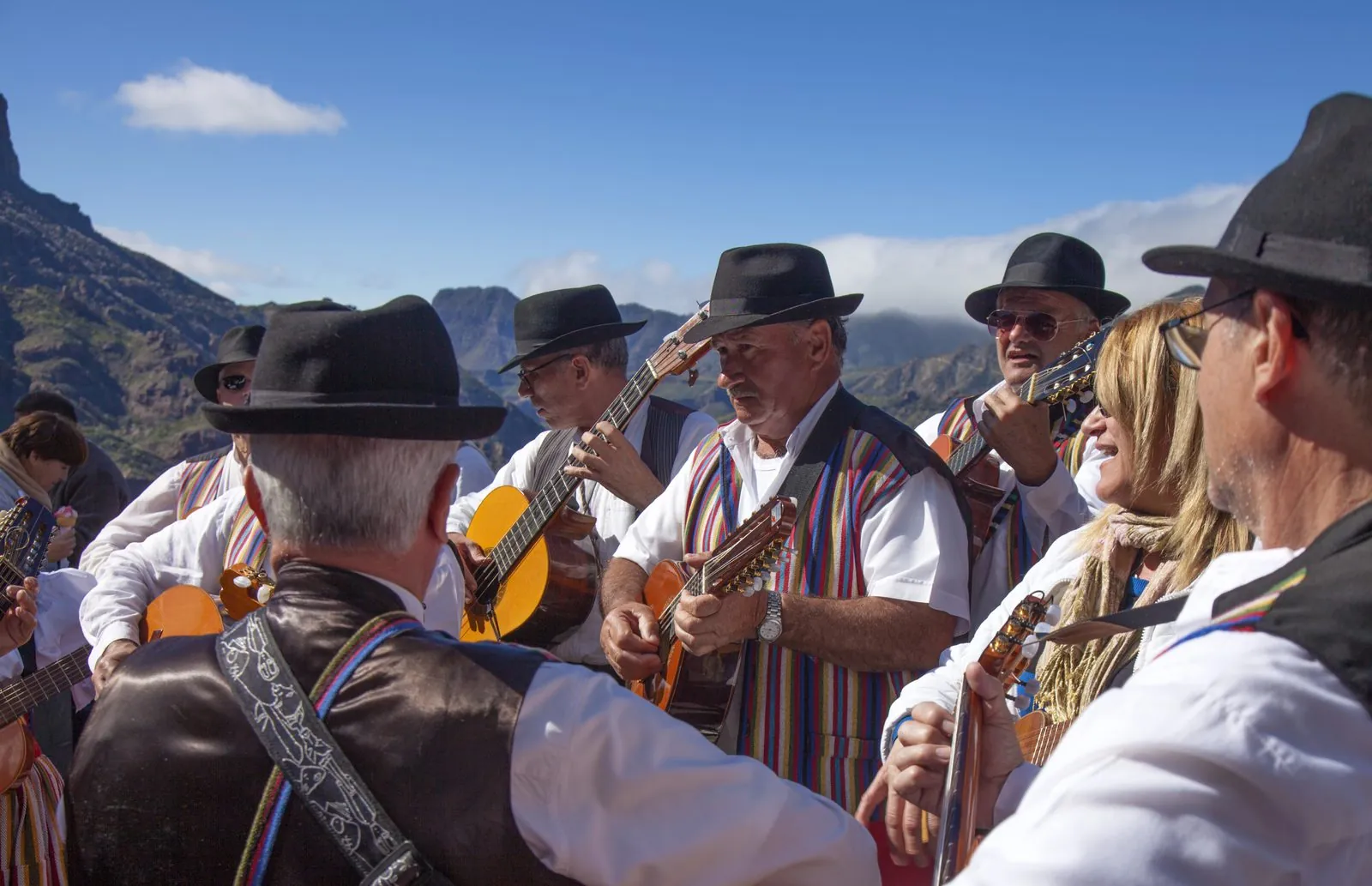
Photo: Tamara Kulikova · CC BY-SA 4.0 · Wikimedia Commons · scaled
The four festivals, and how their dates move
Each village runs its own celebration, and the dates are announced only a few weeks ahead. The 2026 editions give an idea of the pattern, but the 2027 dates had not been published in November 2026, so check the town hall's website or social media before you book anything around them.
| Village | Island | Event | 2026 dates |
|---|---|---|---|
| Tejeda | Gran Canaria | Fiestas del Almendro en Flor, 53rd edition | 31 January to 8 February |
| Valsequillo | Gran Canaria | Ruta del Almendrero en Flor | 30 January to 1 February |
| Santiago del Teide | Tenerife | Campaña Almendro en Flor, 29th edition | 24 January to 22 February |
| Puntagorda | La Palma | Fiesta del Almendro en Flor | 23 January to 1 February |
Dates are from the published 2026 programmes. Expect the 2027 festivals to fall in similar weeks, but not on the same days.
Tejeda: the big one
Tejeda, in the mountain heart of Gran Canaria, has held its almond festival for more than half a century, and it is the largest and best known. The festivities run over about a week, but the main action is on the final weekend. In 2026 the Saturday brought food stalls in the village streets, Canarian wrestling, the shepherds' pole-vault known as salto del pastor, stick-fighting displays and folk music from morning to night, and the Sunday a traditional procession with offerings, more food and live music. A trail race through the almond groves opened the programme the weekend before.
The setting does half the work. The village sits on a ridge looking across the Caldera de Tejeda to Roque Bentayga and, above, Roque Nublo, and the almond terraces drop away below the houses. Tejeda is also the island's almond capital in the kitchen: its bakeries are known for almond sweets, from marzipan and nougat to bienmesabe, the almond cream described on our page on Canarian desserts. Buy them from the village's own workshops rather than the souvenir shops on the coast.
Do not drive up at midday on the festival Saturday. Parking in Tejeda is very limited and the access roads are narrow mountain bends. On the main days, arrive early in the morning or use the shuttle buses the council sometimes lays on, and leave before the evening crowds start heading down in the dark.
Valsequillo: the almond route nearer the city
Valsequillo, on the eastern side of Gran Canaria's mountains, is the closest almond area to Las Palmas and the airport. Its festival takes the form of a route through the hamlets above the town, especially around Tenteniguada, with walks, a market and local produce, and in 2026 it ran for a single long weekend at the end of January. The trees here often flower a little earlier than those around Tejeda.
Notice the name of the event. On the mainland the almond tree is an almendro; in the Canaries country people call it an almendrero, and Valsequillo keeps the island word in its festival title. It is a small thing, but it is the kind of detail that tells you this is a farmers' celebration rather than a tourist invention. It makes an easy half-day from the capital or the east coast.
Santiago del Teide: walking among the trees and the lava
On Tenerife the almond season belongs to Santiago del Teide, the municipality in the west of the island between Teide and the cliffs of Los Gigantes. Its campaign, run by the town hall since 1998, is the longest of the four: in 2026 it lasted almost a month, with guided walks through the almond groves and to heritage sites, family walks, craft and food markets and a photography competition, spread across Santiago del Teide itself, Valle de Arriba, Arguayo, Tamaimo and El Retamar.
What sets it apart is the volcano. One of the guided routes in the programme goes to Chinyero, the cone that erupted in 1909, the most recent eruption on Tenerife. Its lava flow stopped short of Valle de Arriba, and local tradition holds that it halted after villagers carried out a statue of Christ in procession. Walking from blossoming terraces onto black lava in the same morning is something no other almond festival offers; our page asking whether the volcanoes are still active explains where Chinyero fits in the island's history.
Santiago del Teide is also the junction for the road down to Masca, so a blossom walk combines naturally with that village, though the gorge path has its own booking rules.
Puntagorda: La Palma's own almond festival
Most guides stop at Gran Canaria and Tenerife, but the north-west of La Palma has its own almond tradition. Puntagorda, a scattered municipality of farms and pine woods above the island's wild north-west coast, holds a Fiesta del Almendro en Flor that in 2026 ran for ten days at the end of January, mixing culture, food, sport and an open-air dance. It is the smallest and least visited of the four, and if you are already on La Palma in late January it is well worth the drive.
The best walks for blossom
You do not need to join a festival to see the trees. Almond terraces line many of the paths through Gran Canaria's interior and the west of Tenerife, and in February they are at their prettiest. A few practical suggestions:
- Around Tejeda: the old paths that drop from the village into the caldera pass through almond terraces with Roque Bentayga ahead. Our guide to hiking on Gran Canaria has the longer routes.
- Valsequillo and Tenteniguada: gentler walking on farm tracks below the summit ridge, easy to shorten.
- Santiago del Teide: the almond route around the village and Valle de Arriba, and the longer walk to Chinyero through pine forest and lava. Join a guided walk in the campaign programme if you want local knowledge.
Take layers. At a thousand metres a February morning can be close to freezing, cloud can roll in from the north at any time, and the sun is strong once it clears. Good shoes matter on the old stone paths, which are steep and loose in places.
Getting there and getting back
A hire car is the easiest way to reach all four areas. Tejeda is reached from Las Palmas on the GC-15 through Vega de San Mateo, or from the south on the GC-60 through Fataga and San Bartolomé; both are slow, winding roads, so allow around an hour from either coast. Santiago del Teide is about half an hour inland from Los Gigantes and Puerto de Santiago. Our advice on driving in the Canary Islands covers mountain roads, which are narrow, busy with cyclists at weekends and best driven slowly.
Buses do reach Tejeda and Santiago del Teide, but services are infrequent and the last ones down leave early, so check the island timetables before relying on them. Coach tours from the resorts sometimes add almond blossom stops in February. If you would rather stay up in the hills, the historic parador at Cruz de Tejeda is described on our page about paradores and historic hotels.
Making the most of a short season
Almond blossom is one of the best reasons to leave the coast in winter. Aim for the first half of February, go on a weekday morning if you want the terraces to yourself, or on a festival weekend if you want music, wrestling and almond sweets with the flowers. Tejeda is the classic choice, Santiago del Teide the best for walkers, Valsequillo the easiest from Las Palmas, and Puntagorda the one almost nobody outside La Palma has heard of.
Whichever you pick, check the year's dates shortly before you go and be ready to move your plans by a week. The trees, not the town halls, decide when the season starts, and they have never been known to read a programme.