The wild canary is a small, streaky, yellow-green finch that lives in the Canary Islands, Madeira and the Azores, and it is the ancestor of every yellow cage canary in the world. In the wild it is not bright yellow at all. Males are olive-green above with dark streaks and a yellowish face and breast; females are greyer and duller. What it shares with its domestic descendants is the song, a fast, silvery, tumbling twitter that you will hear in gardens, orchards and ravines across the western islands.
Scientists call it Serinus canaria, and in English it is often called the Atlantic canary to separate it from the pet. It is common, unafraid of people and easy to find once you know what to look and listen for. Many visitors hear one every day of their holiday without realising what it is.
This page explains how to recognise the wild bird, where it lives island by island, how and when to find it, and how a modest green finch from a few Atlantic islands became the most famous cage bird on earth. The question of whether the islands were named after the birds or the other way round is settled on our page about the flag and the island symbols: the bird took its name from the islands.
How to recognise one
A wild canary is about 10 to 12 cm long and weighs around 15 g, roughly the size of a blue tit but slimmer. The male has a yellow-green forehead, face and underparts, a greyish-green back with dark streaks, darker wings and a dull yellow rump that shows when it flies away from you. The female is greyer on the head and breast, with less yellow underneath. Young birds are brownish and heavily streaked, and can be confusing in late spring and summer.
Its bill is short, stubby and pale, the bill of a seed-eater. In flight canaries look small and bouncy, often travelling in loose groups and calling constantly as they go. British birdwatchers will find them reminiscent of the European serin or a small, streaky greenfinch; the canary is about a tenth larger than a serin and has less contrast and more grey and brown in its plumage.
The song is the giveaway. Males sing from treetops, wires and television aerials, and in display flights with slow, fluttering wingbeats. It is a long, rapid, silvery jumble of trills and twitters, recognisably the sound of a pet canary but lighter and less polished. Once you have learned it, you will start hearing it in hotel gardens and town squares.
Where it lives, island by island
The species is found only in Macaronesia: the Canary Islands, Madeira and the Azores. In the Canaries it is common on Tenerife, La Gomera, La Palma and El Hierro, more local on Gran Canaria, and rare on Lanzarote and Fuerteventura, where it has only recently begun to breed in small numbers. The estimated population in the Canaries is in the order of 80,000 to 90,000 pairs, with a further 30,000 to 60,000 pairs in the Azores and a few thousand in Madeira.
That distribution follows the water. The canary needs trees and shrubs for nesting, and green ground with weeds and grasses for seed, so it thrives on the higher, wetter western islands and struggles on the dry eastern ones. If you are staying on Lanzarote or Fuerteventura, you are unlikely to see one; on Tenerife or La Gomera you would have to try hard to miss it.
It is a national symbol, not just a pet's ancestor. In 1991 the Canarian parliament chose the wild canary, together with the Canary Island date palm, as the natural symbols of the archipelago as a whole. Each island got its own pair of symbols, but these two represent all of them.
The habitats that suit it
Canaries are birds of semi-open country with scattered trees: orchards, terraced farmland gone a little wild, the edges of woodland, ravines with willows and palms, and parks and gardens in towns. They occur from sea level to well above 1,500 metres, in both pine forest and laurel forest, but they are most at home where trees break up into clearings and cultivated ground. Dense, dark laurel forest and closed pine plantations hold fewer of them than the edges around them.
That makes them a bird of the boundaries. In the Canary pine zone, described on our page about the Canary pine and its forests, look for them in open stands, around picnic areas and where the forest meets fields. In the north of Tenerife and on La Gomera they are common in the farmland and gardens below and around the laurel forests, especially where there are figs, fruit trees and weedy terraces.
Where to see and hear them
You do not need to travel far. On Tenerife, the gardens and older parks of Puerto de la Cruz and La Orotava are reliable, and the botanical garden at Puerto de la Cruz is a pleasant place to watch them feeding at close range. The farmland and ravines on the edge of Anaga Rural Park, around the villages and terraces rather than in the dense forest, are also good.
On Gran Canaria, where the bird is more local, the stream and willows of the Barranco de los Cernícalos are one of the classic spots, and the walk there is worthwhile in its own right. On La Gomera canaries are everywhere in the terraced valleys, from Hermigua and Agulo to Valle Gran Rey, and around the edges of Garajonay National Park. La Palma and El Hierro have them in villages, orchards and around the forest margins.
For a full list of island specialities to look for at the same time, including the blue chaffinch, the laurel pigeons and the Canary Islands chiffchaff, see our page on birdwatching in the Canary Islands.
Listen first, then look up. Canaries feed on the ground and in low weeds, where their streaky backs vanish against the soil. The easiest way to find one is to follow the song to a singing male on a treetop, aerial or wire, then scan the ground beneath for the rest of the flock. Early morning and late afternoon are the liveliest times.
A year in the life of a wild canary
Wild canaries eat mainly seeds, especially of weeds and grasses, and they are fond of figs. They also take buds, other plant material and small insects, especially when feeding young. Outside the breeding season they gather in flocks that roam farmland and scrub, often mixed with other finches.
Breeding in the Canaries runs roughly from January to July, much earlier than in northern Europe. Pairs often nest in loose groups, each defending only a small area around the nest. The nest is a neat cup hidden in the foliage of a tree or shrub, usually 3 to 4 metres off the ground, and the female lays three or four pale blue or blue-green eggs with darker markings. Incubation takes about two weeks, the young leave the nest a couple of weeks later, and a pair may raise two or three broods in a good year. That is why a winter or spring visit is the best time to hear the song at full strength.
From island finch to the world's cage bird
Canaries reached Europe soon after the conquest of the islands in the fifteenth century, carried by Spanish and Portuguese sailors. They were prized for their song long before anyone cared about their colour. Spain tried to keep the trade to itself: breeders and dealers exported only male birds, which sang, and kept the females at home, so that nobody abroad could breed them.
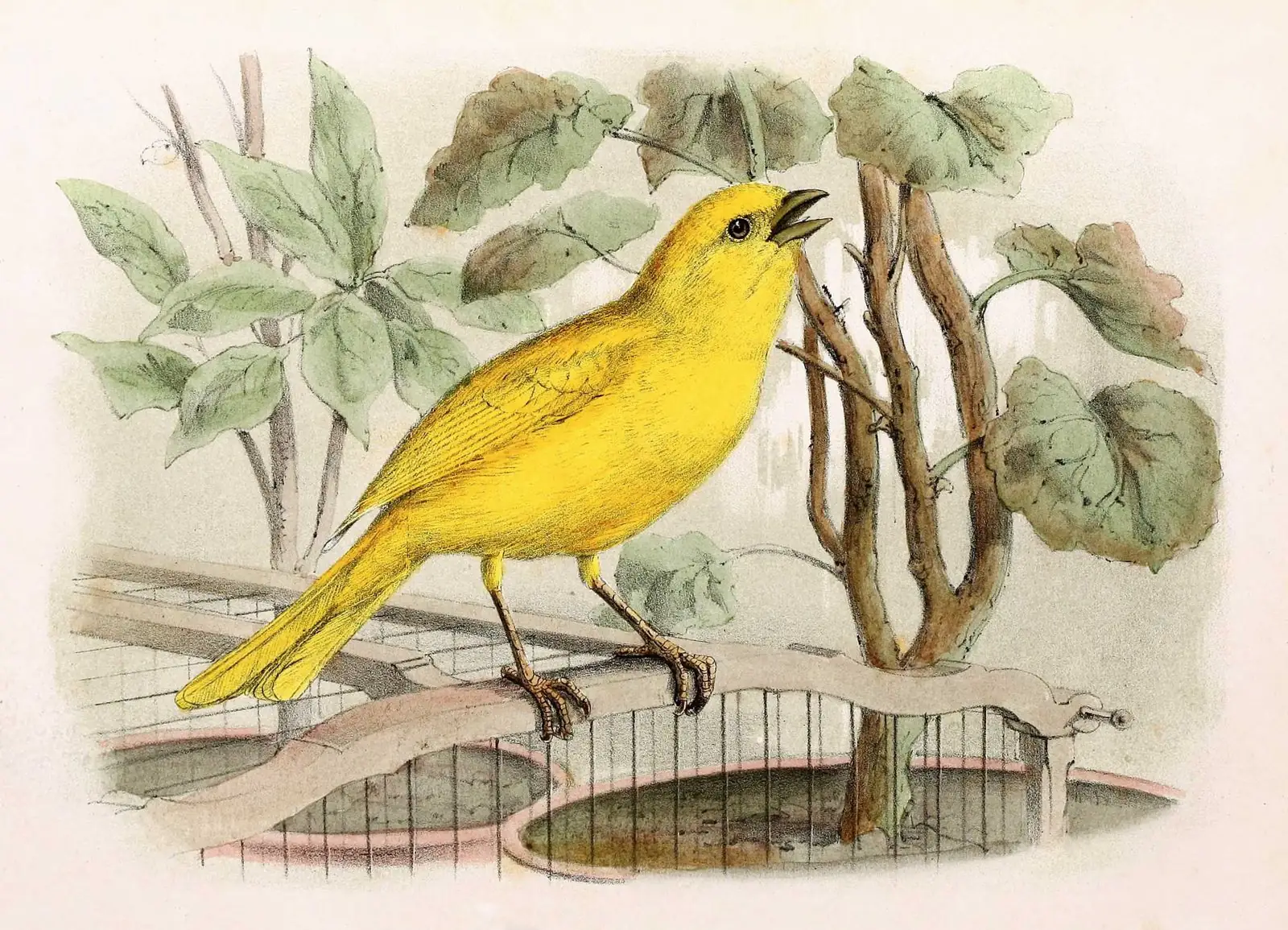
The monopoly did not last. A story recorded by an Italian writer in 1622 tells of a ship carrying canaries that was wrecked near Livorno around 1550, with the birds escaping to Elba and breeding there. Whether or not that is true, captive breeding spread through Italy and then to the German-speaking lands, where breeders in Tyrol were active by about 1600. Somewhere between about 1610 and 1677, birds with yellow plumage appeared in captivity, the result of a mutation that suppressed the dark pigments of the wild bird. From then on, canaries were bred for colour and shape as well as song, and "canary yellow" entered the language.
In the Harz mountains, German breeders developed the Harz Roller, the first canary bred specifically for its song, and exported it to Britain. English breeders concentrated on colour and pattern, producing breeds such as the Lizard, which has existed in its present form since the early eighteenth century. Spain later produced its own song breed, the Spanish Timbrado, developed in the early twentieth century from crosses with wild canaries, so in a sense the wild bird's voice came back into the cage.
The canary in the coal mine, and further afield
The bird's best-known working role was underground. From around 1900, British miners carried canaries into the pits, because the birds were more sensitive than people to carbon monoxide and would show distress before the gas reached dangerous levels for the men. The practice was phased out in British mines in 1986, when electronic detectors replaced them, and the phrase "canary in the coal mine" outlived the job.
People also took the wild-type bird around the world. Canaries were released on Midway Atoll in the Pacific in 1911 and are still established there. A population introduced to Bermuda in 1930 died out by the 1960s, after scale insects devastated the Bermuda cedars it depended on. Escaped cage birds turn up in many countries, but outside Macaronesia the canary has rarely managed to hold on for long.
On the islands themselves, catching wild finches to keep in cages was a common rural pastime for centuries. Today the capture of wild birds is tightly restricted under Spanish and EU wildlife law, and the old trapping tradition has largely died out. If you are ever offered a "wild" canary for sale, say no.
Finding the original canary
The wild canary is a small green finch with a big voice, common on the western Canary Islands and rare in the east, at home in gardens, orchards, ravines and forest edges rather than deep in the woods. Visit Tenerife, La Gomera or La Palma between January and early summer, listen for that tumbling silvery song from a treetop, and you will have found the bird behind every yellow canary on earth, still looking exactly as it did before Europe ever saw it. For the other animals that share its islands, our overview of wildlife in the Canary Islands is the place to continue.