Step into a Canarian laurel forest and you step back in time — millions of years back. Cool, green, dripping with moisture and wrapped in mist, the laurisilva is a survivor from a warmer, wetter age when forests like these covered much of southern Europe and North Africa. The great climate shifts that turned the Mediterranean dry wiped them out almost everywhere else; only on the Atlantic islands, kept damp by the trade winds, did they cling on. Walking beneath their gnarled, moss-hung branches is one of the most atmospheric — and unexpected — experiences the sunny Canaries have to offer.
A living fossil forest
The laurisilva is what botanists call a Tertiary relict — a relic of the Tertiary period, tens of millions of years ago, when this kind of humid subtropical woodland was widespread. As the world's climate cooled and dried, these forests vanished from the mainland. The Canaries and neighbouring Madeira and the Azores, floating in the mild, moist Atlantic, became their last refuge. That's why a Canarian laurel wood feels so different from anything else on the islands: it's a green ghost of an ancient world, preserved by a lucky quirk of geography and weather.
The forest takes its name from the several kinds of laurel-leaved trees that dominate it — glossy, evergreen, tall and dense — but it's really a whole community: tree heath, giant heather, ferns, mosses, lichens and a lush, shaded undergrowth, home to endemic insects and the rare laurel pigeons we describe in our guide to Canary wildlife.
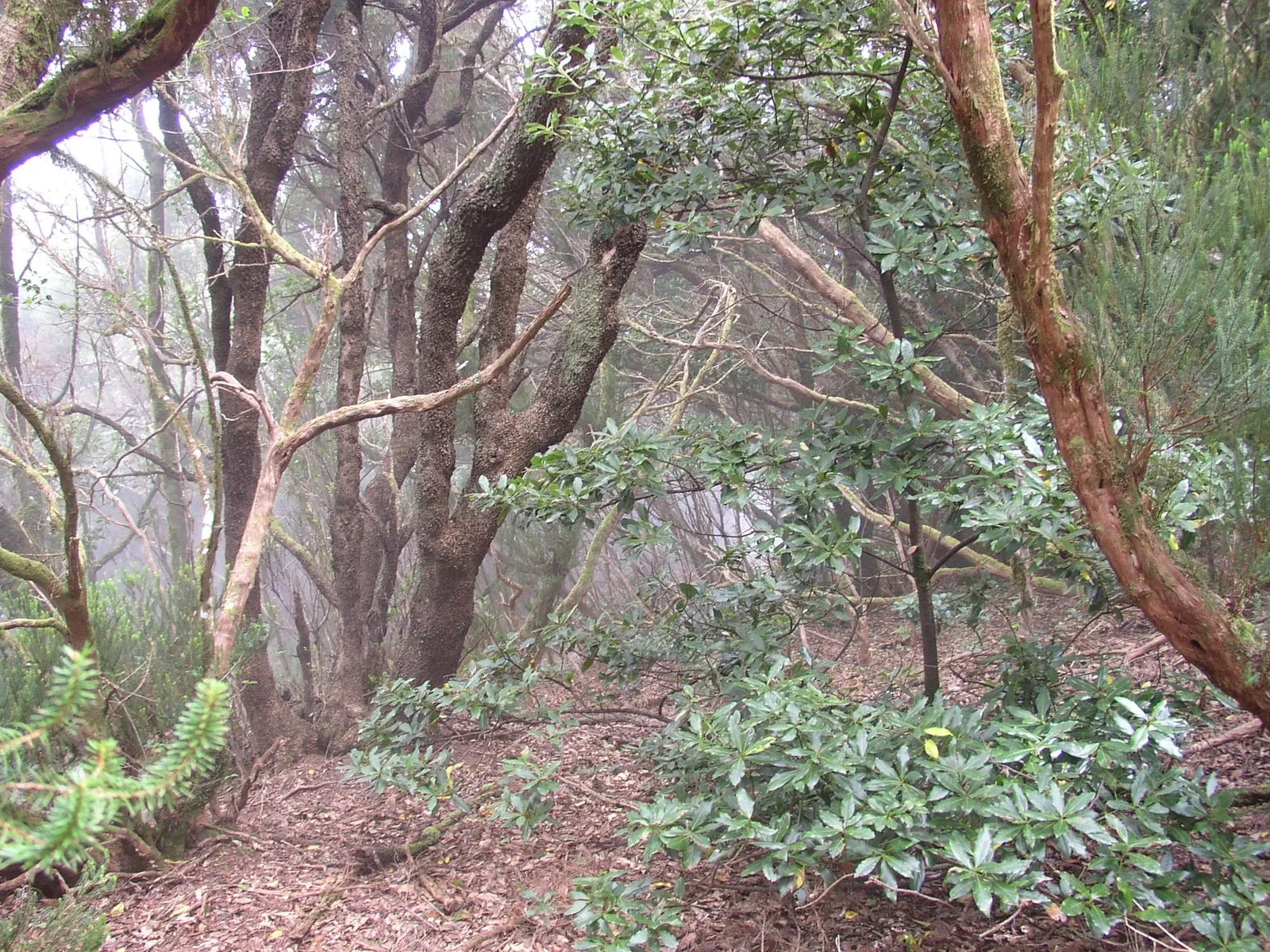
Photo: KUI · CC BY-SA 3.0 · Wikimedia Commons · scaled
The sea of clouds that feeds it
The secret ingredient is the trade winds. These steady, moist north-easterly winds push in off the Atlantic and, when they hit the high ground of the islands, are forced upward. As the air rises and cools, its moisture condenses into a thick bank of cloud that clings to the northern mountain slopes — the famous mar de nubes, or "sea of clouds". The laurel forest lives right in this cloud belt, roughly between 500 and 1,500 metres, drinking in the fog.
Remarkably, the trees don't just wait for rain: their leaves comb water directly out of the passing mist, which drips to the ground in a process called horizontal rainfall. In this way the forest waters itself, and for centuries it has fed springs and streams that supplied the islands below — the laurisilva is a natural reservoir as much as a woodland.
Come prepared for a different climate. While the coast bakes, the laurel forest can be cool, grey and wet, with mist drifting through the trees and slippery paths underfoot. Bring a light waterproof, sturdy shoes and a warm layer even on a hot day — and don't be put off by cloud, because the forest is at its most magical when the fog rolls in.
Where the laurisilva survives
Only pockets of this once-vast forest remain, and each is precious. Three stand out.
Garajonay, La Gomera
The crown jewel is Garajonay National Park on La Gomera, a UNESCO World Heritage Site protecting the largest and best-preserved stretch of laurisilva in the world. Its high, cloud-wreathed plateau is laced with walking trails that wind between towering, twisted trees draped in luminous green moss. It is, quite simply, the place to experience the ancient forest — see our guide to Garajonay National Park.
Anaga, Tenerife
On Tenerife's rugged north-eastern tip, the Anaga Rural Park shelters another superb expanse of laurel forest along a spine of sharp, plunging ridges. Ancient, knotted trees, hidden hamlets and dizzying viewpoints make it one of the island's finest walking areas, easily reached from the north-coast towns. A UNESCO Biosphere Reserve, it's explored in our guide to Anaga Rural Park.
Los Tilos, La Palma
In the green north of La Palma, the Los Tilos forest fills a deep, dramatic ravine with dense laurisilva and tumbling water, at the heart of the island's Biosphere Reserve. Boardwalks and trails lead to waterfalls and a famous viewpoint over the treetops — a lovely, accessible introduction to the forest. More in our guide to Los Tilos.
Why the laurisilva matters
Beyond its beauty, this forest is a working part of the islands. For centuries its mist-harvesting canopy fed the springs and channels that watered the villages below, and it still helps regulate the flow of water and hold the steep slopes together. It is also an irreplaceable gene bank — a refuge of ancient plant lineages and endemic creatures that vanished elsewhere long ago. Together with the forests of Madeira and the Azores it forms one of the last remnants of a habitat that once stretched across two continents, which is exactly why so much of it is now protected as national park and UNESCO-listed land. To lose these woods would be to lose a living link to the deep past that no replanting could ever restore.
Walking the ancient wood
The best way to know the laurisilva is on foot. Well-marked trails thread all three of the main forests, from gentle boardwalk strolls to full-day mountain hikes, and the going is often cool and shaded — a welcome change from beach heat. Listen for the flap of hidden pigeons, look for water beading on every leaf, and don't rush: the pleasure here is in the atmosphere, the green light and the silence.
Tread lightly in a fragile forest. The laurisilva is protected and easily damaged. Keep strictly to marked paths, take nothing — no plants, moss or ferns — and carry all litter out. In dry spells fire risk can close trails, so check local signs and never light anything. These woods survived millions of years; a little care keeps them for the next million.
For many visitors, a day in the cloud forest is the surprise highlight of a Canarian trip — proof that these islands are far more than sun and sand. Pair a laurel-forest walk with the volcanic coast or the high peaks and you'll see the full, astonishing range of what the archipelago holds. Our wider guide to hiking in the Canary Islands can help you plan the route.
A forest that drinks the clouds and remembers a lost world — the laurisilva is the Canaries' quiet miracle.