The Canary Islands are one of Europe's most rewarding birdwatching destinations, and one of its best-kept secrets. Packed into a small area you'll find pine-forest jewels, ancient laurel-wood pigeons, desert-steppe rarities and vast seabird colonies — several of them species you cannot see anywhere else in the world. Add warm weather, short distances and year-round activity, and it's little wonder that keen birders travel here specially. You don't need to be an expert to enjoy it, either: a pair of binoculars and an early start will open up a whole new side of the islands.
The star endemics
Serious birdwatchers come chasing a handful of species that live only in the Canaries or their neighbouring Atlantic islands. A well-planned trip can tick most of them off.
The blue chaffinch
The blue chaffinch is the archipelago's most sought-after bird — a slate-blue finch that lives high in the Canary pine forests and is found nowhere else on Earth. There are two distinct forms: one on Tenerife, around the pinewoods below Mount Teide, and a much rarer one on Gran Canaria, where careful conservation has pulled it back from the edge of extinction. Quiet pine-forest picnic areas and mountain roadside stops are the classic places to look.
Laurel and Bolle's pigeons
Hidden in the misty laurel forests are two shy, beautiful pigeons — the laurel pigeon and Bolle's pigeon — that depend entirely on this ancient woodland. They can be tricky to spot as they crash away through the canopy, but patient watching from forest viewpoints, especially early or late in the day, pays off. The best hunting grounds are the laurisilva of La Gomera, Tenerife's Anaga hills and the forests of La Palma. Read more about their habitat in our guide to the laurel forests.
The houbara bustard
Out on the arid eastern plains lives the houbara bustard, a stately, sandy-brown bird of open semi-desert and one of the great sights of Canarian birding. Its stronghold is the flat, stony steppe of Fuerteventura, with smaller numbers on Lanzarote. In the breeding season males perform a comical, puffed-up display run, all raised white plumes and lowered head. The same steppes are home to cream-coloured coursers, trumpeter finches and stone-curlews, making Fuerteventura the go-to island for desert species.
Berthelot's pipit and other specialities
The most widespread endemic is little Berthelot's pipit, a tame, streaky brown bird you'll meet on almost every walk — coastal scrub, farmland, car parks and mountain trails alike. It's found only in the Canaries, Madeira and the Selvagens, so however common it feels here, it's a genuine speciality. Watch too for the Canary Islands chiffchaff, the local kestrel, Barbary partridge and the wild canary itself.
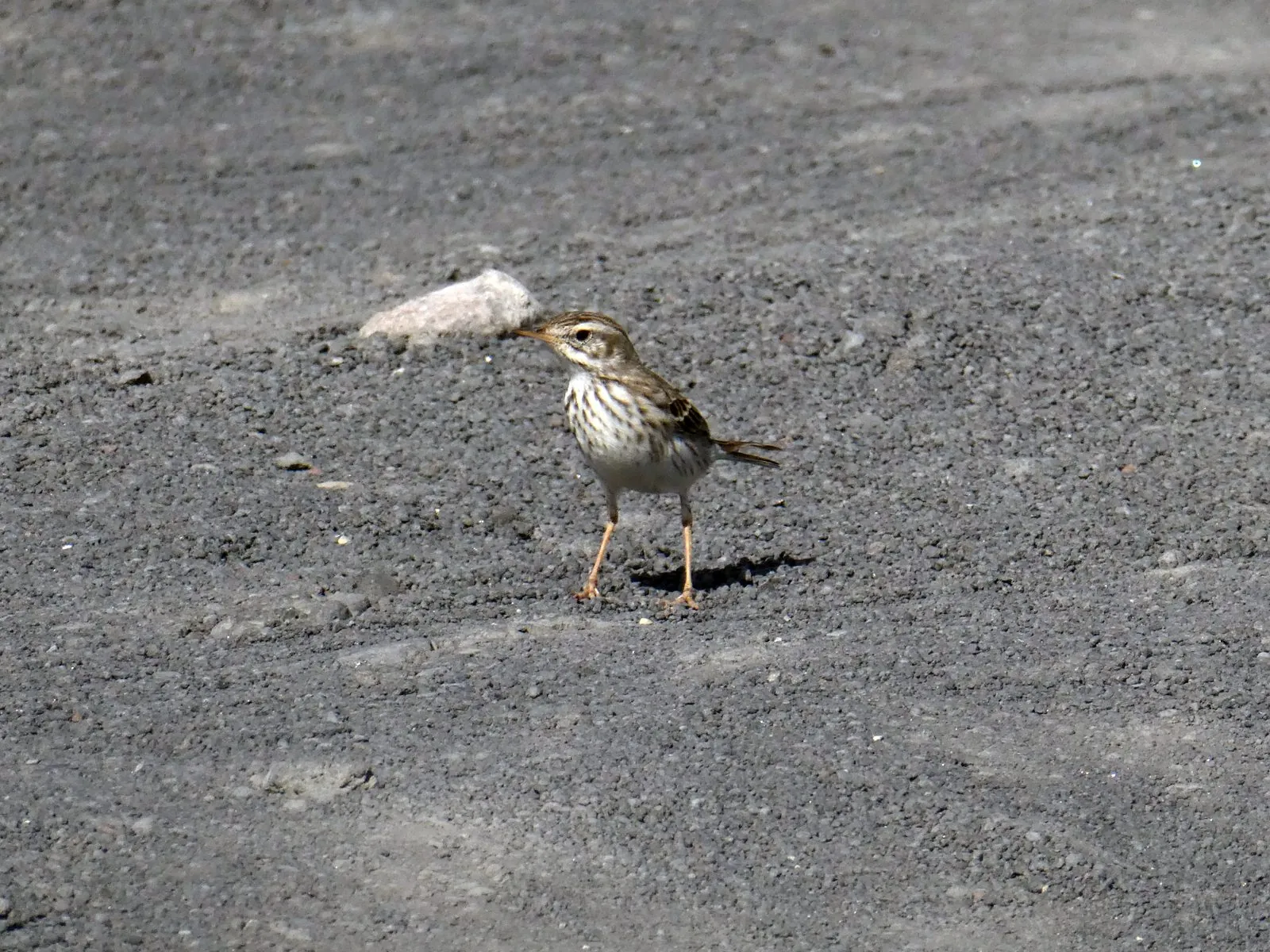
Photo: Syrio · CC BY-SA 4.0 · Wikimedia Commons · scaled
Seabirds and the open Atlantic
The waters around the islands are alive with seabirds. Cory's shearwaters nest in their thousands and stream past headlands at dusk with an eerie, wailing call; storm-petrels, Bulwer's petrels and the rare little shearwater breed on remote islets. Boat trips out from the coast — including many whale and dolphin excursions — often turn up shearwaters, terns and the occasional skua as a bonus. Sea-watching from a clifftop with a flask of coffee is a fine way to spend a breezy morning.
Bring your own binoculars and a field guide. Hire optics are scarce, and a lightweight Canary or Western Palearctic bird guide (or a good phone app) makes identifying the endemics far easier. A modest 8×42 pair of binoculars is ideal for both forest and steppe.
Best islands and sites
| Island | Look for | Best habitats |
|---|---|---|
| Tenerife | Blue chaffinch, laurel pigeons, Berthelot's pipit | Teide pinewoods, Anaga laurel forest |
| Fuerteventura | Houbara bustard, coursers, trumpeter finch | Northern and central desert plains |
| La Gomera | Laurel & Bolle's pigeons | Garajonay laurisilva |
| La Palma | Laurel pigeons, seabirds | Northern forests, coastal cliffs |
| Gran Canaria | Gran Canaria blue chaffinch | Inland pine forest |
When to go
The good news is that the resident endemics can be seen all year round — there's no closed season for the blue chaffinch or the houbara. That said, spring (roughly March to May) is the pick of the seasons: birds are singing and displaying, the desert plains are briefly green, and migrants pass through on their way to and from Africa. Early morning is always best, before the heat builds and while birds are most active; in the forests, the first hours of light are magical. Autumn brings a fresh wave of migrants and seabird passage offshore.
Respect the rarest birds. The houbara bustard and forest pigeons are sensitive to disturbance. Watch from tracks and vehicles rather than walking out across breeding steppe, keep your distance, and never play recorded calls to lure birds — it stresses them and is discouraged in protected areas.
Wetlands, gardens and easy wins
Not all Canarian birding means remote forests and deserts. The islands' scattered reservoirs, coastal lagoons and old salt-pans draw waders, herons, egrets and wintering ducks, and are brilliant for a relaxed morning's watching with a scope. Even hotel gardens and town parks reward a wander: Spanish sparrows, collared doves, hoopoes probing the lawns, kestrels overhead and, in the greener valleys, the wild canary in full song. Botanical gardens and shaded barrancos are magnets for small birds and easy to combine with sightseeing, so you can build a respectable list without ever straying far from your base.
Making a birding trip of it
Because the islands are compact, birdwatching slots easily around a normal holiday. A hire car and a couple of dawn starts can deliver forest and steppe species within a single day, and many of the best sites double as superb walking country — our guide to hiking in the Canary Islands pairs naturally with a bird list. Combine a Fuerteventura desert morning with a laurel-forest day on La Gomera or Tenerife and you'll have seen a spread of birds impossible anywhere else in Europe.
Blue finches in the pines, ghostly pigeons in the laurels, bustards on the dunes — the Canaries pack a lifetime list into a week.