Of all the trees on the Canary Islands, none is tougher, taller or more quietly heroic than the Canary pine. This is a tree that drinks fog out of the sky, shrugs off wildfires that would kill any ordinary conifer, and clothes whole mountainsides in dark, fragrant forest. Pinus canariensis grows naturally nowhere else on earth, and understanding it unlocks much of what makes these volcanic islands green, watered and alive.
Here's the story of the Canary pine — how it survives fire, how it "combs" water from the clouds, and where to walk among the great pinewoods that ring the higher islands.
A pine like no other
The Canary pine is instantly recognisable once you know it. It grows tall and straight, often to 30 metres or more, with a rugged, reddish-brown trunk armoured in thick, deeply fissured bark. Its needles are extraordinarily long — bundled in threes and drooping in soft, blue-green tassels that can reach 30 centimetres. Young trees are feathery; old ones develop a high, open crown. It thrives in a middle band of altitude, roughly between the coastal scrub and the high summits, forming the mountain forest belt of the western and central islands.
Crucially, it's a native. Along with the laurel forests, the pinewoods are the islands' own great woodland — evolved here in isolation and superbly matched to the volcanic soil, thin mountain air and long summer drought.
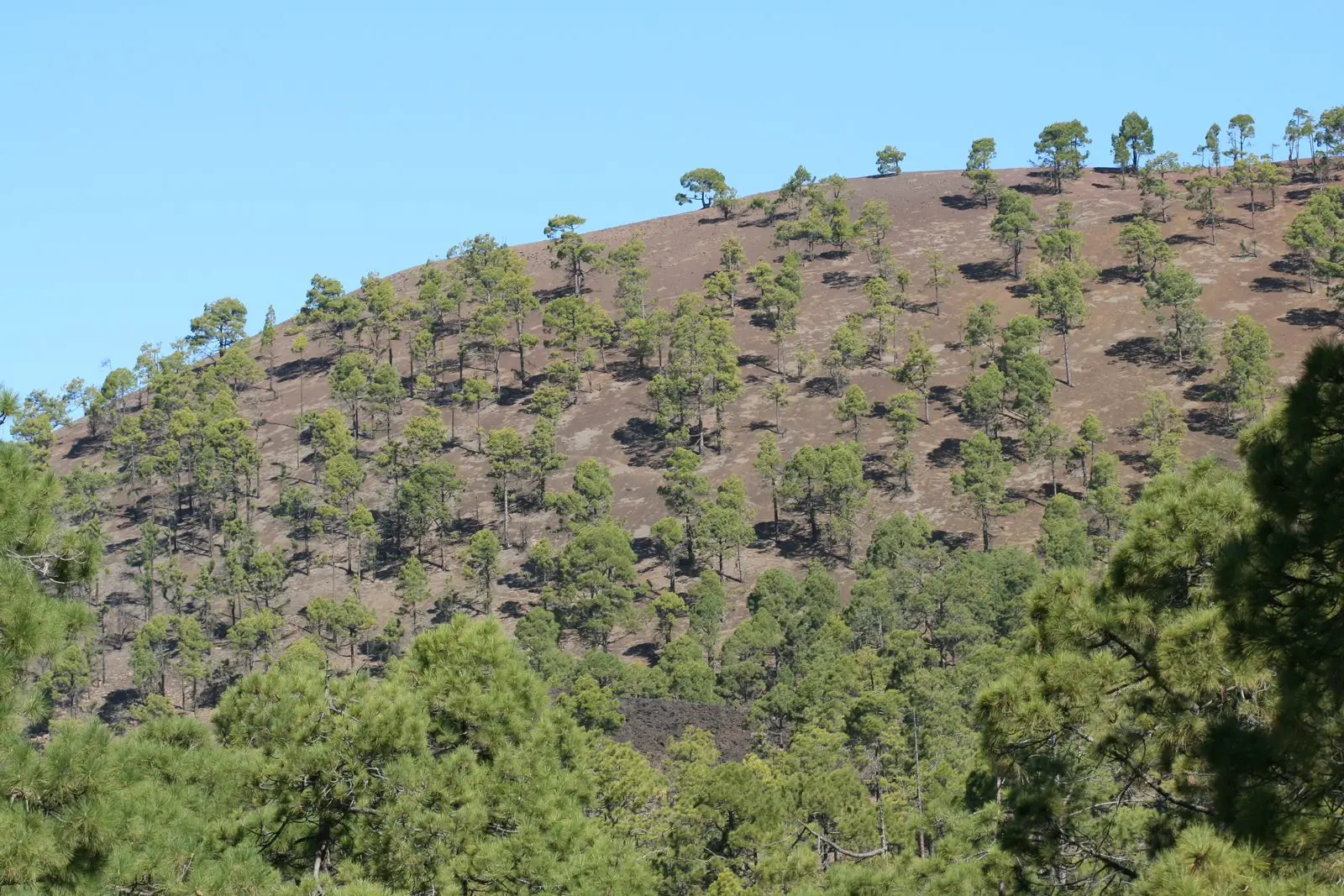
Photo: S. Rae · CC BY 2.0 · Wikimedia Commons · scaled
Fire-resistant — the tree that comes back
The single most remarkable thing about the Canary pine is its relationship with fire. On a volcanic archipelago, lightning strikes and eruptions have started fires for millions of years, and the pine has evolved to survive them. Its trunk is wrapped in exceptionally thick bark that insulates the living tissue beneath from the heat. When a fire sweeps through and scorches a tree black, it may look dead — yet within weeks fresh green needles sprout directly from the blackened trunk and branches, a trick very few pines in the world can perform.
This ability to resprout means Canarian pinewoods recover from wildfire astonishingly fast. Forests that burned severely can be green again within a couple of seasons, the charred giants pushing out new growth as if nothing had happened. It has made the tree a symbol of resilience — and, sadly, a witness to the larger fires that climate change has brought to the islands in recent years.
The pine's toughness doesn't make the forest fireproof. Summer wildfire is a serious and growing risk on the higher islands. In the dry months, never light fires outside designated areas, take all cigarettes and glass home, and check for any local fire warnings before you head into the hills.
Combing the clouds — horizontal rain
The Canary pine's other superpower is catching water out of thin air. The islands sit in the path of the moist trade winds, which push banks of cloud against the mountains at just the altitude the pines grow. Those long, dense needles are perfect fog-catchers: as mist drifts through the canopy, tiny water droplets condense on the needles, gather, and drip steadily to the ground below.
Islanders call this lluvia horizontal — horizontal rain. On a cloudy day you can stand under a pine and feel it "raining" from the branches while the sky above sheds not a drop. Multiplied across a whole forest, this fog-drip adds hugely to the water reaching the soil, recharging springs and aquifers that the islands rely on. The pinewoods aren't just pretty; they are working machines that harvest the islands' most precious resource. Together with the laurisilva they explain why the misty north of each island is so much greener than the sunny south.
The great pine forests
The Spanish name for these upland forests is pinar, and each of the higher islands has its own.
| Forest | Island | What makes it special |
|---|---|---|
| Tamadaba | Gran Canaria | A magnificent pinewood on the cliffs of the northwest, high above the sea |
| Corona Forestal | Tenerife | The largest protected area in the Canaries, ringing Teide with pine |
| Cumbre & Fuencaliente pinewoods | La Palma | Dense forests over young volcanic terrain, some regrown after fire |
| Inagua & Pilancones | Gran Canaria | Wild interior pinewoods, refuge of the blue chaffinch |
The Tamadaba pinewood on Gran Canaria is one of the finest and most accessible, with fragrant forest tracks opening suddenly onto vertiginous coastal viewpoints. On Tenerife the vast Corona Forestal wraps the whole of Teide's flanks in pine. And on La Palma — the greenest, most forested island of all — the pinewoods climb from the ridges toward the observatories, some of them regrown from the roots after eruptions and fires.
The forest's role
The pinewoods do far more than look good. They capture water, hold the steep volcanic soil together against erosion, shelter unique wildlife — the endangered blue chaffinch lives almost entirely among Gran Canaria's and Tenerife's pines — and lock away carbon. For centuries their strong, resinous timber, known as tea, was the islands' prized building wood, used for the carved balconies and beamed ceilings of the old towns. Today the forests are protected, and their greatest value is as living infrastructure for the islands' water and biodiversity.
The pine belt sits at a lovely, cool middle altitude — often above the coastal cloud but below the summit chill. On a hot day it's a perfect escape: shady, scented and several degrees cooler than the beach.
Walking the pinewoods
The best way to know the Canary pine is to walk among it. Well-marked trails thread every major pinar, from gentle forest strolls to long ridge routes, and the springy carpet of fallen needles makes for wonderfully soft walking. The air is resin-scented, the light dappled, and the views — where the trees part over a ravine or a cloud sea — unforgettable. See our guide to hiking in the Canary Islands to plan a route, and pair it with our guide to the wider flora of the Canary Islands to meet the pine's remarkable neighbours. Stand in a Canary pinewood as the mist rolls through and the needles begin to drip, and you're watching one of the island's oldest, quietest miracles at work.