Marooned in the Atlantic off the coast of Africa, the Canary Islands are one of the great plant kingdoms of the world — a place where towers of blue flowers erupt from the volcanic slopes, rosettes cling to bare rock, and ancient forests survive that vanished from Europe millions of years ago. Botanists count well over a thousand native plants here, and a remarkable share of them grow nowhere else on earth. For anyone who loves the natural world, the islands are a living laboratory of evolution as thrilling as the beaches are relaxing.
This is your guide to the extraordinary flora of the Canaries — why these islands breed so many unique plants, the star species to look out for, and the best places to see them, from high-mountain moonscapes to misty laurel forests and beautiful botanical gardens.
Why islands breed endemics
An "endemic" is a species that grows naturally in one place and nowhere else. Islands are famous factories of endemics, and the Canaries are among the richest of all. The reasons are simple and powerful. A seed that drifts, blows or is carried across hundreds of kilometres of ocean arrives isolated from its parent population; over thousands of generations it adapts to local conditions and gradually becomes a new species. Add the islands' astonishing range of habitats — sun-baked coast, cloud-wrapped forest, alpine summit — often packed into a single island, and you get evolution running in many directions at once. Because the archipelago has never been joined to a continent, much of what evolved here stayed here.
The result is a flora with a very high proportion of endemics, some found on just one island or even one mountainside. Several are living relics — "Tertiary relicts" that once grew across the Mediterranean and North Africa in a warmer, wetter age, and survived here after the mainland dried out and iced over.
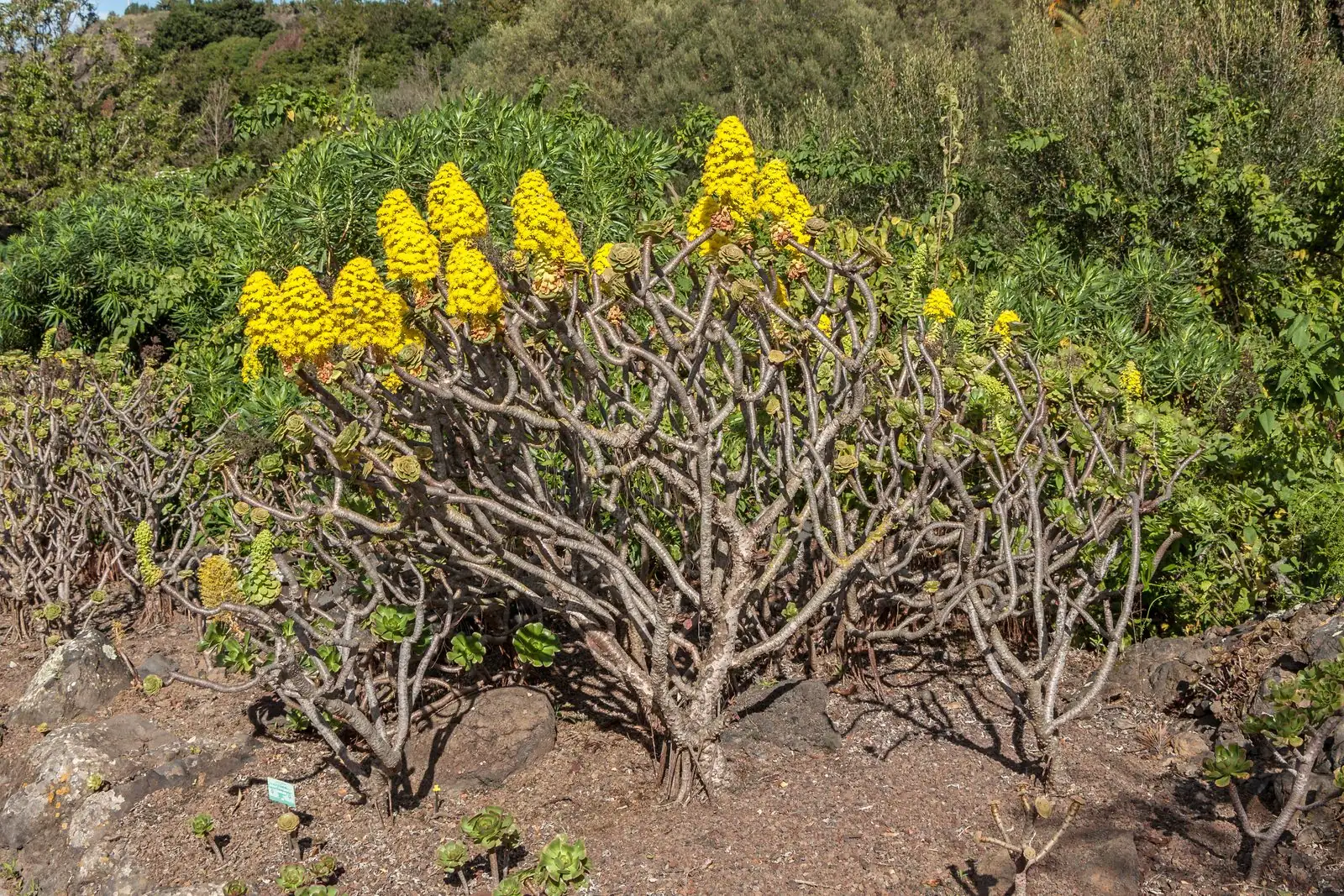
Photo: H. Zell · CC BY-SA 3.0 · Wikimedia Commons · scaled
The stars of the show
Giant blue echiums — the tajinaste
If one plant sums up the drama of Canarian flora, it's the tajinaste. These are echiums — relatives of borage and bugloss — that on the islands have grown into towering spires. The most spectacular, the red-flowering tajinaste rojo of the Teide high country, throws up a dense cone of thousands of blossoms that can stand taller than a person. Others bloom electric blue. They flower in a great flush in late spring, drawing bees and photographers alike, then set seed and die, having lived years to bloom just once.
Houseleeks and aeoniums
Look at almost any old wall, cliff or lava field and you'll spot fleshy rosettes of aeonium — the Canarian houseleeks. This is a group that has exploded into dozens of species across the islands, each adapted to its own niche, from coastal rocks to shady ravines. Their neat, succulent rosettes store water for the long dry season, and in spring many send up conical heads of tiny yellow or pink flowers.
The dragon tree and the Canary palm
Two giants tower over the rest. The extraordinary drago, with its blood-red sap and many-headed crown, is the islands' unofficial emblem — read its full story in our guide to the Canarian dragon tree. The Canary Island date palm, Phoenix canariensis, is the archipelago's own palm: stout, majestic and now planted in warm gardens the world over. On La Gomera and La Palma its sap is still tapped to make miel de palma, or palm honey.
The laurel forest survivors
In the humid north, a whole community of broad-leaved evergreens forms the laurisilva — laurels, the fragrant til, the Canary holly, faya and heath. These are the relics of subtropical forests that once cloaked the Mediterranean. Explore them fully in our guide to the laurel forests.
Spring, roughly March to May, is the peak flowering season, when the tajinaste bloom and the slopes turn green and gold. But the islands have something in leaf and flower year-round — the aeoniums and dragos never go anywhere.
Adapted to a hard, dry land
Canarian plants are masters of survival. On the arid coasts, succulents like the cardón (a candelabra spurge) and fleshy-leaved shrubs hoard water and shrug off salt and drought. Higher up, plants have learned to harvest the trade-wind clouds directly, combing moisture from the mist — the same "horizontal rain" that keeps the northern forests damp while the coast bakes. On the highest summits, hardy brooms and the red tajinaste endure fierce sun, thin air and winter frost. Each zone, from shore to peak, has its own specially tuned cast of plants.
Where to see the flora
Botanical gardens
The easiest and most rewarding introduction is a botanical garden, where the islands' plants are gathered, labelled and beautifully displayed. On Gran Canaria, the Jardín Botánico Canario (the Jardín Canario) near Las Palmas is devoted to the flora of the archipelago and Macaronesia, with whole sections of dragos, aeoniums and laurel species. In Santa Cruz de Tenerife, the Palmetum — a botanical garden built on a reclaimed rubbish tip — holds one of the world's great collections of palms, including the native Canary palm.
Teide and the high country
For the tajinaste and the high-altitude specialists, head up into the caldera of Mount Teide on Tenerife. In late spring the national park's rocky flats blaze with red flower-spires against black lava and pale pumice — one of the most surreal plant spectacles anywhere. Teide broom, Teide violet and other summit endemics cling on in this thin-aired world.
The laurel forests
To walk among the forest relics, visit the laurisilva of the Anaga hills on Tenerife, Los Tilos on La Palma, or the UNESCO-listed Garajonay on La Gomera. These dripping, moss-hung woods feel a world away from the sunbeds — cool, green and primeval.
Much of this flora is rare and legally protected, and some plants grow in fragile habitats. Stay on marked paths, never pick or dig up plants, and take nothing but photographs. A single trampled slope can undo years of recovery.
A garden built by isolation
The flora of the Canaries is one of the islands' quiet wonders — less obvious than the volcanoes or the beaches, but every bit as remarkable once you start to notice it. Learn to recognise a dragon tree's silhouette, an aeonium's rosette or a tajinaste's spire, and the islands open up in a new way. To go further into the natural story, explore our guides to the Canary pine and forests and the wildlife of the Canary Islands — because on these Atlantic islands, the plants are the headline act.