Few living things capture the strange magic of the Canary Islands like the drago — the Canary Islands dragon tree. With its stout, elephantine trunk, its branches splitting again and again into a great umbrella of spiky blue-green crowns, and a blood-red sap that gave it its fearsome name, the Dracaena draco looks less like a tree than a creature from myth. It has been revered here for millennia — sacred to the aboriginal Guanches, prized by medieval apothecaries, and today the unofficial emblem of the islands and the pride of the town of Icod de los Vinos on Tenerife.
Here's the story of the dragon tree — its curious "blood", the legends that surround it, what it has meant to islanders through the ages, and where to see the most famous specimens of all.
What is a dragon tree?
The drago isn't a true tree at all but a giant member of the asparagus family, more closely related to lilies than to oaks. It grows with agonising slowness and has no growth rings, which makes its age notoriously hard to judge. It branches only after flowering — roughly once a decade or so — each time doubling its spreading crowns, so the oldest specimens develop that unmistakable, many-headed silhouette. Native to the Canaries and a few neighbouring Atlantic islands and pockets of North Africa, it's supremely adapted to the islands' dry, mild climate, drinking in moisture from the trade-wind mists.
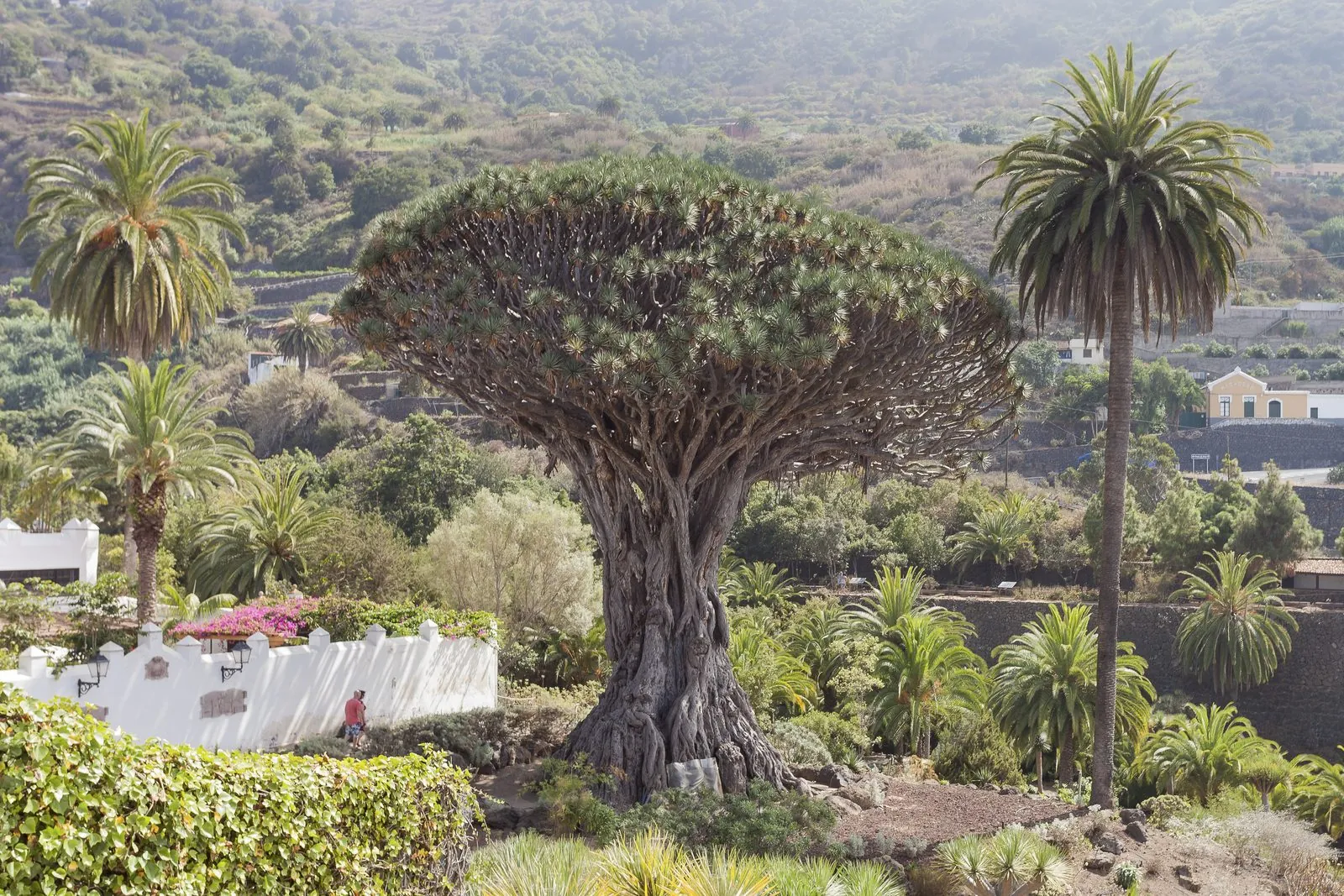
Photo: Luis Miguel Bugallo Sánchez · CC BY-SA 4.0 · Wikimedia Commons · scaled
Dragon's blood — the sap that named it
Cut or wound a drago and its clear sap slowly turns a deep, rusty red on contact with the air — the famous "dragon's blood" (sangre de drago). To the ancients, this looked like proof that the tree bled, and it fed a wealth of legend. It was also genuinely valuable: dragon's blood resin was traded around the Mediterranean and used as a dye, a varnish (prized by violin-makers), an embalming agent, a medicine and a cosmetic. The Guanches used it in their mummification rites and as a folk remedy. For centuries the resin was one of the archipelago's sought-after exports.
You'll still find dragon's blood sold in island craft shops as a curiosity, tincture or varnish. It's a great little souvenir with a genuine backstory — see our guide to Canarian crafts and what to buy for more island keepsakes.
Guanche legend and symbolism
To the pre-Hispanic islanders, the drago was a sacred tree, and it's easy to see why. Its red "blood", its extraordinary longevity and its strange form all lent it an aura of power. Aboriginal peoples are thought to have gathered beneath ancient dragos to hold council and settle disputes, treating them as living meeting places — a role echoed in the old European belief that these trees marked places of wisdom and justice. Classical myth wove the tree into the legend of the Garden of the Hesperides and the hundred-headed dragon Ladon, from whose spilt blood the first dragos were said to have sprung — one of many reasons the Canaries were long imagined as the edge of the known world.
The Drago Milenario of Icod
The most celebrated dragon tree on earth stands in the town of Icod de los Vinos in the north of Tenerife. The Drago Milenario ("thousand-year dragon") is a colossus — many metres tall and broad, with a vast, multi-crowned canopy — and the largest and oldest specimen known. Its exact age is much debated: popular legend claims a thousand years or more, though botanists, working from its branching, tend to estimate several hundred. Whatever the truth, it's a magnificent, jaw-dropping sight, protected in its own park below the town's pretty old centre. You can find the full visitor picture in our guide to the Drago de Icod.
You can't walk right up to or touch the Drago Milenario — it's fenced within a botanical park to protect it. There's an admission charge to enter the park for a close view, though you can glimpse the tree for free from the plaza and viewpoints above. As always, check current opening times and prices with the official site before visiting.
Other notable dragos
Icod's giant is far from the only one worth seeking out.
| Where | Why it's special |
|---|---|
| Icod de los Vinos (Tenerife) | The Drago Milenario — the largest and most famous of all |
| La Laguna & northern Tenerife | Fine mature dragos in gardens and plazas |
| La Palma (Las Tricias, Buracas) | Wild and semi-wild groves in the north |
| Gran Canaria & other islands | Specimens in botanical gardens and old estates |
You'll also spot dragos planted as ornamental trees in plazas, hotel gardens and the islands' botanical collections right across the archipelago — once you learn the silhouette, you'll see them everywhere.
A tree under threat — and protected
Truly wild dragon trees are surprisingly rare, clinging to inaccessible cliffs and ravines, and the species is considered vulnerable in the wild. Centuries of resin-tapping, grazing and habitat loss took their toll. Today the drago is legally protected, and conservation and replanting schemes are helping the species recover — many of the fine specimens you'll see are cultivated. It remains a powerful emblem of Canarian identity, appearing on everything from coins and coats of arms to logos and souvenirs.
Seeing the drago on your trip
The dragon tree is one of the islands' great natural wonders, right up there with the volcanoes and the laurel forests. Pair a visit to the Icod giant with the pretty north-Tenerife coast, or simply keep an eye out for dragos wherever you go — in a plaza, a garden, or growing wild on a cliff. To go deeper into the islands' remarkable natural and human heritage, explore our guides to the wildlife of the Canary Islands and to the Guanches, for whom this extraordinary bleeding tree was sacred. Stand beneath an ancient drago and you're looking at a living link to the deep past of the Atlantic's most magical islands.