The Canary Islands hold four national parks — an extraordinary number for such a small archipelago — and between them they protect some of the most dramatic scenery in all of Spain. There's the roof of the country crowned by a slumbering giant volcano, a badland of raw lava still warm underground, an enchanted forest lost in the clouds, and a vast mountain amphitheatre gouged into an island. Each tells a different chapter of the islands' volcanic and natural story, and two carry UNESCO World Heritage status. Visiting them is the best possible way to understand what makes these islands so special.
Teide National Park, Tenerife
Spain's most visited national park surrounds Mount Teide, at 3,715 metres the highest peak in the country and the third-largest volcano on Earth measured from its ocean floor. The park fills a giant ancient caldera high above the clouds — a wild, otherworldly plateau of coloured lava, rock spires and old flows, ringed by peaks and dotted with endemic plants that bloom in spring. A cable car carries you most of the way up the cone (the final summit path needs a free permit booked in advance), while the roads and trails around the crater floor are spectacular in their own right, by day and under the famous dark skies at night.
Teide is a UNESCO World Heritage Site and one of the world's premier stargazing locations. Full practical details are in our guide to Mount Teide.
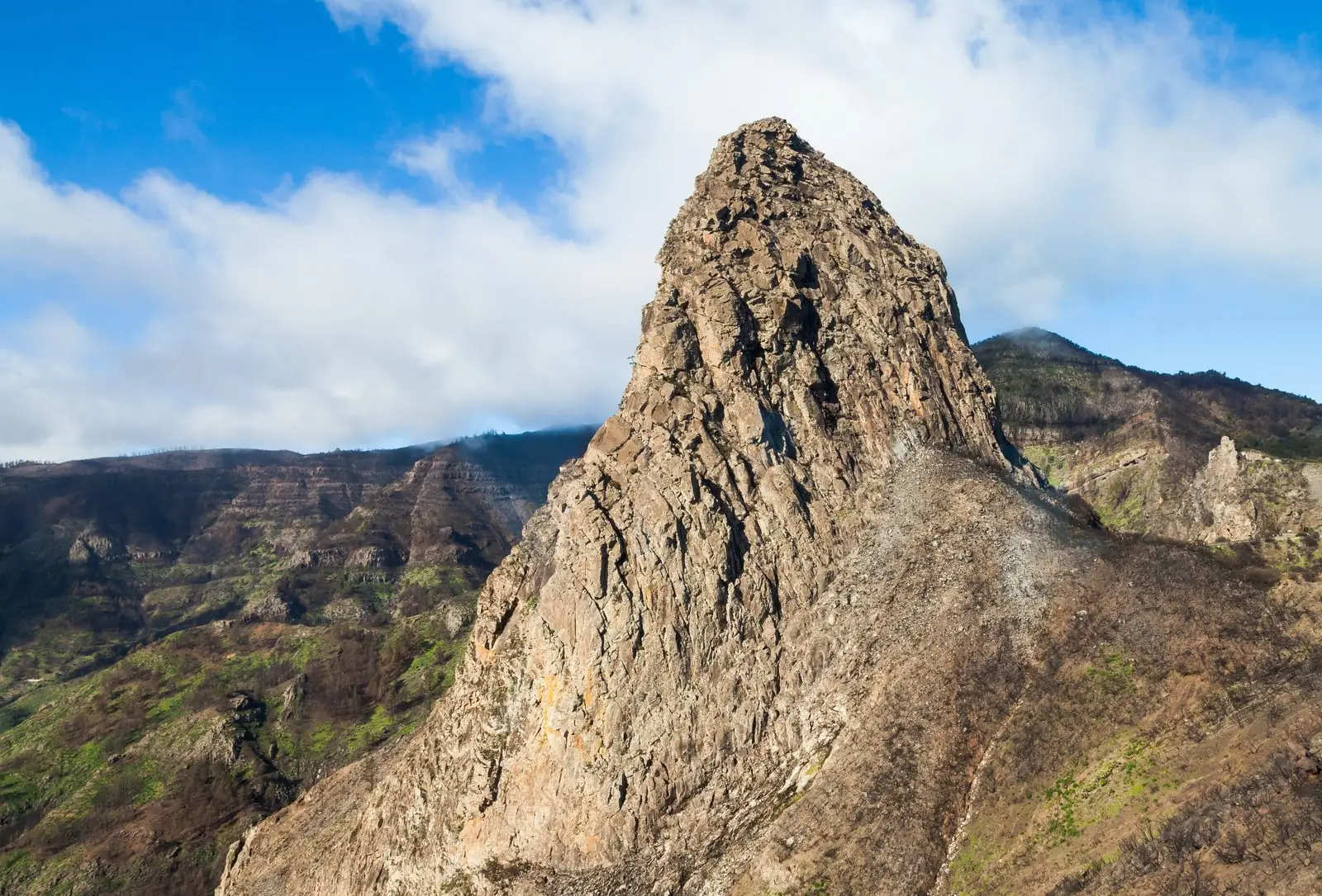
Photo: Diego Delso · CC BY-SA 3.0 · Wikimedia Commons · scaled
Timanfaya National Park, Lanzarote
On Lanzarote, Timanfaya preserves the Mountains of Fire — the barely cooled landscape left by tremendous eruptions in the 1730s that buried a quarter of the island. It's a raw, red-and-black volcanic desert where the ground is still hot enough just below the surface to set brushwood alight and boil water into a geyser, demonstrated daily to visitors. Because the terrain is so fragile and, in places, genuinely dangerous, you explore it mainly from a coach route and viewing terrace rather than on foot. It's the most alien landscape in the Canaries — see our guide to Timanfaya National Park.
Garajonay National Park, La Gomera
High on La Gomera, Garajonay protects the world's finest surviving laurisilva — the ancient, cloud-fed laurel forest that once cloaked southern Europe millions of years ago. Wrapped in mist blown in on the trade winds, its twisted, moss-hung trees feel like something from a fairy tale, and walking its trails is utterly unlike anywhere else on the islands. Like Teide, it's a UNESCO World Heritage Site. There's more on this magical woodland in our features on Garajonay National Park and the laurel forests.
Caldera de Taburiente National Park, La Palma
The green island of La Palma is home to Caldera de Taburiente, a colossal mountain-ringed amphitheatre up to eight kilometres across and nearly two kilometres deep, wooded with Canary pines and threaded by streams and waterfalls. Long thought to be a giant crater, it's now understood to be a huge erosion basin, deepened by ancient landslides — a natural cathedral of ridges, springs and viewpoints. It's a paradise for walkers, from easy rim viewpoints to the tough full descent into the caldera floor, and its exceptionally clear, dark skies help make La Palma a world-renowned star-gazing island. See our guide to Caldera de Taburiente.
The four at a glance
| Park | Island | Protects | UNESCO World Heritage |
|---|---|---|---|
| Teide | Tenerife | Spain's highest volcano & high-altitude caldera | Yes |
| Timanfaya | Lanzarote | Recent lava fields & active geothermal ground | No |
| Garajonay | La Gomera | Ancient laurel cloud-forest | Yes |
| Caldera de Taburiente | La Palma | Giant erosion caldera & pine forest | No |
Visiting responsibly
Three of the four parks — Teide, Garajonay and Caldera de Taburiente — are free to enter and open all year, with visitor centres, marked trails and viewpoints; Timanfaya is the exception, charging a single entrance fee that covers its demonstrations and coach route. Popular access points and the Teide summit path use free timed permits or bookings to manage numbers, so it's always worth checking each park's official website before you set out, especially in peak season.
Start early and check access rules. Car parks at the busiest spots — the Teide cable car, Garajonay's trailheads, Timanfaya's gate — fill fast by mid-morning. Arrive early for space, cooler walking and better light, and book any required permit (such as the Teide peak) well in advance, as free daily slots go quickly.
Protect what you've come to see. These are strictly protected areas. Keep to marked paths, take nothing and leave nothing, never light fires or use drones without permission, and don't stray onto closed or dangerous ground — particularly the hot, unstable lava in Timanfaya. Fragile plants, ancient forest and volcanic terrain all recover slowly, if at all.
More than the four
The national parks are the headline acts, but they sit within a much wider web of protected land. Every inhabited island holds rural parks, natural monuments and nature reserves — from Tenerife's Anaga hills and Gran Canaria's Roque Nublo country to the whole islands of Lanzarote, La Palma, El Hierro, La Gomera and Gran Canaria, each recognised as a UNESCO Biosphere Reserve. Several also enjoy Starlight Reserve status for their exceptionally dark skies. In practice that means a national park visit is rarely an isolated day out: you'll pass viewpoints, laurel woods, volcanic monuments and coastal reserves on the way, all part of the same effort to keep these islands wild. It's one of the most densely protected corners of Europe.
Making the most of them
You could, in theory, tick off all four national parks in a single island-hopping trip — Tenerife, Lanzarote, La Gomera and La Palma each hold one — and doing so would show you the full sweep of the Canaries' natural drama, from lunar lava to enchanted forest. Realistically, most visitors take in one or two per holiday, folding them into time on the beaches and in the towns. Whichever you reach, come with good shoes, water, sun protection and a warm layer for the heights, and give yourself time to slow down. Our wider guide to hiking in the Canary Islands helps you plan the walking.
A volcano roof, a field of fire, a cloud forest and a mountain amphitheatre — four parks, four islands, one unforgettable archipelago.