The Monumento al Campesino is César Manrique's tribute to Lanzarote's farmers: a tall white sculpture on a rocky knoll at Mozaga, in the middle of the island, beside a whitewashed farmhouse complex with craft workshops and a restaurant, and entry is free. The centre is run by the island council's tourist-centre body, CACT, which in November 2026 lists it as open every day from 10:00 to 18:00, with lunch served in the restaurant from 12:00 to 16:00. It is the only one of the CACT centres that charges nothing at the door.
Two things share the name. The sculpture itself is officially called Fecundidad (Fertility), and stands on the Peña de Tajaste. Below it is the Casa-Museo del Campesino, a cluster of courtyards, cisterns, threshing floors and wine presses that Manrique designed to show how rural Lanzarote lived and built. Most visitors simply call the whole place "the Campesino", and so do most road signs.
Plan on about an hour for a wander, longer if you eat. This page explains what the monument means, the storm that nearly destroyed it, what you will find in the house and workshops, how the restaurant works, and how to fit it into a day in the island's wine and Manrique country.
A monument to people who farmed ash
To understand why Manrique built this, you need to know what Lanzarote's farmers were up against. The island gets very little rain, the trade wind blows for much of the year, and the eruptions of 1730–1736 buried a large part of the best farmland under lava and volcanic ash. Instead of abandoning the land, islanders learned to farm the ash itself. They dug pits down through the black picón to the old soil beneath, planted a vine or a fig in each, and built low semicircular stone walls to shelter them from the wind. The ash holds the night dew and slows evaporation, so crops survive on almost no rain.
Manrique, who grew up on Lanzarote and returned in the 1960s determined to protect its character, regarded those farmers as the island's true artists. The landscape they created by hand in places like La Geria, a few minutes' drive south, was to him as much a work of art as anything in a gallery. The Monumento al Campesino was his way of putting that conviction in the middle of the island, in the most visible place he could find, at a time when tourism was beginning to pull young people off the land. Our page on farming and the terraced hills covers the wider farming story across the islands.
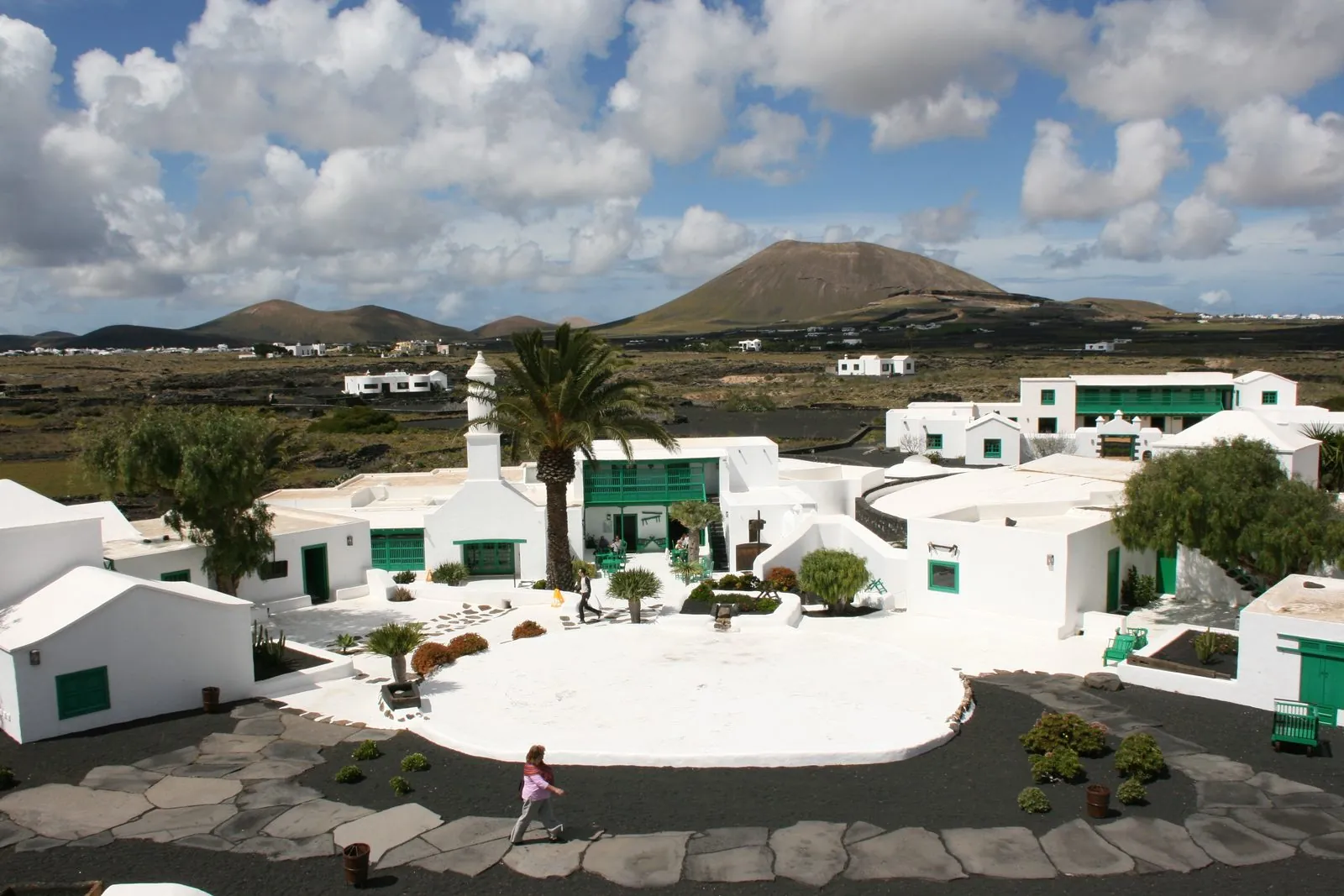
Photo: Frank Vincentz · CC BY-SA 3.0 · Wikimedia Commons · scaled
Fecundidad: what the white tower is made of
From a distance the sculpture looks like a stack of white geometric blocks, roughly fifteen metres tall according to CACT. Up close you realise it is built from scrap. Manrique assembled it from old water tanks and parts salvaged from ships, cylinders and boxes that had been headed for the scrapyard, then had the whole thing painted white like a Lanzarote farmhouse. The cubist influence of 1960s modern art is obvious; so is the island's habit of making do with whatever the sea and the harbour provided.
What it represents is left open on purpose. CACT's own description says many people see a farmer standing beside his camel, the animal that once pulled the ploughs and carried the harvest on Lanzarote, while others see something else entirely. Walk round it and the shapes shift: from one side you may see a figure in a hat, from another a pair of animals, from another nothing but blocks. Treat it as an invitation rather than a puzzle with a right answer.
The storm that brought it down
The sculpture you see today is largely new. In April 2024 a windstorm with gusts of around 80 km/h toppled the upper part of the monument. According to La Voz de Lanzarote, reporting in January 2025, the iron frame had stood exposed to wind and salt for about 55 years and was in far worse condition inside than it looked. The restoration contract had in fact already been awarded before the storm hit.
Rather than patch the original, the Cabildo's restorers had about three-quarters of the work rebuilt as a faithful replica: a new iron structure welded in four sections in a workshop at Playa Honda, then clad in layers of fibreglass and resin and painted to match. The solid concrete base, which survived intact, is original. The work was supervised by the Fundación César Manrique, and the reassembled sculpture was back on its rock by early 2025. It is one of very few Manrique works of which most of what you see is a reconstruction, which local politicians debated at the time; to the eye, it is the same monument.
Older photographs show a weathered tower. Pictures taken before 2024 show the sculpture greyer and streaked with rust. The bright, crisp white you see now is the replica's fresh finish, not a filter, and it will weather in its turn.
Inside the Casa-Museo del Campesino
The farmhouse complex below the monument is not a restored historic house. Manrique began the project in 1968, and instead of copying a single building he combined elements from different parts of the island into one idealised farmstead: thick whitewashed walls, green-painted wooden doors and windows, courtyards with cisterns to catch what little rain falls, a threshing floor, and old wine presses. It reads as a kind of anthology of traditional Canarian architecture, arranged so you can walk through it in a loop.
Inside the rooms are tools, furniture and objects from rural life: ploughs, baskets, kitchen utensils and the equipment used to make wine and cheese. Labels are brief, and the pleasure lies more in the atmosphere than in detailed history. Children tend to like the courtyards and the threshing floor; adults usually linger at the presses and in the shade of the patios.
Accessibility is better than at most CACT centres. CACT describes the centre as mostly adapted for visitors with reduced mobility, although the route up to the sculpture on the rock is not. Photography for personal use is allowed, drones are not, and pets are not allowed apart from assistance dogs.
The craft workshops in the artisans' square
Around the Plaza de los Artesanos, the courtyard at the heart of the complex, small workshops and demonstrations show traditional island crafts, the kind of skills that were once part of every village. CACT warns that the craft programme varies with the centre's schedule, so you may arrive to find someone at work, or nobody in the workshops at all.
If you want to know which island crafts are genuinely made here and what they should cost, our page on Canarian crafts and what to buy is a useful companion. The rules of thumb are simple: handmade pottery is heavy and fairly expensive, and anything suspiciously cheap is probably imported.
Eating at the Campesino
The restaurant is one of the main reasons people come, and many locals use it as a reliable lunch stop. According to CACT it serves Canarian dishes à la carte, with cheeses and wines from Lanzarote's own designation of origin, from 12:00 to 16:00. Tables can be booked online or by phone up to two hours before service, separately from the free museum visit. Outside food and drink are not allowed on site.
The menu changes, so we do not list dishes here, but expect island cooking built around local cheese, potatoes with mojo sauces and Lanzarote wine. From the restaurant terrace you look up at the sculpture on its rock. For a guide to what those dishes are and which ones to try, the page on what to eat in Lanzarote runs through them. Budget as for a proper sit-down Canarian lunch rather than a café snack.
Book lunch, then visit backwards. On busy days the restaurant fills by early afternoon. If you want to eat, book a table online for around one o'clock before you leave your hotel, arrive at noon to look round the house and workshops first, and climb towards the sculpture after lunch, when the tour coaches have left.
Getting to Mozaga
The Monumento al Campesino stands at Mozaga, in the municipality of San Bartolomé, on the road from Arrecife to Tinajo. Its address is Carretera Arrecife a Tinajo 8. It sits close to the centre of Lanzarote, so almost everywhere on the island is within half an hour or so: Arrecife and the airport are a short drive, Costa Teguise and Puerto del Carmen take a little longer, and Playa Blanca roughly three-quarters of an hour. CACT says all its centres have parking, and the sculpture is visible from a long way off, which makes it hard to miss.
Mozaga is also the northern gateway to the wine road. Head south from the roundabout and you are soon among the ash pits and stone shelters of La Geria, with bodegas along the way. Local buses do pass through San Bartolomé and the villages around it, but services are limited, and most visitors come by car or on an island tour. Our page on buses in Lanzarote has the realistic picture.
A half-day in the middle of the island
Because it is so central, the Campesino is the natural hinge of a Manrique day. A comfortable loop runs from the Fundación César Manrique at Tahíche, the artist's house built inside lava bubbles, to Lagomar, the house in a quarry wall at Nazaret, then on to Mozaga for lunch, before an afternoon among the La Geria bodegas. On a Sunday, swap the morning for the market at Teguise, ten minutes to the north.
None of those drives is long, and the free entry here balances the cost of the paid sites. CACT stopped selling multi-centre vouchers, as our page on Lanzarote's combined attractions ticket explains, so the Campesino's zero price is now the simplest saving on the Manrique trail. Our overview of César Manrique's Lanzarote shows how the other centres fit together.
Why the Campesino deserves an hour
It is easy to drive past the white tower at Mozaga on the way to somewhere more famous, and many people do. That is a pity. The Campesino is where Manrique's ideas about the island are stated most plainly: the real heroes of Lanzarote were the people who made a living from ash and wind, and their houses, tools and terraces are worth honouring.
Come for a free hour in the courtyards, stay for lunch on the terrace, and take a moment at the foot of Fecundidad to look at what scrap tanks and white paint can become. Then drive south into La Geria and see the landscape the monument is talking about. Few stops on Lanzarote give you as much for nothing.