Wander into the old heart of a Canarian town and the beaches feel a world away. Here are cobbled streets of whitewashed houses, deep-green and ochre facades, carved wooden balconies overhanging the pavement, and cool hidden courtyards glimpsed through open doorways. Canarian architecture is one of the islands' quiet delights — a distinctive island style, born of Spanish colonial roots, Portuguese and Moorish touches, local timber and the mild Atlantic climate, and beautifully preserved in a handful of historic towns.
This is your guide to traditional Canarian architecture — the carved balconies and colour-washed houses, the leafy patios at the heart of every grand home, and the colonial towns where you can walk straight into the islands' past.
Roots of the island style
When Castile completed its conquest of the islands in the late fifteenth century, settlers arrived from Andalusia, Castile, Portugal and beyond, and they built in the styles of home — adapted to what the islands offered. There was little of the marble or fine stone of mainland Spain, but there was superb timber: the strong, resinous wood of the Canary pine, known as tea. So Canarian builders became masters of wood, lavishing it on balconies, galleries, ceilings and doors while keeping walls simple: rubble and lime, rendered smooth and limewashed dazzling white. The result is a look that is unmistakably its own — Iberian in bones, but islander in flesh.
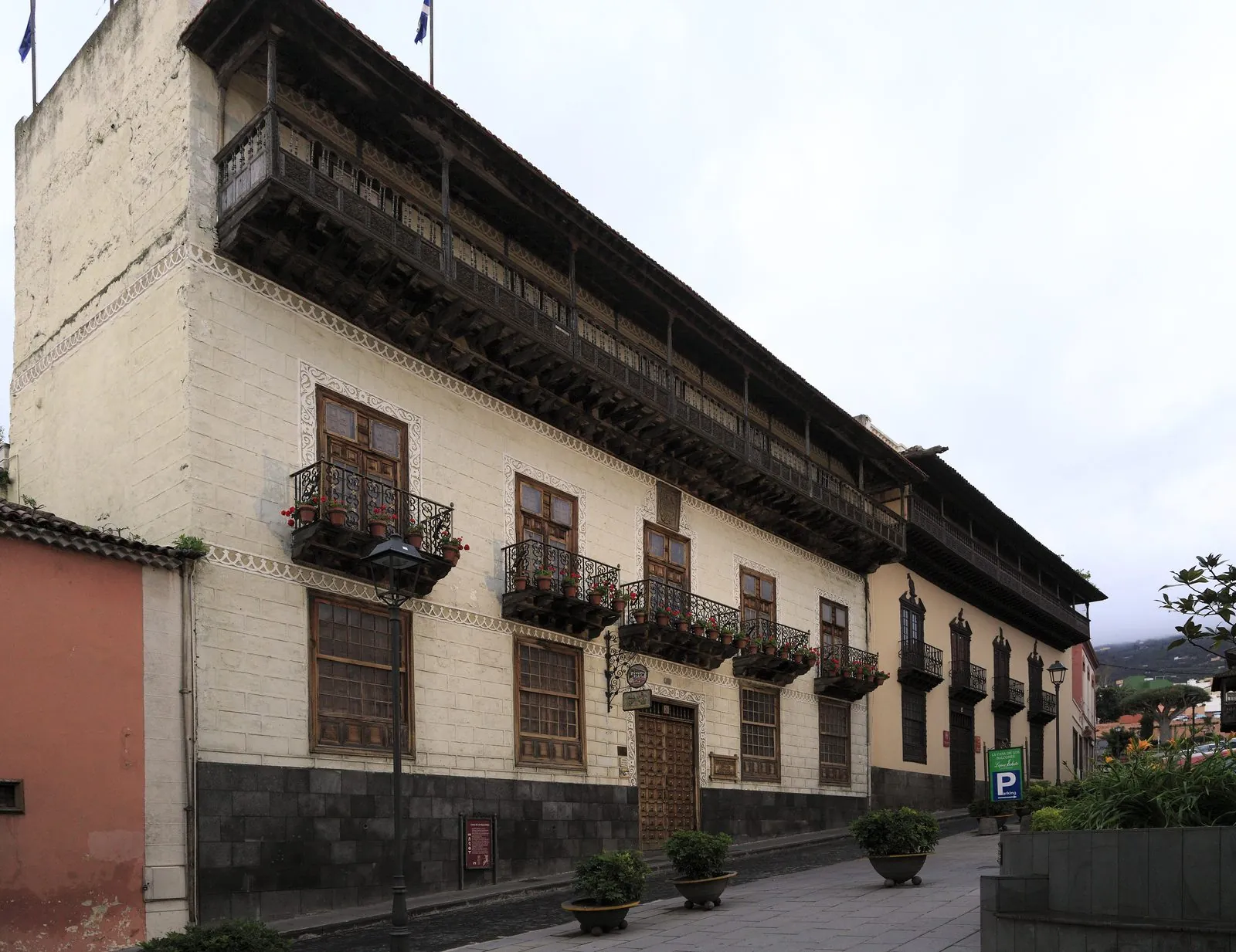
Photo: Falk2 · CC BY-SA 4.0 · Wikimedia Commons · scaled
The carved wooden balcony
If one feature says "Canarian" above all others, it's the balcony. Across the islands, the fronts and inner courtyards of old houses are hung with balconies of dark, richly worked pine — some plain and sturdy, others carved into intricate lattices, turned balusters and lidded galleries that run the whole width of a house. The finest are true works of joinery, assembled without nails and glowing with age. They served a practical purpose too, catching the breeze, shading the rooms below and letting the household watch the street unseen. In the ports, upper-floor timber galleries let merchant families look out over the harbour.
The absolute showcase of Canarian balconies is the seafront row at Santa Cruz de La Palma, where a line of tall old houses trails wooden balconies right along the waterfront — one of the most photographed sights on the islands.
Whitewashed and colour-washed houses
The classic Canarian house is low, thick-walled and flat- or gently tile-roofed, its walls limewashed brilliant white to bounce away the sun. But the islands love colour too. Window surrounds, corner-stones, doors and balconies are often picked out in deep green, ox-blood red, blue or ochre, giving whole streets a cheerful, painted quality. On Lanzarote the tradition took on a strict, beautiful discipline — white houses with green woodwork inland and blue on the coast — a code championed by the artist César Manrique that still shapes the island's low-rise, harmonious look.
The patio — a house turned inward
Behind many a plain street door lies the real heart of the grand Canarian house: the patio. Rooms are arranged around an open central courtyard, often two storeys high and ringed with wooden galleries, cool and shaded, planted with palms, ferns and flowers and centred on a well or fountain. This inward-looking plan — an idea inherited from Andalusia and ultimately from the Roman and Moorish worlds — kept homes private, cool and calm in the island heat. Many of the finest patios now belong to museums, town halls and boutique hotels, so you can step inside and see how the islands' merchant and landowning families once lived.
The colonial towns to explore
The best way to enjoy all this is simply to walk the old towns. A handful preserve their historic centres almost intact.
| Town | Island | What to see |
|---|---|---|
| La Laguna | Tenerife | UNESCO-listed old capital; a grid of noble houses, patios and churches |
| La Orotava | Tenerife | Grand mansions, balconies and steep flower-filled streets |
| Teguise | Lanzarote | The former island capital; white houses and a famous Sunday market |
| Betancuria | Fuerteventura | Tiny, tranquil first capital tucked in the hills |
| Vegueta (Las Palmas) | Gran Canaria | The islands' oldest quarter, where the conquest began |
San Cristóbal de La Laguna is the jewel: Tenerife's old capital and a UNESCO World Heritage Site, laid out on an early grid plan that was copied across Spain's American colonies. Its streets are lined with noble houses, their doorways opening onto galleried patios. Nearby, La Orotava tumbles down a hillside in a cascade of grand mansions and carved balconies, most famously the Casa de los Balcones. On Lanzarote, the old capital of Teguise is a serene grid of whitewashed houses that bursts into life for its Sunday market. And in Vegueta, the first-founded quarter of Las Palmas on Gran Canaria, cathedral, colonial mansions and the Casa de Colón cluster around handsome plazas.
Living in the rock — the cave houses
Not all traditional homes were built up; some were dug in. Across Gran Canaria and beyond, islanders carved houses directly into the soft volcanic rock, cool in summer and warm in winter — a tradition stretching back to the aboriginal Guanches and still lived in today. Discover this remarkable strand of island building in our guide to the cave houses of the Canaries.
Many old patios and balconied houses are private homes. Where they're open — as museums, shops or hotels — you're welcome inside, but elsewhere admire from the street and ask before photographing through someone's doorway.
Why it's worth seeking out
It's easy to spend a Canary holiday entirely on the coast and never see this side of the islands — which would be a shame, because the old towns are where their character lives. An hour wandering La Laguna's streets or La Orotava's balconied hillside, coffee in a courtyard café, tells you more about the islands' history and soul than any resort ever could. Pair a town visit with our guides to the islands' crafts and what to buy and their history, and let the carved balconies and whitewashed walls lead you back through five centuries of island life.