Lagomar is a house built into the wall of an old volcanic quarry at Nazaret, in the middle of Lanzarote, and in 2026 it is open to visitors as a small museum with a café, bar and restaurant on site. You walk through rooms that are partly caves and partly built, along tunnels and up steps cut into the rock, past a green pool fringed with palms, and out onto terraces that look across the plain towards Teguise. It takes about an hour and it is unlike any other house you are likely to walk round.
Two famous names hang over the place. One is César Manrique, the artist who shaped modern Lanzarote, whose influence is everywhere in the design even though the person who actually built it was his collaborator Jesús Soto. The other is Omar Sharif, the star of Lawrence of Arabia and Doctor Zhivago, who is said to have bought the house and lost it in a single hand of cards. That second story is the one every coach guide tells, and it is almost certainly not true.
This page explains what Lagomar is, who really made it, what the Sharif legend is worth, and how to fit a visit into a day on the island. If you have already been to Manrique's own home at Tahíche, Lagomar is the natural next stop: the same idea, carried further into the rock, on a more domestic scale.
What you actually see
The setting comes first. Nazaret sits at the foot of a hill that was quarried for building stone, and the excavation left a sheer, layered face of brown and ochre volcanic rock. Lagomar was not placed in front of that wall but pushed into it. The rooms follow the existing hollows and tunnels, so a kitchen, a living room or a bedroom may have a rough cave ceiling overhead and a whitewashed wall on one side, with a window looking straight out from the cliff.
Between the rooms run narrow passages, twisting staircases and small bridges, some of them only wide enough for one person at a time. At the bottom of the quarry is the lake that gives the place half its name: a pool of still, greenish water ringed by palms and cactus, with the rock face rising behind it. Above, terraces and viewing platforms catch the light and the breeze. The overall effect is less a house than a small village folded into a cliff, and it rewards slow walking rather than a quick circuit.
Inside, the furnishing is sparse. A room on the upper level holds old photographs and panels on the building's history, and there are sculptures and art pieces placed through the grounds. Children tend to love it, because it is essentially a maze with secret passages; anyone with stiff knees should know there are a lot of uneven steps.
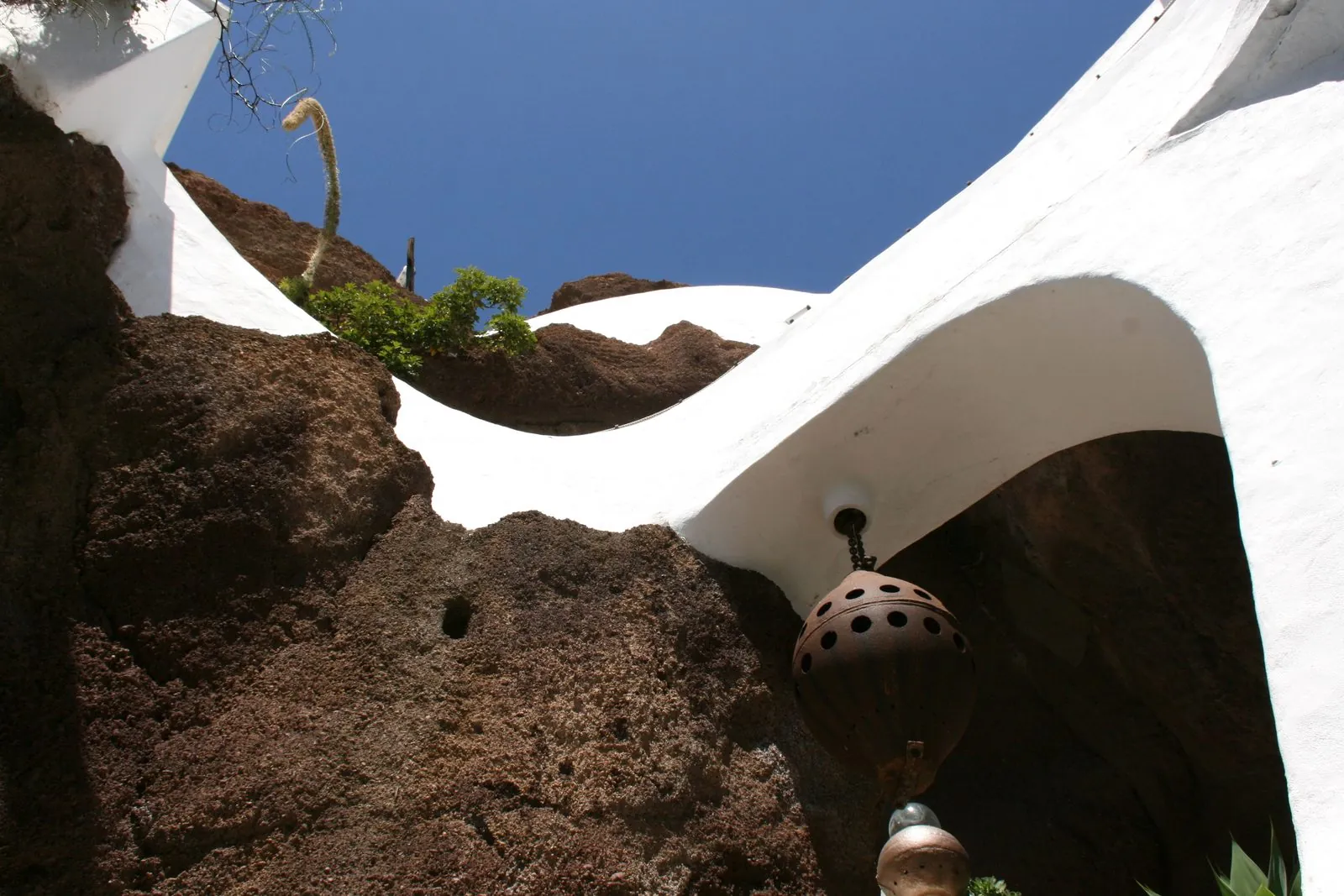
Photo: Frank Vincentz · CC BY-SA 3.0 · Wikimedia Commons · scaled
The detail most visitors walk past
Look up at the ceilings. The heavy timber beams in several of the rooms were not bought from a merchant. According to Teguise's own tourism office, they were salvaged from ships wrecked on Lanzarote's coast, and they still carry the marks and the weathering of their first life. On an island that has almost no trees of its own, wood washed up by the Atlantic was a resource, and the builders of Lagomar used it the way island farmers had always used whatever the sea delivered.
It is a small thing, but it is the key to the whole building. Almost nothing at Lagomar is imported or decorative for its own sake: the walls are the quarry, the stone is local lava, the roof timbers are wreckage, the plants are the ones that survive here without help. That is precisely the philosophy Manrique preached about building on Lanzarote, which is why the house is so often put down to him.
Manrique, Soto, and who really designed it
Lagomar is regularly described as "a Manrique house". The truth is more interesting and a little more modest. The building is attributed to Jesús Soto, a Canarian artist who worked closely with Manrique for years. Soto is the man the island council commissioned in the 1960s to turn the Cueva de los Verdes into a show cave, laying the path and designing the lighting and sound that visitors still walk through today. He knew how to work with volcanic hollows better than almost anyone on the island.
Manrique's role is harder to pin down. Some accounts say the original owner commissioned the house from Manrique and that he worked on it with Soto; others credit Soto alone and treat Manrique as the inspiration rather than the designer. What is clear is that Lagomar is not one of the seven tourist centres that Manrique created for the island and that the Cabildo still runs, and it is not managed by the foundation that looks after his legacy. It is privately owned and privately operated.
The fair way to put it is that Lagomar belongs to the Manrique school without being a Manrique work in the way that Jameos del Agua or the Mirador del Río are. If you want to understand where the ideas came from, the place to start is our portrait of César Manrique the artist, and the house he built for himself, now the Fundación César Manrique at Tahíche, a few minutes' drive away.
The Omar Sharif story, and what it is worth
The legend runs like this. Omar Sharif, on Lanzarote for filming in the early 1970s, saw the house, fell for it and bought it on the spot. Sharif was also one of the best-known bridge players in the world, and the story goes that shortly afterwards he sat down to a game with the house's builder or another local figure, staked the property and lost it. In some versions it happens within a day of the sale; in others it takes a little longer.
There is no evidence that any of it happened. Recent reporting in the local English-language press says the current owners themselves accept it is a legend and that there is no record of Sharif ever owning the property. What does seem solid is that Sharif was on the island in the early 1970s: he played Captain Nemo in a European television adaptation of The Mysterious Island made at that time, and Lanzarote's lunar landscapes were used in a good deal of film and television of that era, as our page on the islands on screen describes. He is said to have allowed his name to be associated with the place afterwards.
The name looks like part of the joke. The centre often writes itself as LagOmar, with a capital O in the middle: lago for the lake, mar for the sea, and Omar hiding in between. Enjoy the story as a story. It is a good one, it sells tickets, and nobody at the door will be offended if you do not believe it.
Do not quote the card game as fact. Many websites, and some printed guides, state flatly that Sharif lost Lagomar at bridge. None of them cites a source, and the people who run Lagomar no longer claim it. Treat any version with a precise date, a named winner or a sum of money as embroidery.
What Lagomar is today
Today Lagomar works as a combination of museum, gallery and hospitality venue. You buy a ticket at the entrance and are free to wander the house and grounds at your own pace; there are information panels but no compulsory guided tour. Tour companies on the island also sell packages that combine entry with a guide, and some of these include early access before the coaches arrive.
The café and bar sit around the courtyard and pool, and there is a restaurant on site that operates as a separate business from the museum, with its own hours. That matters if you are planning to eat there in the evening: online listings disagree about when the kitchen and bar open, with some showing lunchtime service and others evening only, so check the current arrangement directly rather than relying on an older review.
The venue also leans on its Sharif connection in a gentler way, by hosting bridge games and tournaments. If you arrive on an event day, parts of the site may be busier than usual.
Opening hours, tickets and practicalities
Recent visitor information gives museum hours of roughly 10:00 to 18:00, daily. Ticket prices have risen over the years: older guides quote around €6 for an adult, while 2026 reports put adult entry at around €10, with reduced rates for children and for Canarian residents. Treat these as typical rather than guaranteed and confirm on the day, because private bookings can affect access.
- Time needed: about an hour for the house and grounds, longer if you stop for a drink.
- Footwear: proper shoes, not flip-flops. The steps are uneven and some are steep.
- Accessibility: very limited. Much of the house can only be reached by stairs and narrow passages, so wheelchair users and anyone using a pushchair will see only part of it.
- Tickets: bought at the entrance; resellers also sell entry online, sometimes bundled with a guide.
- Not a CACT centre: Lagomar is private and not one of the Cabildo's tourist centres, so it has its own ticket; the island's other sights are each paid for separately too.
Getting to Nazaret
Nazaret is a small village in the municipality of Teguise, on the road between Tahíche and the old town of Teguise. It is a short drive inland from Costa Teguise and roughly a quarter of an hour from Arrecife. The village is small and quiet, and the address to put into a satnav is Calle los Loros in Nazaret.
By car is by far the easiest way. Local buses do pass through the area on the routes towards Teguise, but services to the smaller villages are not frequent, and our page on Lanzarote's buses will tell you what is realistic. A taxi from Costa Teguise is a short, inexpensive hop, and plenty of island tours include Lagomar as one stop in a half-day circuit.
Make it a Sunday morning pairing. Teguise is only a few minutes up the road, and its Sunday market is the biggest on the island. Arrive at Lagomar when it opens at ten, before the market crowds spread out, then drive on to Teguise and its Sunday market for late morning. The other way round, you will hit both at their busiest.
How it fits into a day on Lanzarote
Lagomar sits in the middle of the island's Manrique country, and the obvious day out links it with the places that explain it. Start at the Fundación at Tahíche, Manrique's own house built inside a chain of lava bubbles, then drive the few kilometres to Nazaret and see how Soto took the same idea into a quarry wall. In the afternoon, head north to the Jameos del Agua or south-west to the Monumento al Campesino, the island's tribute to its farmers, which sits close to the geographical centre of Lanzarote.
That loop covers a good share of the Manrique trail across Lanzarote, and none of the drives is longer than half an hour. If you are interested in the wider tradition of living inside rock, which runs from Guanche caves to modern homes on several islands, our page on the cave houses of the Canaries puts Lagomar into context.
Is it worth the stop?
For most visitors, yes. Lagomar is smaller than the big Cabildo centres and less polished, and part of its charm is that it still feels like a house rather than an attraction. It is at its best for anyone interested in architecture, for families with children old enough to manage the steps, and for anyone who has seen the Fundación and wants a second, more eccentric take on the same idea.
Go for the building, not the celebrity. The Sharif legend is fun, but what stays with you is the way a quarry scar was turned into somewhere people actually lived, using wreck timber, lava and a pool of water at the bottom of a pit. It is a short detour from almost anywhere on Lanzarote, and an hour well spent before lunch in Teguise.