Of all the extraordinary places César Manrique created on Lanzarote, none is more personal than the home he built for himself at Taro de Tahíche — a house set partly inside a string of volcanic bubbles left by a lava flow, now open to visitors as the Fundación César Manrique. It's the clearest possible expression of the artist's guiding idea: that people can live beautifully with nature rather than against it. Wander from bright white rooms above ground into cavern-like living spaces hollowed from the lava below, and you understand at a glance the man who shaped modern Lanzarote.
A house inside the lava
When Manrique returned to Lanzarote in the late 1960s, he chose to build on a field of solidified lava from the great 18th-century eruptions. Where the flow had cooled it had left a series of large volcanic bubbles, and Manrique turned five of them into interconnected rooms, linking the underground chambers with whitewashed corridors and planting them with living trees that reach up towards openings in the roof. Above, the house is classic Manrique — crisp white walls, black lava, splashes of colour, sea and sky. Below, it's a cool, otherworldly warren where a fig tree grows out of the rock and a swimming pool glows against black stone. It served as his home for around two decades.
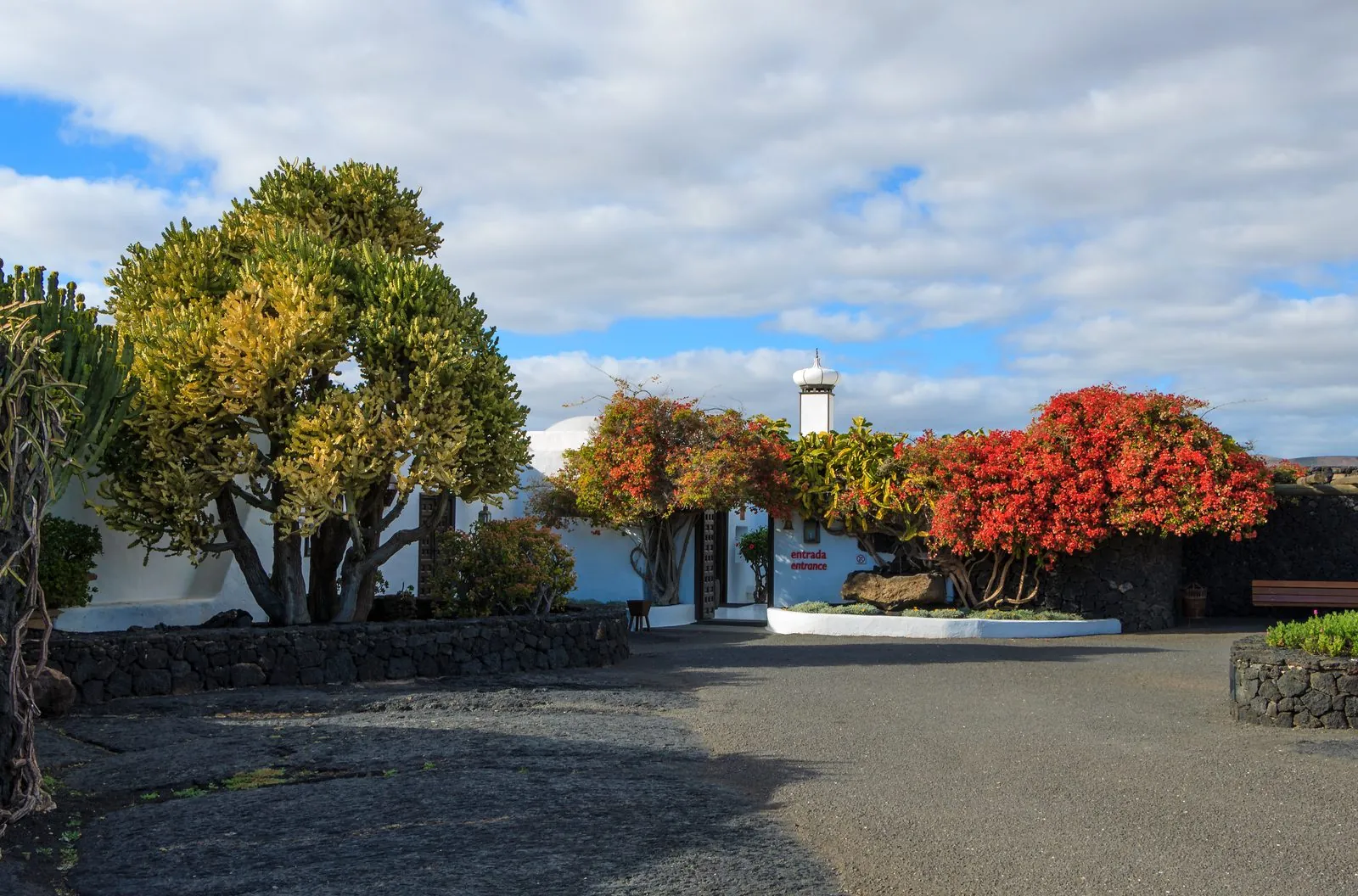
Photo: H. Zell · CC BY-SA 3.0 · Wikimedia Commons · scaled
Living with the volcano
The bubble rooms are the emotional heart of the visit. Each is a whole space carved out of a lava void, painted white and furnished simply, connected by tunnels that were once natural channels in the rock. It's playful and serene at once, and it makes Manrique's philosophy tangible: instead of flattening the volcanic landscape, he moved into it. That same instinct runs through all his island projects, from Jameos del Agua and the Jardín de Cactus to the clifftop viewpoint at Mirador del Río.
Understand the man first. A few minutes with our profile of César Manrique the artist will deepen the visit enormously — his story explains why the whole of Lanzarote looks the way it does, and why this house matters so much.
Art, workshop and legacy
The upper level of the property now works as a museum and gallery. You'll see Manrique's own paintings and sculptures alongside pieces by contemporaries he admired — there are works on paper and canvas, and rotating exhibitions — plus his airy former studio, left much as it was. Since his death in 1992, the Fundación has run from here, working to protect the island's landscape and keep his vision alive. It's a fitting home for it: the building is itself the greatest work on show.
Tahíche and Haría
The Fundación sits at Tahíche, in the middle of Lanzarote and an easy drive from the capital, Arrecife, or the main resorts. Note that this is not the same as Manrique's later home in Haría, the pretty "valley of a thousand palms" in the green north, which is preserved separately as the Casa-Museo. Both are run by the Fundación and both are wonderful; if you're a fan, a combined ticket covering the two makes a lovely day exploring the artist's private world.
Do the two houses together. The Tahíche foundation (the lava-bubble home) and the Haría house-museum tell two chapters of Manrique's life. A combined ticket links them, and the drive up to leafy Haría through the volcanic interior is beautiful in its own right.
Planning your visit
The Fundación opens daily with a standard admission charge, with cheaper tickets for children and a combined option covering the Haría house-museum; as of 2026 both remain reasonably priced, but hours and prices can change, so check the official site — fcmanrique.org — before you go. Allow around an hour and a half, more if you linger over the art or stop at the café. It's one of the busier Manrique sites, so an earlier start helps you enjoy the bubble rooms in relative calm.
Why you shouldn't miss it
If you visit only one Manrique site on Lanzarote, this is a strong contender — it's where his whole vision began, and where his art and his life meet most intimately. Combined with the MIAC at the Castillo de San José and the other stops on our Manrique trail, it turns a beach holiday into a proper cultural adventure. For more ideas, see our full list of things to do.
A home built inside five volcanic bubbles, where a fig tree grows from the lava — the Fundación César Manrique is the artist's soul made architecture.