The Jardín de Cactus was César Manrique's last great work — and, many would argue, his most perfect. On the northeast side of Lanzarote, near the village of Guatiza, he took a disused volcanic quarry and turned it into a sculpted, terraced amphitheatre planted with thousands of cacti from around the world. Crowned by a restored old windmill and encircled by curving stone walls, it's as much a piece of art as a garden — the clearest possible expression of his lifelong belief that even an industrial scar could be made beautiful.
From quarry to masterpiece
Before Manrique got to work, the site was a rofero — a pit dug out to extract the volcanic gravel (rofe or picón) that Lanzarote's farmers spread on their fields to trap moisture. When the digging stopped, it became a rubbish-strewn hole in the ground. Manrique saw potential where others saw a dump. Using the excavated bowl as his starting point, he shaped it into a spiralling series of terraces, cut steps and walkways into the black rock, and set curving grey-stone planters throughout — turning the very shape of the old quarry into the bones of the design. Work finished in 1990, and it proved to be his final major project on the island before his death two years later.
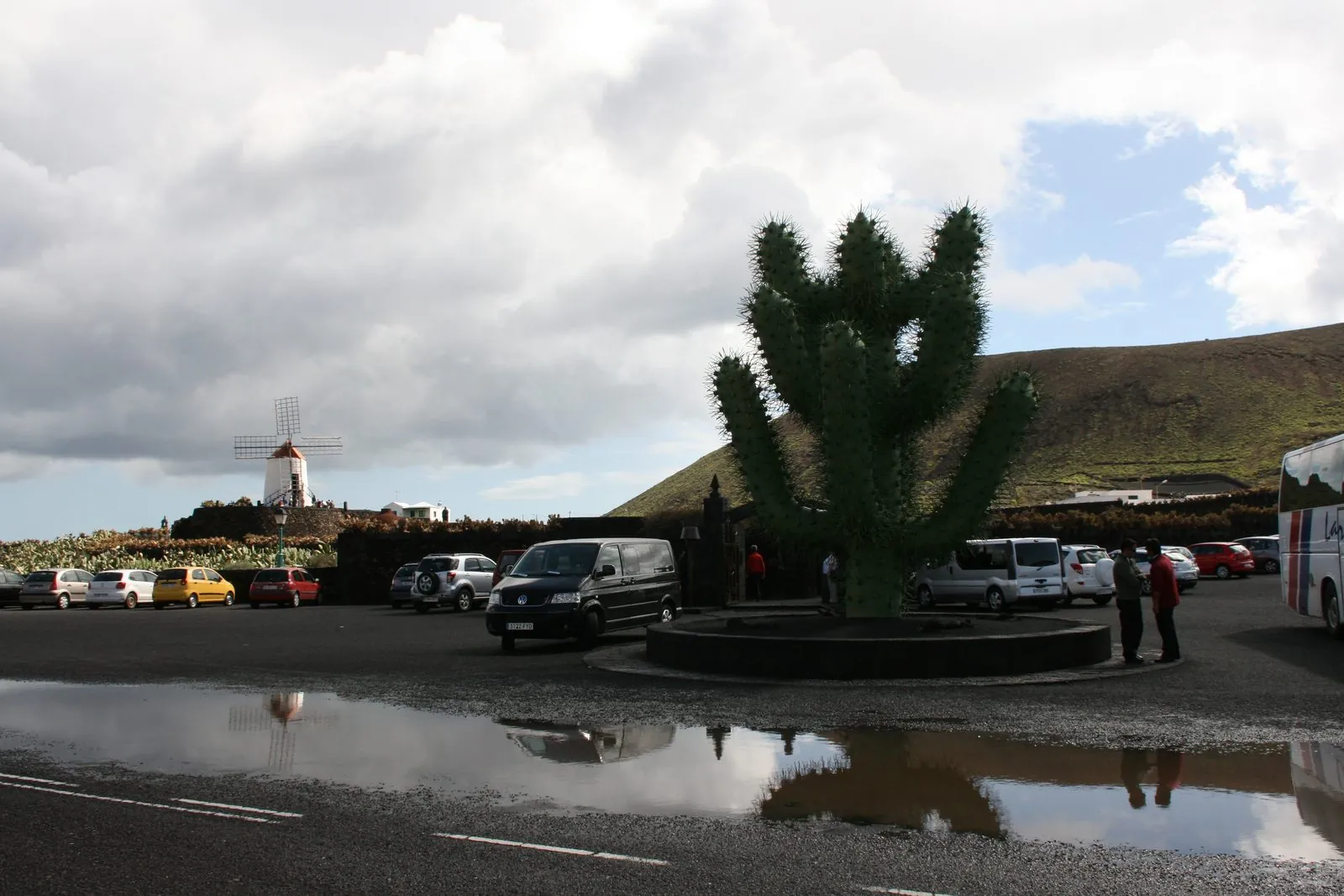
Photo: Frank Vincentz · CC BY-SA 3.0 · Wikimedia Commons · scaled
Around 4,500 cacti
The garden holds in the region of 4,500 cactus plants, drawn from hundreds of species and five continents — a living collection that ranges from squat, fist-sized specimens to towering columns several metres tall. Walking the terraces, you pass prickly pears, barrel cacti, spiny giants and strange, sculptural forms that look almost man-made. Manrique arranged them not as a botanist would, in tidy labelled rows, but as an artist would, playing with height, silhouette and the contrast between green flesh, silver spines and jet-black gravel. The effect changes constantly as the light moves across the bowl through the day.
Go for the light. Late afternoon is magical here, when low sun rakes across the spines and long shadows fall down the terraces. It's also cooler than the middle of the day, when the sheltered bowl can get hot, and better for photographs of the windmill against the sky.
The windmill and cochineal country
Crowning the rim of the garden is a beautifully restored gofio windmill — one of the last of its kind still standing on the island. Step inside and you can see the old milling gear that once ground toasted grain into gofio, the roasted-flour staple of Canarian cooking. The setting is no accident: the surrounding fields of Guatiza and Mala are planted with the prickly-pear cactus that hosts the cochineal insect, once farmed here in huge quantities to produce a prized natural crimson dye. Manrique's cactus garden is a witty, affectionate nod to the very crop that shaped this corner of Lanzarote.
Design in the details
As at all his sites, it's worth slowing down to notice the small things. There's a striking metal-and-stone cactus sculpture at the entrance, a little café-bar where you can sit with a drink and survey the whole bowl from above, and — a lovely surprise — a resident population of frogs and koi in a small pool near the base. Even the toilets and railings carry Manrique's signature curves. Nothing is generic; everything belongs.
Tickets and the CACT network
The Jardín de Cactus is run by the CACT (Centros de Arte, Cultura y Turismo), the island's public cultural body that manages most of the Manrique attractions. Entry is ticketed per site, and if you're seeing more than one a combined pass generally works out cheaper.
Look into a combined ticket. As of 2026, single-site adult entry is typically around €5–10, with multi-site passes and reductions for children and residents. Because prices and opening hours shift with the season, check the current details on the official CACT Lanzarote website before your visit.
Where it fits in your trip
The garden sits roughly midway between the northern caves and central Lanzarote, so it pairs neatly with the Fundación César Manrique at Tahíche on a day exploring the middle of the island, or slots into the drive up to the northern trio of Jameos del Agua, Cueva de los Verdes and Mirador del Río. It's compact — an hour or so is plenty — which makes it easy to combine with a longer outing. A hire car makes reaching it simple.
If the family enjoys gardens and gentle attractions like this, it's a short leap in spirit to the lush aviaries and hillside grounds of Guinate Tropical Park further north. And to understand how the Jardín de Cactus caps a whole life's work, read our overview of César Manrique's Lanzarote. Browse more things to do across the Canaries to weave it into the rest of your holiday.
He took a rubbish-filled quarry and grew a masterpiece out of it — the Jardín de Cactus is Manrique's final, and finest, act of turning scar into beauty.