Mirador del Río is the view César Manrique hid inside a cliff. From the top of the Famara escarpment at Lanzarote's northern tip, the land drops away several hundred metres straight down to the sea, and across the narrow strait floats the low green island of La Graciosa and the scattered islets of the Chinijo archipelago. Manrique carved a viewpoint into the rock so discreetly that from the approach road you'd barely know it was there — and then opened it up inside to reveal one of the most breathtaking panoramas in the Canaries.
Architecture that disappears
Built in the early 1970s on the site of an old military gun battery, Mirador del Río is a masterclass in Manrique's guiding principle: architecture that serves the landscape rather than competing with it. From outside, the structure is almost invisible, its curved white forms tucked into the rim of the cliff and topped with stone so it reads as part of the mountain. You enter through a plain doorway, walk down a curving passage — and then the space suddenly opens into two great domed chambers with vast curved windows framing the sea and sky beyond. It's a deliberate piece of theatre: concealment, then revelation.
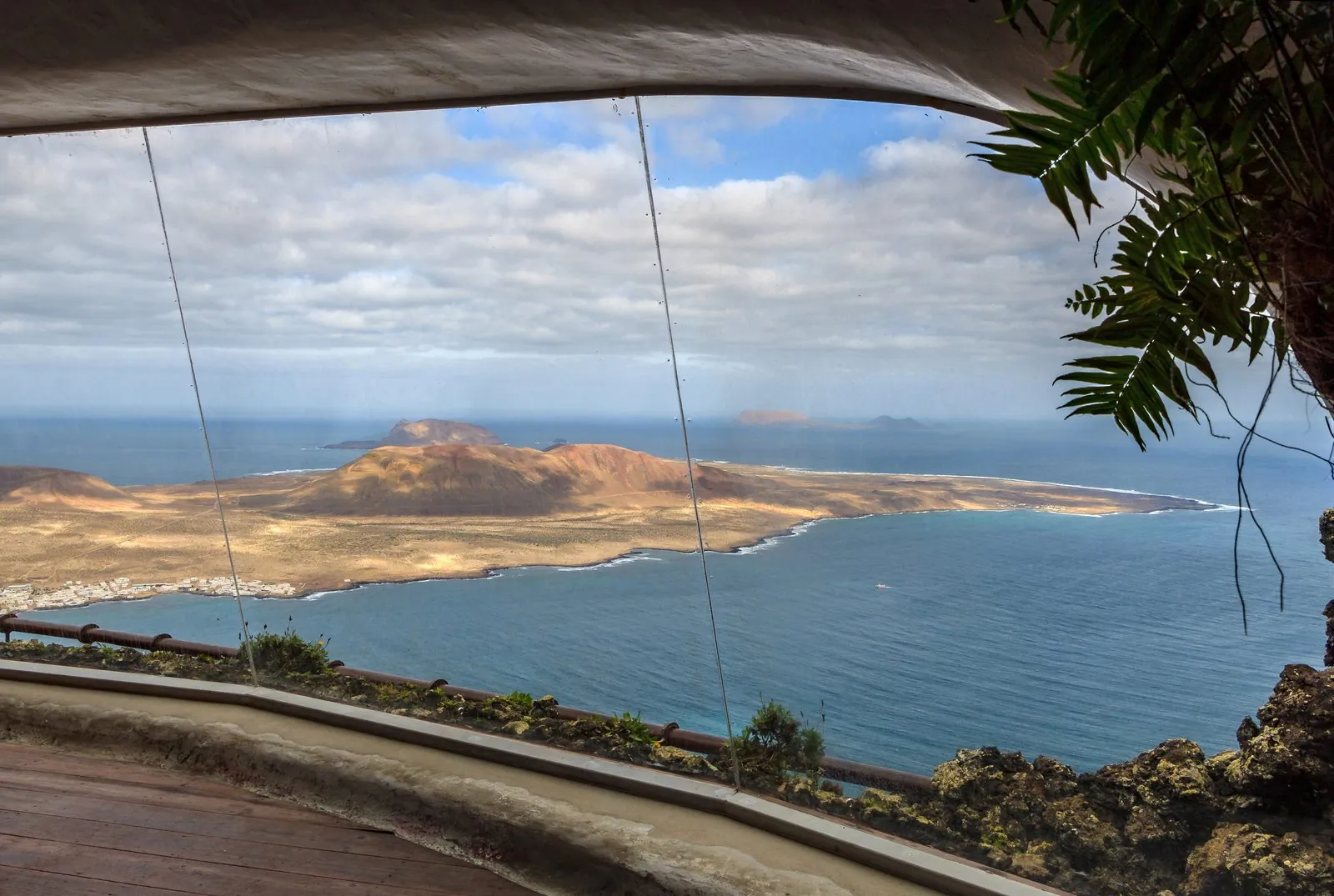
Photo: H. Zell · CC BY-SA 3.0 · Wikimedia Commons · scaled
The view
And what a revelation it is. Directly below lie the salt pans of the old Salinas del Río, and beyond them the strait known as El Río — "the river" — that gives the viewpoint its name. Across the water sits La Graciosa, the smallest of the inhabited Canary Islands and officially the eighth, its sandy tracks and tiny harbour village clearly visible on a clear day. Further out you can pick out the uninhabited islets of Montaña Clara, Alegranza and the two rocky Roques that make up the rest of the Chinijo Archipelago, the largest marine reserve in Europe. On a bright morning the colours — white salt, blue sea, gold sand, black rock — are unforgettable.
Come on a clear day and bring a jacket. This is one of the windiest, most exposed corners of the island, and cloud can roll in over the cliff top even when the resorts are basking. A crisp, clear morning gives the sharpest views across to La Graciosa — and it's usually cooler and breezier up here than down on the coast.
The café and terrace
Inside the domes you'll find a café where you can sit with a coffee and take in the view through those huge sculpted windows — a wonderfully relaxed way to enjoy the panorama out of the wind. Manrique's signature touches are everywhere, from the flowing white curves of the ceilings to a couple of his hanging metal sculptures. Step out onto the terrace and the view opens up fully, with nothing between you and the drop but a low wall. It's the sort of place where you plan to stay ten minutes and end up lingering for an hour.
Getting there
Mirador del Río sits at the far north of the island, reached by a scenic drive up through the pretty valley town of Haría — the "valley of a thousand palms" where Manrique spent his final years — and on across the high ground of the Risco de Famara. The road is easy but winding, and the scenery on the way is half the pleasure, so allow plenty of time and consider combining the trip with a wander around Haría's leafy square and weekly craft market. A hire car is much the easiest way to reach this remote corner.
Tickets and the CACT network
Like most of the island's flagship sites, Mirador del Río is run by the CACT (Centros de Arte, Cultura y Turismo), Lanzarote's public cultural body. Entry is ticketed, and if you're visiting several Manrique attractions a combined pass usually saves money over paying for each separately.
Consider a combined ticket. As of 2026, single-site adult entry is typically in the region of €5–10, with multi-site passes and reductions for children and residents. Prices and opening hours vary by season, so check the current details on the official CACT Lanzarote website before you go.
Combine it with the northern sites
Mirador del Río forms a natural trio with the two halves of the Corona lava tube nearby — Jameos del Agua and its blind albino crabs, and the underground galleries of Cueva de los Verdes. All three lie within a short drive of one another in the island's north, so it's easy to see them in a single day. If you're tempted to go a step further, boats cross the strait from the port of Órzola to La Graciosa itself — a wonderful car-free day trip once you've admired the island from above.
To see how this viewpoint fits into the artist's wider legacy, read our overview of César Manrique's Lanzarote, and browse more things to do across the Canaries to plan the rest of your holiday. Few places sum up the island so completely: Manrique's design, the volcanic drama and the endless blue of the Atlantic, all working as one.
Hidden in a cliff, opening onto half a sea of islands — Mirador del Río is the view Lanzarote keeps up its sleeve.