Gáldar is one of the most historically important towns in the Canary Islands — the ancient royal capital of Gran Canaria's aboriginal people, and home to the Cueva Pintada, a decorated cave whose geometric wall paintings are among the finest relics of pre-conquest island life. Set in the fertile, banana-growing north-west, it's a proper town with deep roots, ideal for anyone who wants to understand the island before the Spanish arrived.
Come for the extraordinary painted cave and its museum, a dignified old town crowned by an ancient dragon tree, and the sense of standing somewhere that really mattered long before the resorts existed. It pairs beautifully with the coast and mountains of the northern Gran Canaria.
What it's like
Gáldar sits beneath its own volcanic cone, the Montaña de Gáldar, in the green, cloud-fed north-west where bananas and sub-tropical crops thrive. This was the seat of the guanarteme, the aboriginal king who ruled this half of the island, and the town has carried an air of quiet importance ever since. Today it's a busy, workaday place with an elegant historic core, largely untouched by mass tourism.
The atmosphere is authentically local: Spanish on every corner, a proper market, families going about their day. Visitors come mainly for the archaeology and to feel the real texture of island life, and the town rewards a slow, curious wander far more than a quick photo stop.
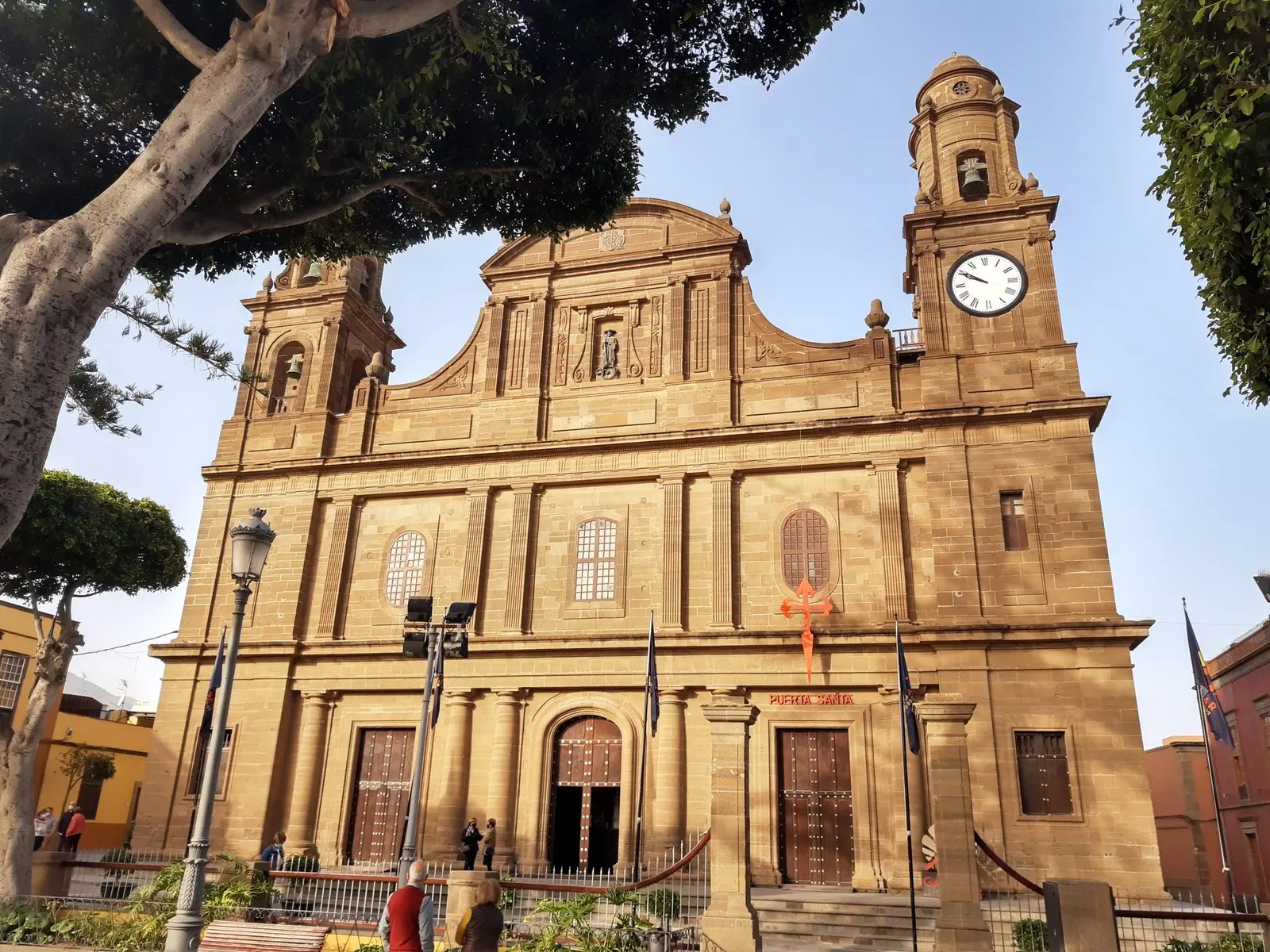
Photo: Gerda Arendt · CC BY-SA 4.0 · Wikimedia Commons · scaled
What to see and do
The Cueva Pintada
Gáldar's treasure is the Cueva Pintada ("Painted Cave"), the single most important archaeological site tied to the island's aboriginal Guanches — or more precisely the ancient Canarians of Gran Canaria. Rediscovered in the 19th century and now protected inside a striking modern museum, its walls carry bold geometric friezes of red, white and black triangles and squares whose exact meaning is still debated. The excavated village around it, a whole quarter of ancient dwellings, is revealed on a walkway above the dig. Guided visits explain how these islanders lived, farmed and worshipped before the 15th-century conquest. Our guide to the Cueva Pintada covers what to expect; because visitor numbers are limited to protect the paintings, it's wise to book ahead.
Access to the painted chamber itself is carefully controlled and timed to preserve the fragile pigments. Booking your slot online in advance — as of 2026 — is the surest way to avoid disappointment; check the official museum site for opening days and prices.
The old town and the drago tree
The historic centre is a pleasure to explore on foot. Around the main square stand the neoclassical church of Santiago de los Caballeros and the handsome town hall — and in the town hall's courtyard grows a magnificent old dragon tree (drago), one of the most celebrated on the island, said to be among the oldest of its kind. These strange, umbrella-shaped trees are a Canarian icon; you can read more in our feature on the Canarian dragon tree. The theatre, the market and the shady plazas complete a genuinely characterful old core.
Nearby archaeology
The area is thick with pre-Hispanic sites. Just outside town, the necropolis and coastal sites hint at how densely this fertile corner was settled, and a short drive east brings you to the remarkable granary caves of Cenobio de Valerón, a honeycomb of storage cavities dug into a cliff. Together they make Gáldar the natural base for an "ancient island" day.
Where to stay and eat
Gáldar is a day-trip town rather than a resort, and most visitors stay in Las Palmas or the south and drive over. A few small guesthouses and rural cottages nearby suit travellers who want a quiet, local base.
Eating is honest and good value: local restaurants around the centre serve Canarian home cooking, fresh fish from the nearby coast and, of course, papas arrugadas with mojo. Down at the town's fishing harbour and the neighbouring coast you'll find excellent seafood spots — read more in our Canarian food guide.
Getting there and around
Gáldar lies on the north-west coast, roughly 30 minutes' drive from Las Palmas on the fast northern motorway and about an hour and a half from the southern resorts. A hire car is the most flexible way to visit and to link Gáldar with the surrounding villages and coast — see our guides to getting around and car hire. Regular buses (guaguas) also connect the town with the capital.
Nearby
Gáldar sits in a wonderfully rich pocket of the island. Just west along the coast, the lovely valley town of Agaete and its harbour, Puerto de las Nieves, offer sea pools and the Tenerife ferry; inland, the roads climb toward the pine forests of Tamadaba and the central peaks. The banana-growing coast around Gáldar also has some of the island's best surf. Start with our Gran Canaria hub to weave this deep-history corner into the rest of your trip.