Playa de las Cucharas is the main beach of Costa Teguise, on Lanzarote's east coast: a golden-sand bay of roughly 640 metres, divided and sheltered by breakwaters of black volcanic rock, with lifeguards, sunbeds and a promenade, and the island's best-known windsurfing schools working straight off the sand. In the morning it is an ordinary, comfortable resort beach. By early afternoon, when the trade wind fills in, it turns into an open-air classroom, with rows of beginners wobbling on boards inside the breakwaters and more experienced sailors out beyond them.
The wind is the thing to understand about this beach. It is why Las Cucharas exists in its current form, why the schools are here, and why some visitors love it and others leave by two o'clock with sand in their sandwiches. Get the timing right and it is one of the easiest beach days on the island.
This page explains how the bay is laid out, what the wind does through the day and the year, what the beach offers families and sailors, and how to get there.
A bay built around breakwaters
Las Cucharas is not a wild, natural beach. Like the rest of Costa Teguise, which was laid out as a planned resort from the 1970s onwards, it was shaped for holidaymakers. A series of rock breakwaters, or groynes, runs out from the shore, holding the sand in place and breaking the bay into a chain of shallow, partly enclosed sections. The Spanish ministry's beach guide puts the whole beach at about 640 metres long and around 20 metres wide, so it is compact: you can walk from one end to the other in under ten minutes.
Those breakwaters are what make the beach work. They take the sting out of the swell, so the water inside them is usually calm and shallow, and they give the sand a series of sheltered corners. Behind the beach runs a promenade lined with apartments, bars, cafés and small shopping centres, and Teguise's tourism office describes the setting, fairly, as a controlled tourist environment. It is tidy, well kept and very much a resort beach.
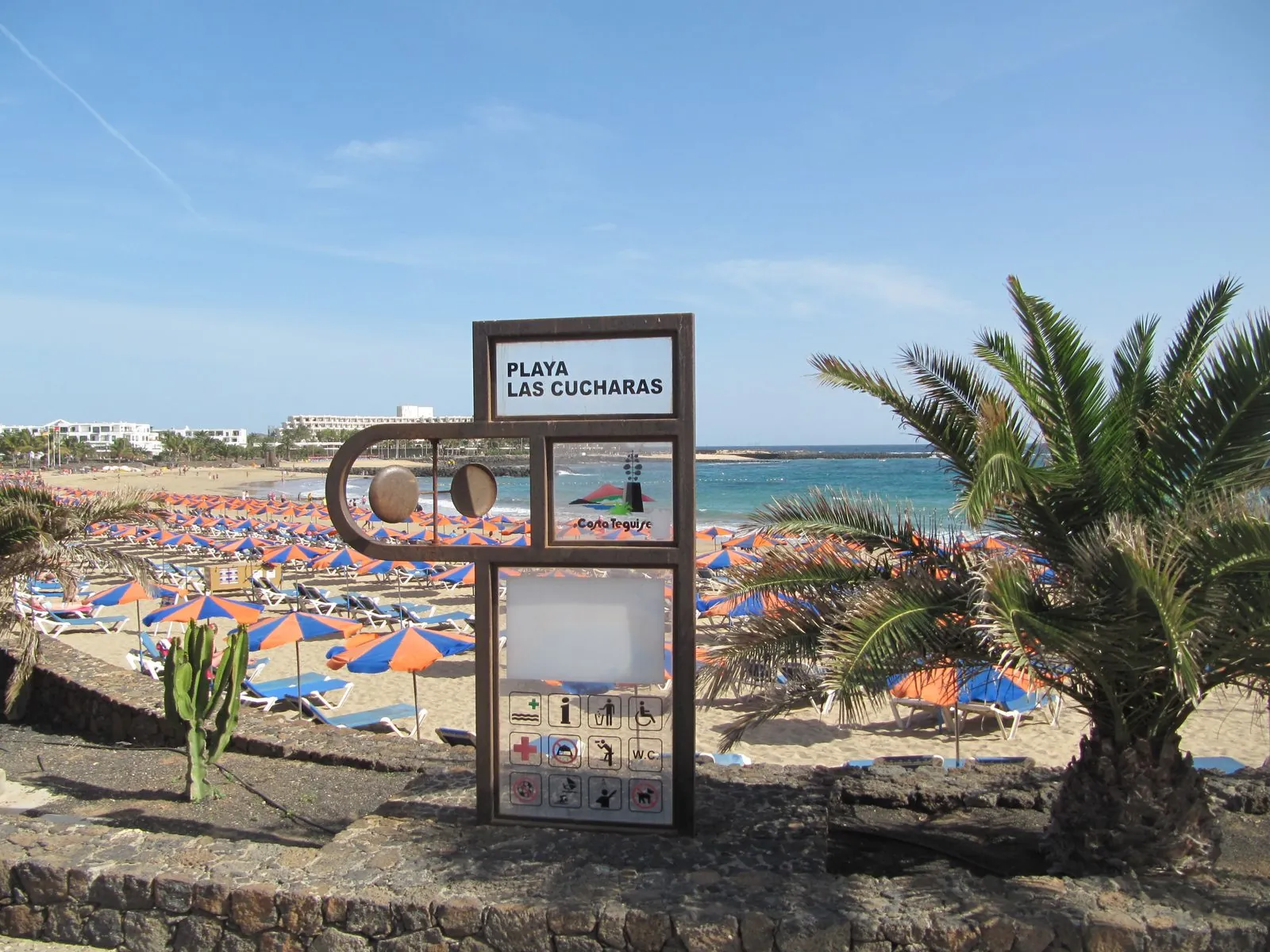
Photo: Michiel1972 · CC BY-SA 3.0 · Wikimedia Commons · scaled
What the trade wind does here
Costa Teguise faces east into the Atlantic, and Lanzarote sits in the path of the north-easterly trade winds, the alisios. On this coast they blow side-on along the beach rather than straight in from the sea or straight out from the land. That matters more than it sounds. A side-shore wind is ideal for learning to windsurf, because a beginner who loses control drifts along the bay rather than out to sea, and can walk back up the beach. It is also why Las Cucharas has been Lanzarote's windsurfing centre almost since the resort was built.
The pattern through the day is fairly reliable. Mornings are often light, sometimes almost still, and then the breeze builds from late morning, peaking in the afternoon. Through the year, the trades are strongest in summer, especially July and August, and usually gentler in winter and spring, though they are rarely absent for long. Our page on how windy the Canary Islands are explains why the east coast catches more of it than the south.
Book the 10 a.m. lesson, not the 3 p.m. one. Instructors at Las Cucharas use the morning lull to get complete beginners standing up in flat water, and save the windier afternoon sessions for people who already know how to turn. If you have never windsurfed before, an early start will feel like a different sport.
Learning to sail at Las Cucharas
Several windsurfing and diving schools operate on and around the beach, according to Teguise's tourism office, offering lessons and equipment hire. Beginners usually start with a short session on land, then move to the shallow water between the breakwaters on wide, stable boards. More confident sailors take their kit beyond the groynes, where the wind accelerates around the headland but the swell stays smaller than on the island's exposed north-west coast at Famara.
The beach also has a place on the professional circuit. Teguise's tourism office says that every June the bay hosts the PWA Windsurf World Championship event known as Costa Teguise – La Santa Surf, a stop on the international windsurfing tour. If you are here in June, check the PWA calendar for that year's dates: watching the freestyle riders from the promenade is free, and the town is busier than usual.
For a wider view of where to sail on all the islands, from beginner bays to wave spots, our guide to windsurfing and kitesurfing in the Canaries compares Las Cucharas with Fuerteventura and Gran Canaria.
Swimming, sunbathing and children
For swimming, the water inside the breakwaters is usually calm, shallow near the shore and clear on a still day. Lifeguards cover the beach, and the standard flag system applies; check our page on beach flags and swimming safety if you are unsure what a yellow or red flag means. The one real hazard on a windy afternoon is the traffic of boards and sails, so swimmers should keep to the bathing area and give the windsurfing zone a wide berth.
Families get the best of the beach in the morning. Toddlers can paddle in the shallows, the sand is soft and golden, and the breeze is light. After lunch, a stiff wind can whip loose sand across the beach and make sunbathing tiring, and small children tend to get cold quickly once they are wet. If you have very young children, the smaller, quieter Playa del Jablillo a short walk away is often calmer, and the page on Lanzarote with kids rates the island's beaches by how gentle they are.
Do not trust a parasol in the afternoon wind. On a windy day at Las Cucharas, an unanchored umbrella can be pulled out of the sand and sent tumbling along the beach. Use the hired parasols, which are fixed, bring a proper windbreak, or plan to leave the sand by early afternoon.
On the sand and along the promenade
The ministry's beach guide lists a full set of services: lifeguards, toilets, showers and footbaths, sunbed and parasol hire, watersports equipment rental, adapted access for people with reduced mobility, parking and beach cleaning. The promenade behind gives you cafés, ice cream and full restaurant meals within a minute's walk, so there is no need to carry a picnic.
The promenade also links Las Cucharas with the rest of the resort. Follow it and you reach the smaller beaches of Los Charcos, Jablillo and Bastián; walk inland and you reach the Pueblo Marinero, the village-style square at the heart of Costa Teguise, about 700 metres away. On a wet or very windy day, the Lanzarote Aquarium is a short walk inland in the El Trébol commercial centre.
Reaching the beach
If you are staying in Costa Teguise you will almost certainly walk. From elsewhere, Intercity Lanzarote's line 1 runs frequently between Arrecife and Costa Teguise, and line 3 runs directly between Costa Teguise and Puerto del Carmen, so you do not need to change in the capital. The nearest stops are at Lanzarote Gardens and at the Pueblo Marinero, each a few hundred metres from the sand. Our page on buses in Lanzarote explains fares and frequencies.
By car, the beach is about 8 kilometres from Arrecife, roughly a quarter of an hour, and around 15 kilometres from the airport. There are free car parks a few minutes' walk from the sand, but in high season they fill early.
Las Cucharas or Playa Grande?
Visitors choosing between Lanzarote's two big resort beaches often compare Las Cucharas with Playa Grande in Puerto del Carmen. Playa Grande is longer, livelier and more sheltered from the trade wind, which makes it the better all-day sunbathing beach. Las Cucharas is smaller, quieter in the evening, windier in the afternoon and far better for anyone who wants to learn a watersport. For a full ranking, our list of the best beaches in Lanzarote puts both in context.
Pairing it with the rest of the island
Costa Teguise is close to some of Lanzarote's most rewarding inland sights, which makes a beach morning at Las Cucharas easy to combine with something else in the windy afternoon. The old town of Teguise, with its famous Sunday market, is a short drive inland, and Intercity Lanzarote's line 11 runs from the resort to the market. Further north, Manrique's Jardín de Cactus at Guatiza is a short drive north, and a fine way to spend a breezy afternoon.
Who Las Cucharas suits, and when to go
Las Cucharas is the right beach for anyone who wants to try windsurfing, for families happy to spend the morning on the sand and the afternoon elsewhere, and for anyone staying in Costa Teguise who wants a tidy, fully serviced beach on the doorstep. It is the wrong choice for a long, still day on a sunbed in July. Come early, swim before the wind arrives, and either pick up a board or head inland when it does. Plan the rest of your stay with our Lanzarote guide.