Playa Grande is the main beach of Puerto del Carmen on Lanzarote: a long, fairly narrow strip of light golden sand running about 1.2 kilometres along the Avenida de las Playas, with usually gentle water, lifeguards in the bathing season and the resort's bars and restaurants directly across the road. It is the beach most people mean when they say they spent the day "on the beach in Puerto del Carmen", and it is the easiest beach on the island to reach without a car.
It is not Lanzarote's most beautiful stretch of sand. That title belongs to the Papagayo coves in the far south. What Playa Grande offers instead is convenience: you can walk down from an apartment in flip-flops, swim, buy an ice cream, hire a pedalo and be back at the pool by lunch. For a family on a first visit to the island, that is often exactly what is wanted.
One thing to sort out before you go: Playa Grande has a second name, and it is the same name as a different resort. That causes more confusion than you might think, and it is explained below.
Two names, one beach
Locals and most English-language guides call it Playa Grande, the big beach, to set it apart from the little cove of Playa Chica a few hundred metres west. But in the Spanish government's official beach guide, and on some maps and tourist board listings, it appears as Playa Blanca. That is also the name of the resort at the southern tip of the island, more than half an hour's drive away, whose own town beaches are a completely different place.
In practice this trips people up in three ways. A satnav search for "Playa Blanca beach" may route you south instead of to the centre of Puerto del Carmen. A taxi driver asked for "Playa Blanca" will reasonably assume you mean the resort. And reviews or official data filed under "Playa Blanca, Tías" are about this beach, not the one in Yaiza. If in doubt, say "Playa Grande, Puerto del Carmen" or ask for the Avenida de las Playas, and you will end up in the right place.
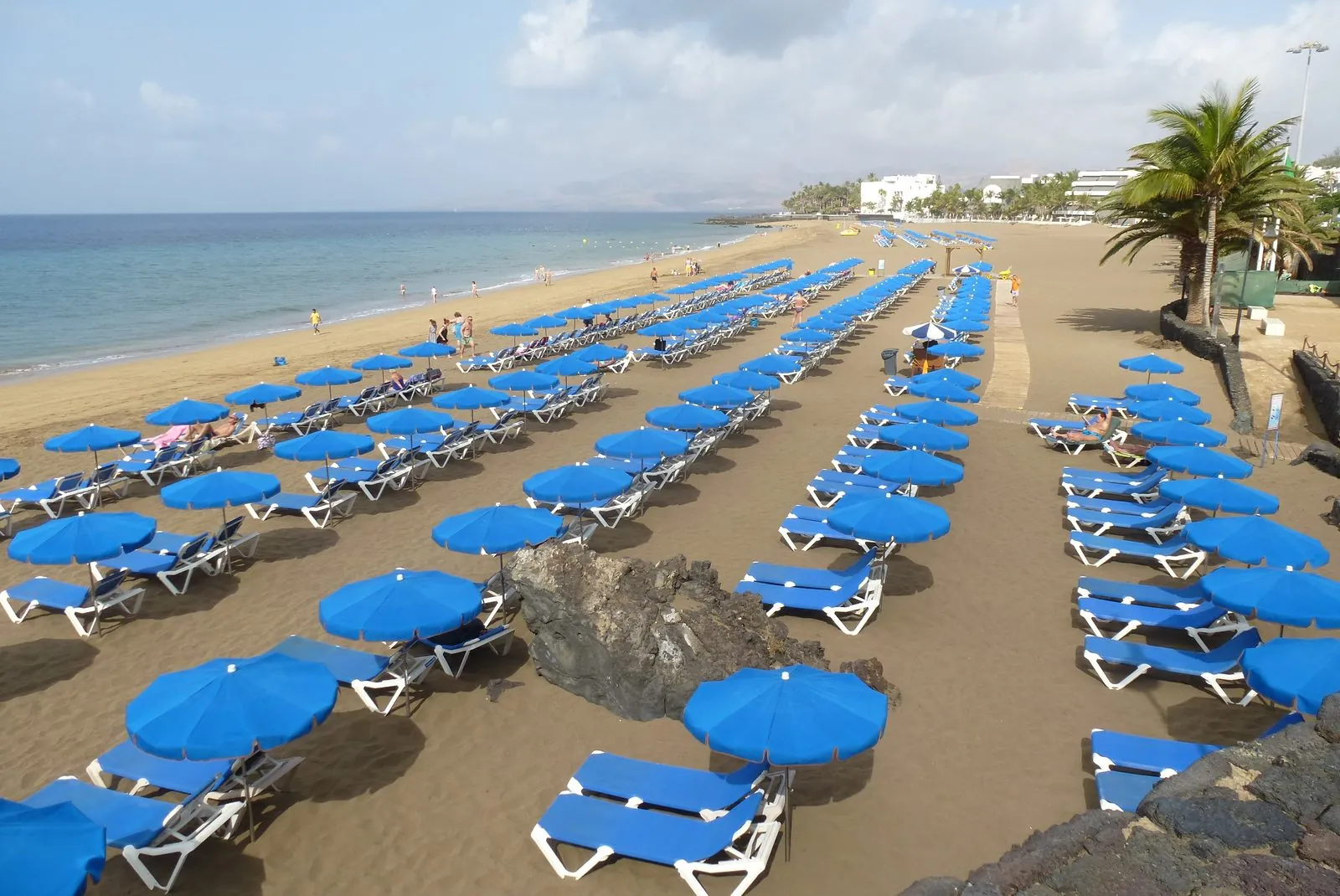
Photo: Bayreuth2009 · CC BY 3.0 · Wikimedia Commons · scaled
The sand, the shape and the water
According to the figures in the Spanish ministry's beach guide, the beach measures about 1,190 metres long and around 35 metres wide. Those two numbers explain its character. It is long enough that even in August you can usually find a gap by walking a few minutes along it, but it is narrow, and the Atlantic tide changes how much of it you get. At high water on a busy afternoon the sunbeds and towels are squeezed into a fairly slim strip between the sea and the promenade wall; at low tide there is a broad, firm apron of sand that is good for walking and for children's sandcastles.
The sand itself is light and golden rather than the black volcanic grit you find on much of Lanzarote's coast, and the beach slopes gently into the sea. On a normal day the water is calm or has small waves, because this south-east-facing coast is partly sheltered from the north-easterly trade winds that batter the other side of the island. It is still the open Atlantic, though, with no breakwaters, so on days when a southerly swell or strong wind arrives the surf can build quickly.
Sea temperatures are typical of the Canaries: coolest in late winter and early spring, at around 19 °C, and warmest in late summer and early autumn, in the low twenties. Most northern Europeans find it refreshing rather than cold from May onwards, and bracing in February.
Swimming safely off Playa Grande
For most of the year this is one of the easier places on Lanzarote to swim. Lifeguards cover the beach during the official bathing season and fly the standard coloured flags; outside that period, and early or late in the day, there may be no cover at all, so check for a flag before you go in. A yellow flag means swim with care, and red means stay out of the water, however calm it looks from the sand. Our page on beach flags and swimming safety explains the system and what to do if you are caught in a current.
Watch for marked channels. Pedalos, kayaks and paddleboards are rented on the beach, and boats and jet skis need a corridor to come in and go out; swimmers should stay within the buoyed bathing zone and keep out of those lanes. Children in inflatables are the classic worry here, because an offshore breeze in the afternoon can carry a light rubber ring away from the shore faster than a parent can wade after it.
The afternoon breeze pushes inflatables out to sea. On Playa Grande the wind often freshens after lunch and can blow off the land as well as along it. Keep lilos, rings and inflatable unicorns for the morning, tie anything light to a parent, and never let a child drift beyond standing depth on one.
Sunbeds, showers and other services
As a fully serviced town beach, Playa Grande has most of what you need within a few steps. The ministry's beach guide lists lifeguards in season, showers, toilets, adapted access for people with reduced mobility and a promenade, and the beach has rows of sunbeds and parasols for hire. Prices for a sunbed and parasol vary by season and by section of the beach, so ask before you lie down rather than finding a ticket-seller standing over you an hour later.
Watersports rental operates from the sand, and dive schools use the coast around the resort. You do not need to bring a picnic: across the Avenida there are cafés, supermarkets, ice cream parlours and restaurants for a full lunch, though prices on the front row are higher than one street back.
Go one street back for lunch. The terraces directly facing Playa Grande charge for the view. Walk a block inland, or along the promenade towards the old harbour, and the same paella or fish of the day is often noticeably cheaper, with Canarian families at the next table.
Getting there, and where to leave the car
Most visitors simply walk, because the bulk of Puerto del Carmen's hotels and apartments are strung along or just above the Avenida de las Playas. The promenade runs the length of the resort, so you can also reach the beach on foot from the quieter apartments around Playa de los Pocillos to the east.
By bus, Intercity Lanzarote's line 2 runs from Arrecife through the airport area to Puerto del Carmen, and line 3 links the resort directly with Costa Teguise. The nearest stop to the middle of the beach is at the Atlántico shopping centre, roughly 500 metres away. Our page on Lanzarote's bus network has the details, and the operator's website carries the current timetables.
Driving is the awkward option. There is no large car park dedicated to the beach, so you are looking for a space in the streets behind the Avenida or in one of the paid car parks a walk away, and in high season these fill up by mid-morning. Kerbside markings matter: blue lines usually mean pay and display, yellow means no parking. Our guide to parking rules and kerb colours explains the system before you get a ticket.
A day around the beach
Playa Grande works well as the centre of a lazy day rather than the whole of it. A good pattern is to swim in the morning, when the sea is usually at its calmest and the beach is quieter, then walk west along the promenade to Playa Chica. That small cove is the island's best-known shore-diving and snorkelling spot, and on a still morning you can see fish within a few strokes of the sand; the island-wide guide to the best snorkelling spots puts it in context.
Carry on past Playa Chica and you reach the old harbour, the original fishing village around which the resort grew, with its fish restaurants and boat trips. In the evening the strip behind Playa Grande is where Puerto del Carmen's nightlife is concentrated, from quiet cocktail terraces to late bars. Families with a car can head a short way uphill to Rancho Texas, the animal park and water park on the inland edge of the resort.
When to go
Lanzarote is a year-round beach island, and Playa Grande is usable in every month. In winter the sun is lower and typical daytime highs are in the low twenties, warm enough for sunbathing out of the wind but cool for long swims. Summer brings the strongest trade winds of the year, though this southern coast feels less of them than Costa Teguise or Famara.
Within a day, the best hours are early. Before about ten the sand is firm, the water is usually still and the sunbed rows are half empty; by early afternoon the beach is at its busiest, the breeze has picked up, and the sun is at its fiercest. Late afternoon, when the day-trippers leave and the light turns golden, is the other good window.
How it compares with the rest of Lanzarote
Seen against the island's other beaches, Playa Grande wins on access and services and loses on scenery. Papagayo is wilder and prettier but needs a car and a dirt track; Caletón Blanco in the north is better for toddlers at low tide; Famara is far more dramatic but often unsafe for swimming. Our ranking of the best beaches in Lanzarote sets them side by side.
Is Playa Grande the right beach for you?
If you are staying in Puerto del Carmen, have children who want sand and an ice cream rather than a view, or simply do not want to drive, Playa Grande is the obvious choice and a perfectly good one. Arrive early, watch the flags, keep the inflatables close and eat one street back. If what you want is the postcard Lanzarote of pale coves and empty sand, treat Playa Grande as your everyday beach and save a day for the south of Lanzarote.