Playa de las Conchas is a long, empty curve of golden sand on the northern tip of La Graciosa, about five kilometres from the harbour at Caleta de Sebo, and it is one of the most beautiful beaches in the Canary Islands to look at and one of the most dangerous to swim from. There is no lifeguard, no shade, no bar and no drinking water. The sea in front of it is the open Atlantic, and strong currents and a heavy shore break have killed and injured bathers here. Go for the view, the walk and the sand; get in the water only on a genuinely flat day, and only up to your knees if you have any doubt at all.
La Graciosa is the small, car-free island off the northern tip of Lanzarote, reached by a short ferry from Órzola. Las Conchas lies on its far side from the village, below the rust-red cone of Montaña Bermeja, and looks straight out at the uninhabited islet of Montaña Clara with Alegranza behind it. Nothing is built anywhere in sight. That is the whole appeal, and it is also the reason the beach demands more respect than any resort strand on Lanzarote.
This page covers what the beach is like, why the sea here is treacherous, how to get there from Caleta de Sebo on foot, by bike or by jeep taxi, and what to carry. For the island as a whole, start with our page on La Graciosa.
Sand, red mountain and three islets
The beach is a broad crescent of golden sand, with dark lava reefs at either end and a backdrop of bare volcanic slopes. Montaña Bermeja, whose name simply means "red mountain", rises immediately behind the sand, and its colour, the pale beach and the deep blue water make one of the strongest contrasts in the archipelago. Directly offshore sits Montaña Clara, a steep, uninhabited islet that looks close enough to swim to and is not. Further out are Roque del Oeste and Alegranza, the most northerly of the Canaries.
The name means "beach of the shells", and you will see plenty of broken shell mixed into the sand at the tideline. It is tempting to pocket a few. Please do not: the whole of La Graciosa lies within the Parque Natural del Archipiélago Chinijo, and the sea around it is the marine reserve of La Graciosa and the islets north of Lanzarote, created in 1995 and one of the largest in Europe. Taking natural material, shellfish or anything living from the shore is exactly what the rules are there to stop.
There is nothing else here. No sunbeds, no showers, no toilets, no kiosk, no signal mast with flags. Even in summer, when the jeep taxis bring a steady trickle of visitors, the sand is wide enough that it rarely feels crowded.
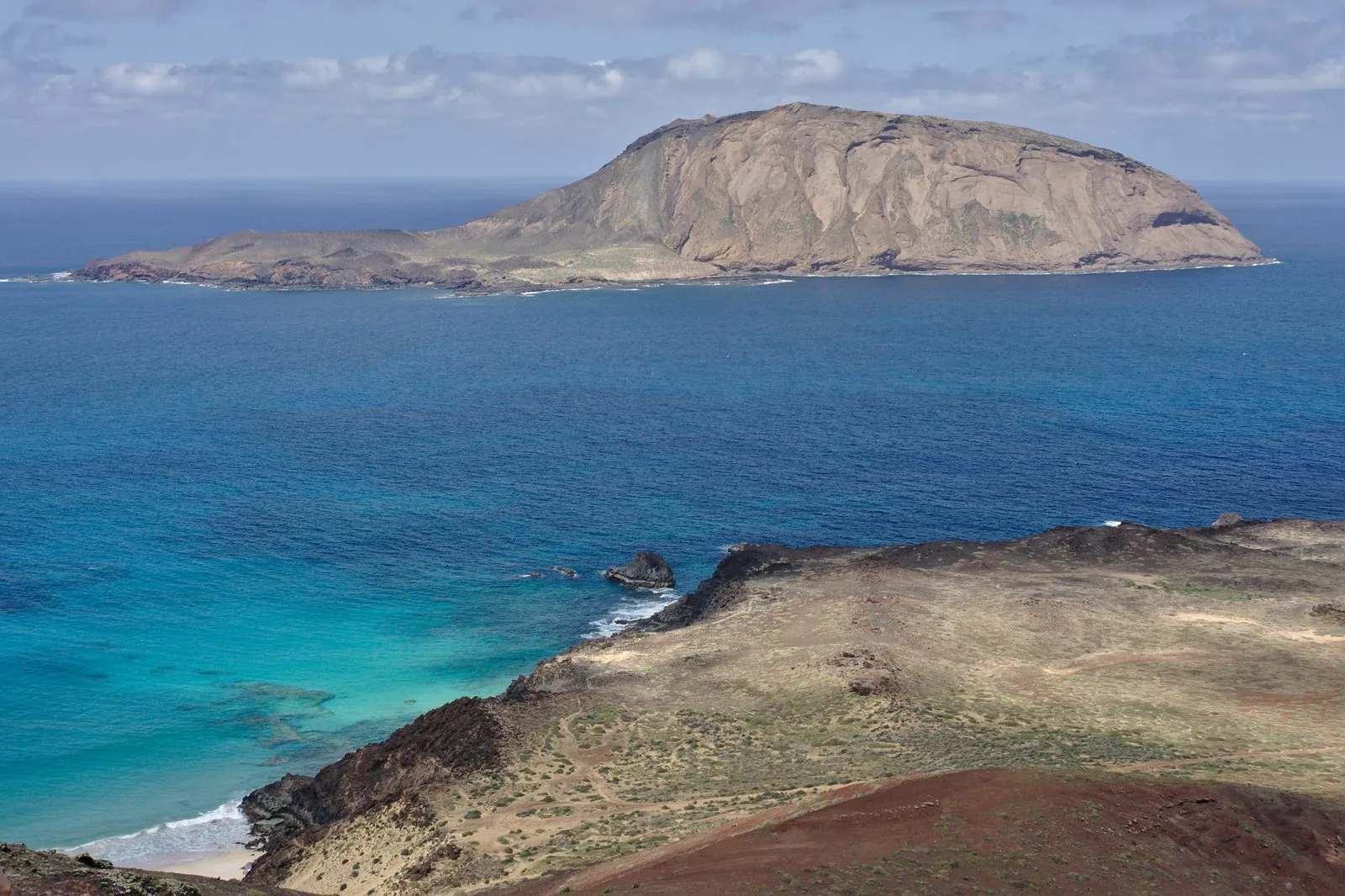
Photo: Alexander Klink · CC BY 4.0 · Wikimedia Commons · scaled
Why the water here is dangerous
Las Conchas faces north-west, straight into the Atlantic swell that rolls down from the North Atlantic for most of the year. There is no reef, breakwater or headland to soften it, so waves that look modest from the top of the sand break hard and close to shore, and the water that piles up on the beach drains back out in strong rip currents. The sheltered beaches on the south of the island, facing Lanzarote across the channel called El Río, are a different sea altogether.
The record is not reassuring. On 26 December 2013, according to La Voz de Lanzarote, a foreign father and his eight-year-old daughter drowned here after being dragged out by the current, and three other members of the group were rescued; Aemet had issued a coastal warning that day. In January 2024 the same paper reported that a 65-year-old woman was knocked over by waves, struck the bottom and was taken to the health centre in Caleta de Sebo with a suspected fracture. On 17 August 2026, rtvc.es reported that a 50-year-old man was seriously injured by a wave at Las Conchas and flown to Arrecife by the emergency helicopter.
No lifeguard, and help is a long way off. Las Conchas has no lifeguard service and no rescue post. In the 2013 drownings, rescuers reported that the beach's distance from the usual emergency access points made the response harder. Do not swim if there is any surf, never swim alone, keep children out of the water entirely unless the sea is like glass, and remember that you are an hour or more from the village on foot. If someone is in trouble, call 112.
None of this means the sea is always wild. On rare windless days in late summer the surface can lie almost flat and the water is spectacularly clear. Even then, a paddle at the edge is one thing; a swim out to cool off is another, and the official route leaflet from Spain's national parks body tells walkers to take extreme care at Las Conchas because of its strong currents and its terrain. Our page on beach flags and swimming safety explains how to spot a rip and what to do if you are caught in one.
Getting to Caleta de Sebo first
Every visit starts with the ferry from Órzola, at the northern end of Lanzarote, to Caleta de Sebo, La Graciosa's only real village. The crossing takes roughly 25 to 30 minutes, and several boats a day run in each direction, more in summer. Timetables, operators and how to fit the trip into a day are covered on our page about the day trip to La Graciosa, so they are not repeated here. Book a return that leaves you at least five hours on the island if Las Conchas is the goal.
Caleta de Sebo is also the only place on La Graciosa where you can buy anything. The national parks leaflet for the island is blunt about it: there are no water fountains anywhere on La Graciosa, and the village is the only point of supply. Fill your bottles and buy lunch before you set off.
Walking, cycling or the jeep taxi
Las Conchas is about 5.1 kilometres from the harbour along sandy and stony tracks, according to the island's visitor information. There are three ways to cover it.
- On foot: allow around 1 hour 20 minutes each way at a steady pace. The track is easy to follow and climbs gently between the volcanic cones of Las Agujas before dropping towards Montaña Bermeja. It is fully exposed, with no shade at all.
- By bike: bike hire shops wait near the harbour, and the ride takes roughly 35 to 40 minutes. Sandy patches will make you push now and then, and the visitor information suggests an electric bike if you have not cycled for a while.
- By jeep taxi: four-wheel-drive taxis queue at the port and run out to the beach, usually returning for you at an agreed time. Prices are fixed locally and change; agree the fare and the pick-up time before you set off.
The jeeps use the same track as walkers and cyclists, and the dust they raise is the one real nuisance on the walk out. If you are on foot, step to the side and let them pass. Our page on day trips from Lanzarote sets La Graciosa against the other outings from the island if you are still deciding whether to go.
Las Conchas on the long northern loop
Las Conchas does not have to be an out-and-back. Spain's national parks body publishes a waymarked circular, the Ruta del Norte, that runs 15.4 kilometres from Caleta de Sebo round Las Agujas and Montaña Bermeja and back down the east coast, with Las Conchas as a short spur of 0.6 kilometres each way from a junction on the main track. Beyond that junction the route continues to Playa del Ámbar on the north coast, passes a turning for the basalt arch at Majapalomas, and offers another spur to the tiny hamlet of Pedro Barba, which has no services for visitors.
The descent from Las Agujas towards the Llano de la Baja del Ganado is the moment most walkers remember: Montaña Bermeja in front, and Montaña Clara, the rocks and Alegranza strung out across the sea beyond. The whole loop is graded easy, but it is a long day in the sun on soft ground. Walk it clockwise as the leaflet describes, or take a bike as far as the junction for Las Conchas and do the rest on foot. Do not climb on the Majapalomas arch; the leaflet warns that it is at risk of collapse.
Turn round and look at Lanzarote. On the last stretch back into Caleta de Sebo, the track drops towards the village with the whole Famara cliff wall across the water in front of you. Late in the afternoon the cliffs turn orange, and it is the best free view of the day. If you have seen La Graciosa from the Mirador del Río, this is the same scene from the other side.
The rules that come with a natural park
La Graciosa's protection is not a formality, and the rules affect what you do on the beach. Stay on the marked tracks, because trampling kills the low vegetation that holds the sand together. Fires are banned, and so is leaving cigarette ends on the sand. Do not use soap or shampoo on the beaches. Gathering shellfish, octopus or limpets is prohibited, spearfishing is not allowed, and diving is permitted only in designated zones with authorisation.
Camping on the beach is not allowed. The only place to camp on La Graciosa is the authorised site at the Bahía del Salado, near the village, and it needs a permit booked in advance through the national parks reservation system; our page on camping in the Canary Islands explains how that works. Whatever you bring to Las Conchas, take all of it back to the bins in Caleta de Sebo.
What to carry for a day at Las Conchas
Treat the trip as a short desert walk with a beach at the end. The north of La Graciosa is low, bare and windswept, and the reflected glare off the sand is fierce even on a breezy day.
- At least two litres of water per person, more in summer; there is none on the way.
- Food for the whole day, bought in the village.
- A sunshade or umbrella you can weigh down, a hat and high-factor sun cream; our page on sun safety explains why the breeze fools people.
- A windproof layer: the trade wind can make the beach feel cool even when the sun is burning.
- Proper shoes or sturdy sandals for the track, and a bag for your rubbish.
- A charged phone, and the time of your return boat written down.
The trade wind blows from the north-east much of the year and often strengthens in the afternoon; our page on whether it is windy in the Canary Islands explains the pattern. At Las Conchas it whips sand across the beach rather than raising surf, because the big waves come from distant Atlantic storms, not the local wind. A calm, sunny morning on La Graciosa says nothing about whether the swell is running.
Where to swim instead on La Graciosa
If you want a proper swim, do it on the south coast. Playa de la Francesa, about 2.8 kilometres from the harbour, faces Lanzarote across El Río and is usually far calmer; Playa de la Cocina, tucked under Montaña Amarilla a kilometre further on, is another sheltered option. Even these have no lifeguard, and emergency services have had to evacuate bathers from La Graciosa's calmer beaches too, so the usual care still applies. The beaches right in front of Caleta de Sebo are the gentlest of all for small children.
A sensible plan for a long day is to walk or cycle out to Las Conchas in the morning, before the heat and the wind build, eat lunch on the sand, then head back and spend the afternoon swimming at La Francesa before the evening boat. Our round-up of the best beaches in Lanzarote puts Las Conchas alongside the island's other beaches, from the calm Papagayo coves to the surf at Famara.
Worth the trek, not worth the risk
Playa de las Conchas earns its reputation. The red mountain, the empty golden sand and the line of islets offshore make it the most striking beach in the Lanzarote area, and the walk or ride out across La Graciosa is half the pleasure. Go early, carry everything you need, and give yourself time to sit and take it in.
Just do not mistake it for a swimming beach. It has no lifeguard, it faces the open ocean, and the people who have been hurt here mostly misjudged waves that did not look dangerous from the sand. Admire it, paddle with care on a flat day, and save the real swim for the sheltered south side of the island.