Playa de Esquinzo is a wide stretch of pale sand on the Jandía coast of southern Fuerteventura, about ten kilometres north-east of Morro Jable, with a handful of large hotels on the low bluff behind it and much less going on than at the resort beaches either side. It is public, like every beach in Spain, so you do not need to be staying in one of those hotels to use it. The water is usually clear and turquoise, the sand is soft, and the main thing to plan around is the wind rather than the crowds.
Esquinzo is part of the long run of beaches that fills the south-east side of the Jandía peninsula, from Costa Calma down to Morro Jable. Its neighbours are better known: the lagoon at Sotavento to the north-east and the endless promenade beach of El Matorral to the south-west. Esquinzo sits between them as a quieter bay, and that is the reason to choose it.
This page explains which Esquinzo you are looking for (there are two on the island), how to get onto the sand, what the sea does through the day, and how a stay or a day here fits with the rest of Fuerteventura.
Two beaches called Esquinzo
Before anything else, make sure you are heading for the right one. Fuerteventura has two beaches with this name, at opposite ends of the island. The one on this page is in the municipality of Pájara, on the sheltered Jandía coast, next to the hotel area that has taken the same name. The other is in La Oliva in the far north, a few kilometres south of El Cotillo: a small cove under low cliffs, reached by a dirt track and a scramble down, and known mainly to experienced surfers.
The confusion is real, not theoretical. Spain's official tourism portal, spain.info, lists a single "Esquinzo" beach on Fuerteventura, and it is the northern one in La Oliva: 300 metres long, strong waves and wind, difficult access on foot, a surf spot. Some booking sites and map apps mix the two up as well. If you are searching for a route or asking a taxi driver, say "Esquinzo, Jandía" or "Esquinzo-Butihondo", which is how the southern beach and hotel zone are often described. If you actually want the northern surf cove, start from our page on the beaches around El Cotillo, because it is a completely different kind of place.
Check the municipality, not just the name. A beach review that mentions cliffs, reef breaks and a gravel track is almost certainly describing the northern Esquinzo near El Cotillo. If it mentions sunbeds, a beach bar and hotels above the sand, it is the Jandía one.
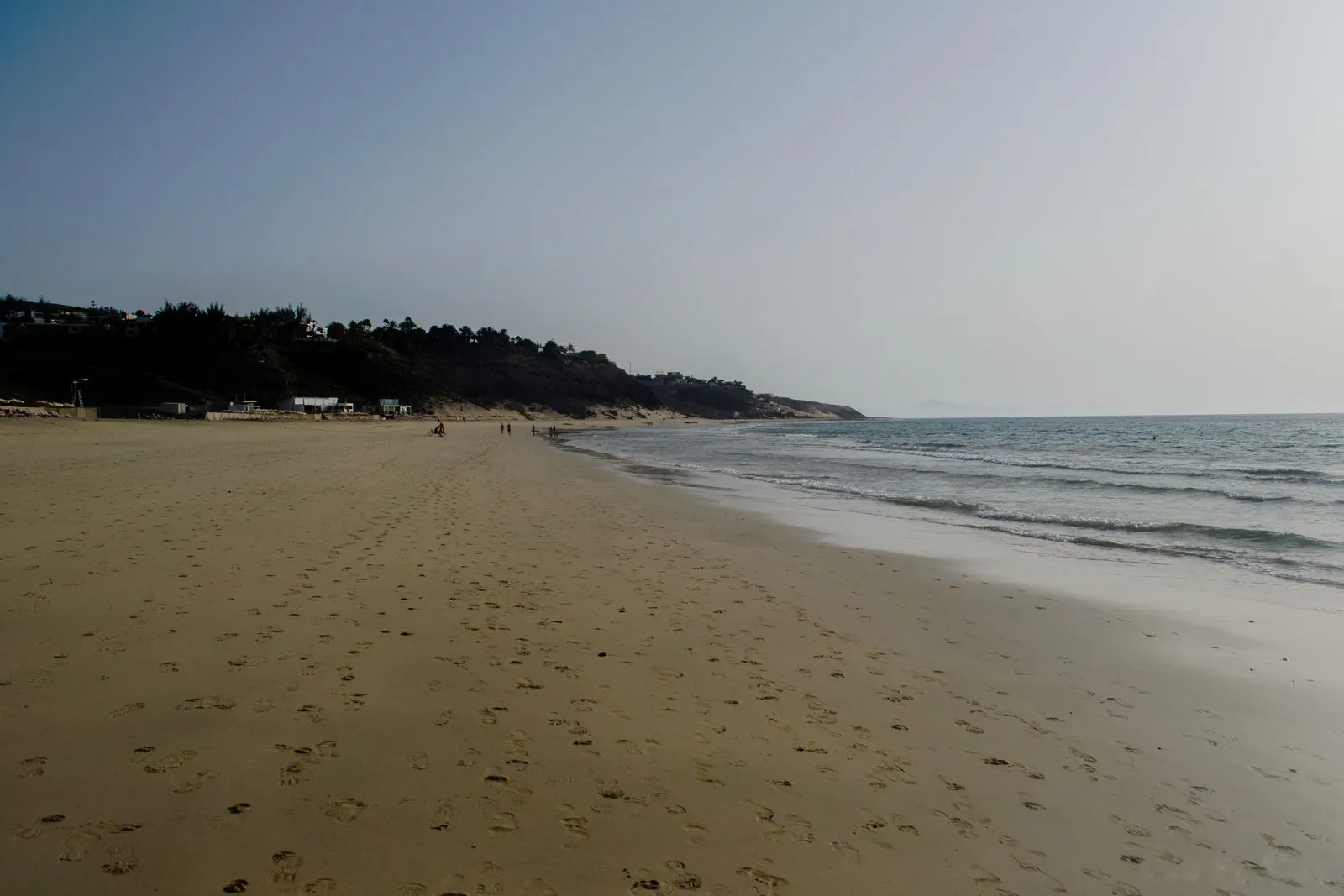
Photo: Iván Hernández Cazorla · CC BY-SA 4.0 · Wikimedia Commons · scaled
The shape of the bay
The southern Esquinzo is a broad, gently sloping beach of fine, light-golden sand, framed by low headlands of dark rock and backed by a sandy bluff rather than a promenade. The hotels sit on top of that bluff, set back from the beach, and paths and steps lead down from them to the sand. From the water you see a line of low white buildings and, behind them, the bare brown ridges of the Jandía massif climbing towards the island's highest peak.
Accounts of the length vary, because the sand runs into the neighbouring bays and there is no hard edge to measure from. One German travel guide puts the main beach at around 500 metres. What matters more is that the coast here is a chain of sandy bays broken by rocky points, and on a falling tide you can walk from one to the next for kilometres. The beach is noticeably wider at low water than at high, as the flat sand drains away towards the sea.
The atmosphere is that of a hotel beach without a resort town attached. There are no shops on the sand and no strip of bars behind it. In the middle of the day the area in front of the hotels gets reasonably busy, with sunbeds and a few windbreaks; walk ten minutes in either direction and you will usually have plenty of space.
Getting onto the sand
Under Spain's coastal law the beach and the shoreline are public property, so a hotel can manage its own grounds but not the sand in front of them. If you are not staying at Esquinzo, you reach the beach by public paths from the road above the hotels. One travel guide notes parking within about a hundred metres of the sand, though spaces are limited and fill up in high season; arriving before about 10:30 makes life easier.
Fuerteventura's bus company, Tiadhe, runs line 05 between Costa Calma and Morro Jable along the main road above the hotels, and the long-distance lines from Puerto del Rosario also run down this coast to Morro Jable. Ask the driver for the Esquinzo stop and check the current timetable on Tiadhe's website, as frequencies drop at weekends. Our page on buses in Fuerteventura explains fares, the travel card and how reliable the southern routes are.
Some of the descents from the bluff are sandy and a little steep, and a few involve steps. Anyone with a pushchair, a wheelchair or unsteady legs will find the flat promenade beach at El Matorral much easier going.
The sea, the wind and the afternoon
The Jandía coast faces south-east, away from the big Atlantic swell that pounds Fuerteventura's west side, so on most days the sea at Esquinzo is gentler than on the island's wilder beaches. The water is clear over a sandy bottom, and one travel guide rates it highly for swimming and, on calm days, for snorkelling along the rocks at the edges of the bay.
The catch is the trade wind. It blows from the north-east for much of the year, and on this coast it often builds through the late morning and is strongest in the afternoon. It does not usually bring big surf to Esquinzo, but it does bring a choppy sea, blowing sand and a beach that feels far cooler than the thermometer says. Mornings are the time for a calm swim; by mid-afternoon many people retreat behind a windbreak or back up to the pool.
Do not assume there is a lifeguard. We could not confirm lifeguard cover at Esquinzo for 2026, and on many of the quieter Jandía beaches there is none. If you see a flag mast, follow the flag; if you do not, keep to your depth, watch children closely, and stay out when the wind has whipped up a shore break. Our page on beach flags and swimming safety covers what to look for.
The wind that annoys swimmers is the reason this coast is famous among windsurfers and kitesurfers. Esquinzo itself is not a watersports centre, but the professional schools and the World Cup venue are only a short drive north-east at Sotavento, where the wind blows across a shallow lagoon at low tide.
Sunbeds, shade and what to bring
Facilities are modest and concentrated in front of the hotels. Expect sunbeds and parasols for hire on the main stretch, a beach bar or kiosk serving drinks and snacks, and showers near the access points. Prices vary from season to season, so ask before you sit down.
Away from the central section there is nothing at all, and no natural shade anywhere on the beach. Bring water, a hat and proper sun cream, and if you plan to walk the shore, take shoes for the rocky points. A windbreak, or one of the low stone shelters that people build on Fuerteventura's beaches, makes a long afternoon far more comfortable.
Walking the shore to Butihondo and beyond
The best way to understand Esquinzo is to walk away from it. Heading south-west along the sand and over the low rocky points brings you to Playa de Butihondo, the next bay along, which is usually quieter still. Carry on and the shoreline eventually leads towards Morro Jable and the long beach of El Matorral, a walk of two hours or more for anyone who keeps going.
Time it with the tide. Some of the rocky headlands are easy to pass at low water and awkward or impossible at high water, when you will have to climb up onto the bluff and find a path round. Set off on a falling tide and you will have the most sand to walk on. North-east, the coast leads towards the bays of Mal Nombre and the lagoon country around Sotavento and Costa Calma.
Naturism at Esquinzo
Like most of the long Jandía beaches, Esquinzo is relaxed about nudity. Away from the hotels you will often see people sunbathing naked, especially on the stretches towards Butihondo, which several sources describe as a favourite with naturists. There is no formally designated naturist zone, and the area right in front of the hotels is mostly costumed. Spain does not ban nudity on beaches, and the usual etiquette is simply to put some distance between yourself and families. Our page on naturism and nudist beaches covers the wider picture across the islands.
A base for the far south of the island
Esquinzo works best for people who want a beach holiday with very little in the way of nightlife. The hotels are self-contained, and for restaurants, shops or an evening walk you will need to go to Morro Jable, about ten minutes' drive south-west, with its harbour, fish restaurants and seafront promenade, or to Costa Calma to the north-east. A hire car makes a big difference here.
From Esquinzo the wild end of the peninsula is also within easy reach. The road beyond Morro Jable turns to a long unsurfaced track out to the lighthouse and fishing hamlet at Punta de Jandía, with the turn-off over the mountains to Cofete, the great empty beach on the other side; check your hire-car contract before driving it, because most forbid unpaved roads. Walkers can climb Pico de la Zarza, at 807 metres the highest point on Fuerteventura, from the edge of Morro Jable. If you are still choosing a base, our page on where to stay in Fuerteventura compares the south with Corralejo and Caleta de Fuste.
The quiet bay in the middle
Playa de Esquinzo does one thing well. It gives you the pale sand and turquoise water of the Jandía coast without a resort town in your sightline, with just enough on hand to stay all day and plenty of empty shore if you walk. Swim in the morning before the wind gets up, walk to Butihondo on a falling tide, and drive to Morro Jable for dinner.
Just make sure you have the right Esquinzo before you set off. The one in the south is a gentle hotel beach on the leeward coast; the one in the north is a cliff-backed surf cove. They share a name and almost nothing else.