La Palma may be the "Beautiful Island", but it's short on sandy beaches — which is exactly why its natural pools are so treasured. On a steep, green, wave-lashed coast, the piscinas naturales are where Palmeros swim: clear Atlantic water held in dark volcanic rock, many of them lovingly kept with terraces, ladders and, in season, lifeguards. From the far north to the sunny west, these charcos offer some of the most rewarding swimming on La Palma — set against scenery that's pure drama.
La Fajana, Barlovento — the postcard pools of the north
High on the wild northern coast below the village of Barlovento, La Fajana is La Palma's most celebrated natural pool complex — and one of the finest in the Canaries. Three interconnected pools of clear seawater sit right at the ocean's edge, protected by a sturdy sea wall, with sunbathing terraces, steps, ladders and a little café nearby. It's the rare natural pool that's genuinely easy for everyone: children, older swimmers and the less confident can all enjoy the calm, deep water while the Atlantic thunders against the barrier just beyond.
The setting is unforgettable — sheer cliffs cloaked in green, the vast open ocean, and often a rainbow of spray hanging in the air. It's the north's must-do swim, and worth the winding drive up from wherever you're staying.
Even a walled pool needs a calm sea. La Fajana faces the full force of the northern Atlantic, and on days with a big swell the waves crash clean over the barrier, closing the pools and making the terraces dangerous. Check the swell forecast before you drive up, obey any closure signs or lifeguard instructions, and never climb onto the outer wall to watch the waves — that's how people get swept in. On a calm day it's paradise; on a wild one, admire it from a safe distance.
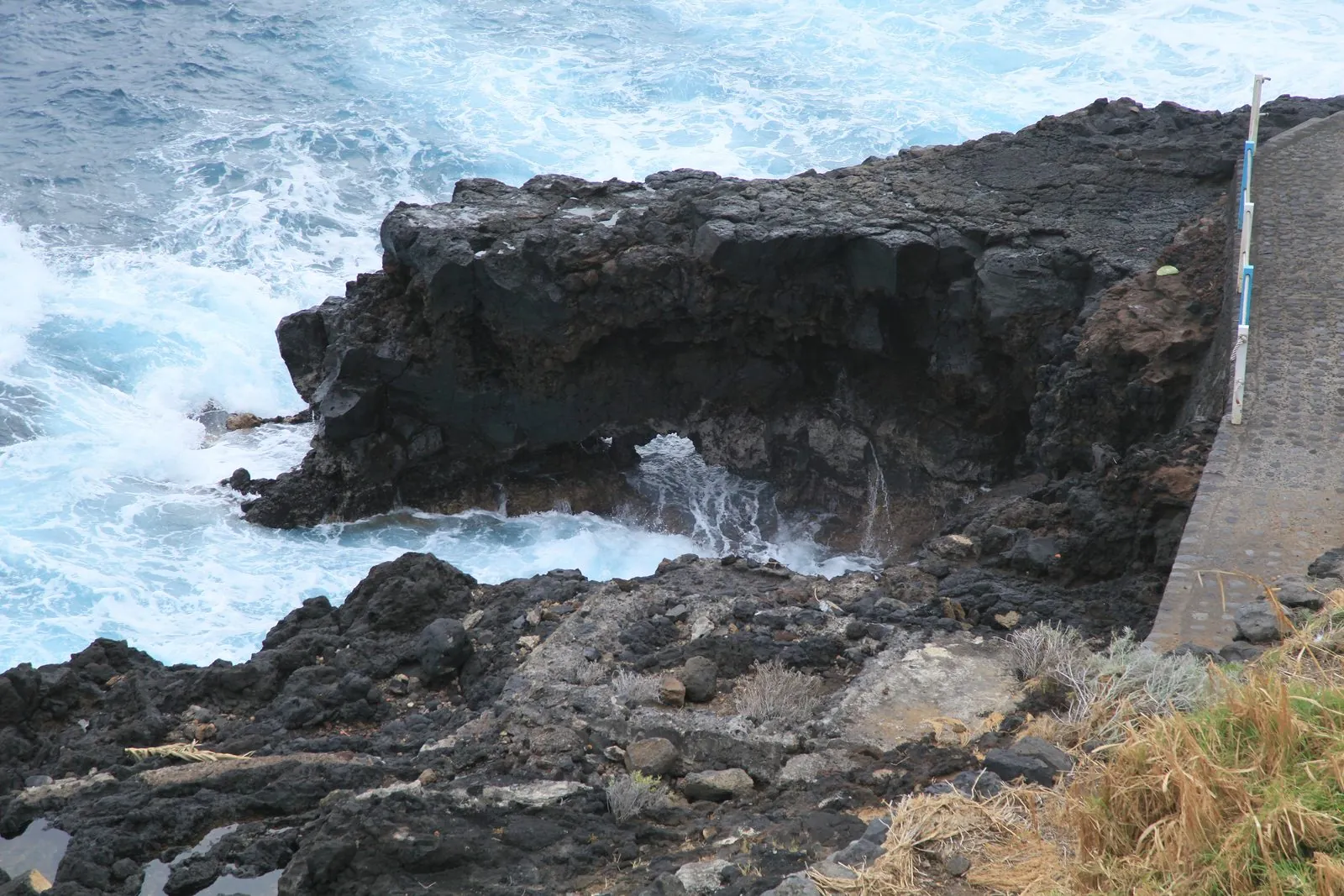
Photo: Frank Vincentz · CC BY-SA 3.0 · Wikimedia Commons · scaled
Charco Azul, San Andrés y Sauces — the "blue pool"
A little further round the northeast coast, near the pretty town of San Andrés y Sauces, Charco Azul — the "Blue Pool" — lives up to its name. This much-loved complex has been built up around a natural rock basin into a proper little lido, with a large main pool, smaller ones for children, concrete terraces and railings, all right beside the crashing sea. The water is deep, clear and a beautiful blue, and the sheltered design makes it one of the safest natural swims on the island — see our full guide to Charco Azul.
It's an easy add-on to a day exploring the green northeast, and sits close to the ancient laurel forest of Los Tilos, one of La Palma's natural wonders. Swim in the morning, walk among the giant ferns and waterfalls in the afternoon — a perfect pairing of sea and forest.
Make it a north-coast loop. La Fajana, Charco Azul and Los Tilos all lie within a short drive of one another. String them together for a brilliant day out on La Palma's lush, dramatic northern side — a world away from the sunnier west.
The Puerto Naos area and the sunny west
Over on the warmer, drier west coast, the resort of Puerto Naos is better known for its long black-sand beach, but this side of the island has its own rock pools and sheltered coves for calm-day swimming. This is the coast most affected by the 2021 Tajogaite (Cumbre Vieja) eruption, whose lava reshaped the shoreline near Tazacorte and even created new land where it met the sea. The area has reopened to visitors, though some access can still change — so check locally before heading to any specific spot, and enjoy the extraordinary sight of a coastline still being made.
Why La Palma swims in pools, not on sand
La Palma is one of the youngest, steepest and greenest of the Canaries — a volcano rising almost sheer from the deep Atlantic. That geography leaves little room for broad sandy beaches; instead the coast is mostly cliff and dark volcanic rock, with beaches of black sand and pebble. It's the perfect recipe for charcos, and generations of islanders have turned the best of them into the calm, well-loved pools you'll swim in today. Choosing a natural pool over a beach here isn't a compromise — it's the authentic La Palma experience.
Before you go
You'll want a hire car, as the pools are scattered along a coast of steep, winding roads. A few essentials:
- Reef shoes for grip on wet rock and terraces.
- A mask and snorkel — the clear water is full of fish.
- Sun cream, water and a windproof layer; the north can be cool and breezy even when it's warm.
- A swell forecast check, especially for the exposed northern pools.
Pick a calm day, respect the ocean, and La Palma's natural pools will give you some of the loveliest swimming in the archipelago. For pools on the other islands, see our overview of the natural pools of the Canary Islands.
Deep blue water, sheer green cliffs and the roar of the open Atlantic — La Palma's pools are swimming with a view like no other.