The Castillo de Santa Bárbara still stands on the rim of the Guanapay volcano above Teguise, and the view from it is as good as ever, but the Museo de la Piratería that used to fill it no longer exists: it closed for building works in January 2020, and the town council has since said the castle will not go back to being a piracy museum. In July 2026 La Voz de Lanzarote reported that the restored fortress stood empty, with no exhibition inside and occasional closures without notice. Many guidebooks, road signs and websites, including the museum's own old site, still advertise the pirates.
That does not make the trip pointless. The drive up Guanapay takes a few minutes from the old capital, and from the top you look across the plain of Teguise to the volcanoes in the south and the sea on both coasts. The castle itself is one of the oldest fortifications on the island, and its story is the story of why Teguise, set back from the sea, was raided anyway.
This page sets out what is actually there in late 2026, what happened to the museum, what is planned next, and how to make the climb worthwhile on a day in Teguise. If you came looking for opening hours and a ticket price, the honest answer is that no current official timetable is published; the section on visiting below explains how to check before you go.
Why there is a castle on a volcano
Teguise was Lanzarote's capital for roughly four centuries, until Arrecife took over in the middle of the 19th century. It was placed inland deliberately, away from the beaches where raiders landed, but the island was so flat and open that a few hours' march brought any landing party to its streets. What Teguise needed was a lookout: somewhere to see sails approaching and to give the townspeople time to flee or hide.
Guanapay, an old volcanic cone rising just east of the town, was the obvious spot. According to Teguise's tourism office, the first fortification on its rim was built in the first half of the 16th century by Sancho de Herrera, one of the island's lords, as a watchtower over the ports and coast. From the top a sentry could see both shores of Lanzarote and signal to the town below, and the fort could shelter people and valuables during an attack.
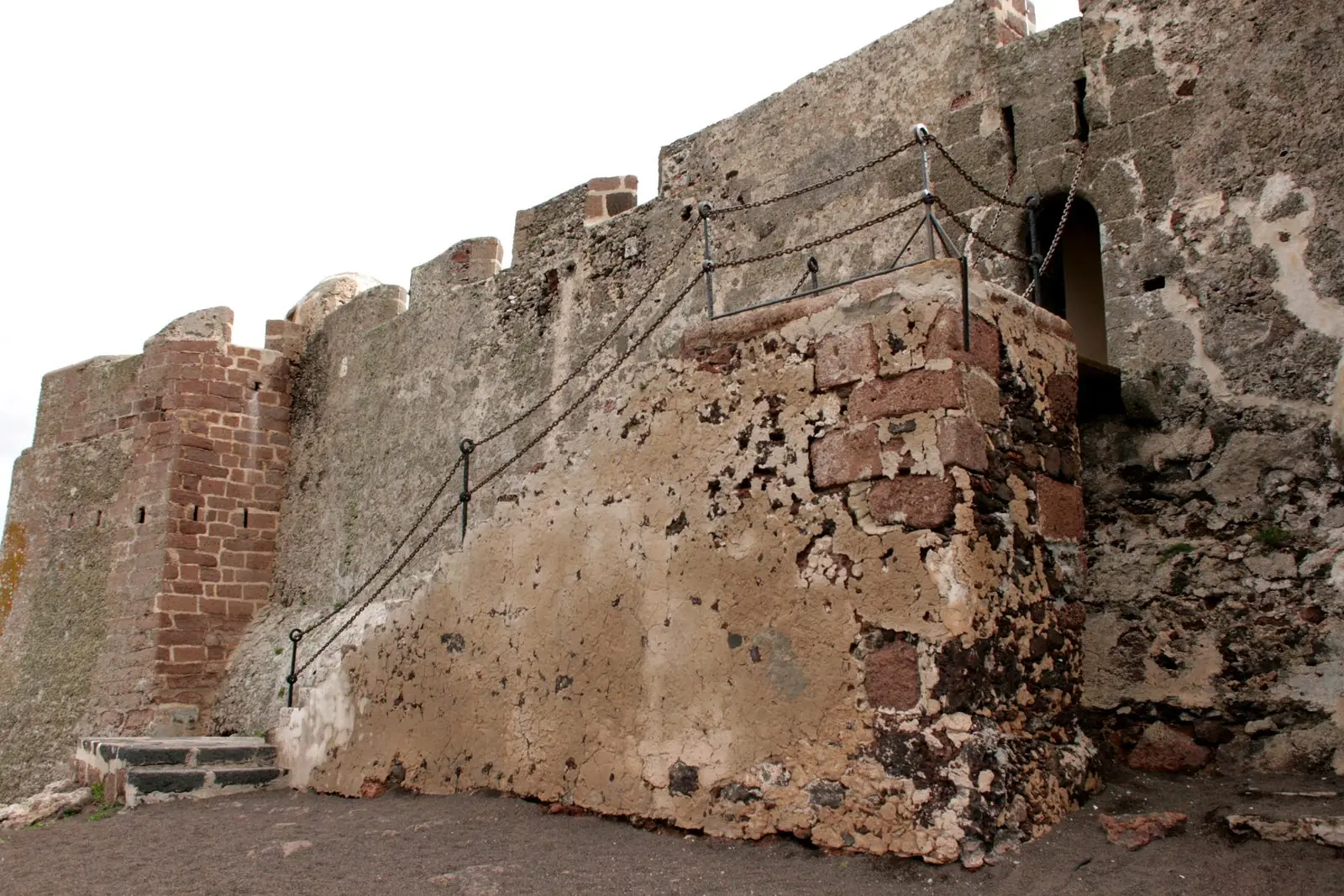
Photo: Frank Vincentz · CC BY-SA 3.0 · Wikimedia Commons · scaled
Raids, rebuilds and a dovecote
A watchtower did not stop the corsairs. Teguise was sacked repeatedly in the 16th and 17th centuries, by Berber raiders from North Africa and by European privateers. The 1586 attack led by Morato Arráez is remembered in the name of the Callejón de la Sangre, the Alley of Blood, near the parish church, and in 1618 a far larger raid carried hundreds of islanders into slavery. Our page on pirates and corsairs in the Canaries tells that wider history, and the lava tube of the Cueva de los Verdes in the north is where islanders are said to have hidden from the raiders.
The castle you see today owes its shape to rebuilding after those attacks. La Voz de Lanzarote, summarising its history in 2022, notes that its present appearance dates from works completed in 1596, when Captain Gaspar de Salcedo added the two towers that give it a lozenge-shaped plan. The Italian military engineer Leonardo Torriani, sent by the Spanish crown to inspect the islands' defences, visited later and proposed improvements. Once cannon and coastal forts made it obsolete, the castle fell into decline, and for a time it served as a military pigeon loft, used until 1899.
A fortress that housed messenger pigeons. Before radio, the army used carrier pigeons to carry messages between posts, and a high, isolated building made a good loft. The castle that once watched for corsairs ended its military life as a dovecote, a detail almost no guidebook mentions.
From emigrants to pirates to nothing
The castle's modern life has been a series of museums. Preservation efforts began in 1960 with a local group, the Friends of the Castles of Lanzarote. In 1991 it opened as a museum of Canarian emigration to Latin America, and since 1998 it has been managed by the Teguise town council. The emigration museum later gave way to the Museo de la Piratería, which told the story of the raids on Teguise, the famous corsairs and the slave-taking; its own website marked the museum's seventh anniversary in April 2018, which puts its opening around 2011.
On 31 January 2020 the council announced that the castle would close for safety reasons while rehabilitation work was carried out. When La Voz de Lanzarote reported in November 2022 that the €1.3 million works were finished, with new viewing points and a lighting system of more than 33 projectors, the council said the castle's next use would be neither the emigration museum nor the piracy museum. The pirates had gone for good.
Since then the castle has opened and closed. In February 2025 the same paper reported that it had reopened after months shut for electrical repairs nearby, and that the plan was to turn it into a Museum of the History of Teguise. In April 2025 La Voz described a new museum project backed by the Canary Islands government, designed by the architect Carlos Pallés, to present Lanzarote's history and Teguise's role as capital with audiovisuals, augmented reality and ramps for accessibility. No opening date was given.
What you find there in 2026
The most recent report we found is from July 2026, when the opposition group Primero Teguise visited and La Voz de Lanzarote published its findings. The building "remains completely empty", the paper said: no pirates, no history panels, no content. Electricity came from a petrol generator running beside the building, there was exposed wiring and junction boxes without covers near the top, and visitors had scratched graffiti into the restored render. The group also complained that the castle sometimes closed without notice, while road signs and the old museum website still promised a museum.
In other words, if the door is open when you arrive, what you get is the restored stone shell of the fort and its viewpoints, not an exhibition. That is still something: the walls and the two towers give a real sense of how small and exposed a garrison up here must have been. But it is a short visit, and you should not drive up expecting the displays of costumes, weapons and ship models described in older reviews.
The museum on your map closed in 2020. Online maps, hotel leaflets and some tour descriptions still list a Pirate Museum with hours and a ticket price. Those details date from before the closure. If someone sells you a tour that includes "entry to the Museum of Piracy", ask what you will actually see.
The view: why the climb is still worth it
Whatever is happening inside, the setting does the work. The castle sits on the lip of Guanapay's crater, and from the car park and the walls you look down into the hollow of the cone on one side and out over Teguise on the other. On a clear day the panorama runs across the plain of the island's centre to the volcanoes around Timanfaya in the south-west, with the Atlantic visible on both coasts. It is one of the few places where you can see how small and how volcanic Lanzarote really is.
The light is best in the morning, before haze builds, or in late afternoon when the low sun picks out the whitewashed town below. The rim is exposed and the trade wind can be fierce; bring a layer, and keep a hand on children anywhere near the crater's edge.
Visiting: what to check before you go
No current opening hours or ticket price for the castle are published by the Teguise council or its tourism office; the tourism office's own castle page still describes the old emigration museum. Because of that, we do not quote a timetable here. Before 2020 the museum opened most days from morning to mid-afternoon, and if the castle is open in 2026 it is likely to keep similar daytime hours, but treat that as a guess, not a schedule.
- Check first: the Teguise tourist office in the old town (telephone +34 928 845 398, according to its official website) can tell you whether the castle is open that day.
- Getting up: a road climbs from the edge of Teguise to a small car park below the walls; it is a few minutes by car. Walking up from the town is possible but steep and exposed.
- Combine it: park in Teguise, see the old town, and drive up only if the tourist office says the castle is open, or simply for the view from the car park.
- Not a CACT centre: the castle is run by the town council, not by the island's tourist-centre body, so it has never been part of any CACT ticket.
Fitting it into a day around Teguise
The best way to use the castle is as a short add-on to Teguise itself. On a Sunday, see the market in the morning and drive up Guanapay as the crowds peak in the plaza; on a weekday, walk the quiet old streets first, find the Callejón de la Sangre, and then go up for the view of the town you have just explored. Our page on the old capital and its Sunday market covers the town in full.
Within a few minutes' drive are Lagomar, the house in a quarry wall at Nazaret, and the Monumento al Campesino at Mozaga, where the restaurant makes a good lunch stop. If it is fortress history you are after, the round Castillo de San José in Arrecife is open and lived-in, as the MIAC contemporary art museum, with a Manrique-designed restaurant looking over the harbour.
Go for the view, not the pirates
The Castillo de Santa Bárbara is no longer the piracy museum the guidebooks describe, and in late 2026 it is an empty, restored shell waiting for a new purpose, open on some days and shut on others. A future museum of Teguise's history has been announced but not dated.
For now, drive up Guanapay for the panorama and the sense of a lookout that watched for raiders four hundred years ago, check with the tourist office if you want to step inside, and spend the rest of your time down in Teguise, where the history the castle was built to protect is still standing. Our list of the best things to do in Lanzarote has plenty to fill the afternoon.