For three centuries after the conquest, the Canary Islands lived under a constant shadow at sea. Stranded on the great sailing route between Europe, Africa and the Americas, and rich with sugar, wine and cochineal, they were a magnet for every kind of raider — English privateers, Dutch war fleets and, most feared of all, the Barbary corsairs of North Africa, who came not for cargo but for people. The islands answered with a ring of castles and watchtowers, some of which you can still visit today.
This is the swashbuckling side of Canarian history: the sieges, the sackings, the night-time raids on sleeping villages, and the stubborn defences that grew up in response.
Why the islands were a target
Geography made the Canaries both prosperous and vulnerable. Every treasure fleet returning from the Americas, every ship bound for the African coast, passed within reach. The islands themselves exported valuable sugar and later wine — the sweet malmsey ("Canary sack") that even Shakespeare's characters drank. Wealthy ports with thin defences, scattered across open water, were an obvious prize. And unlike a mainland city, an island raid offered a clean getaway by sea.
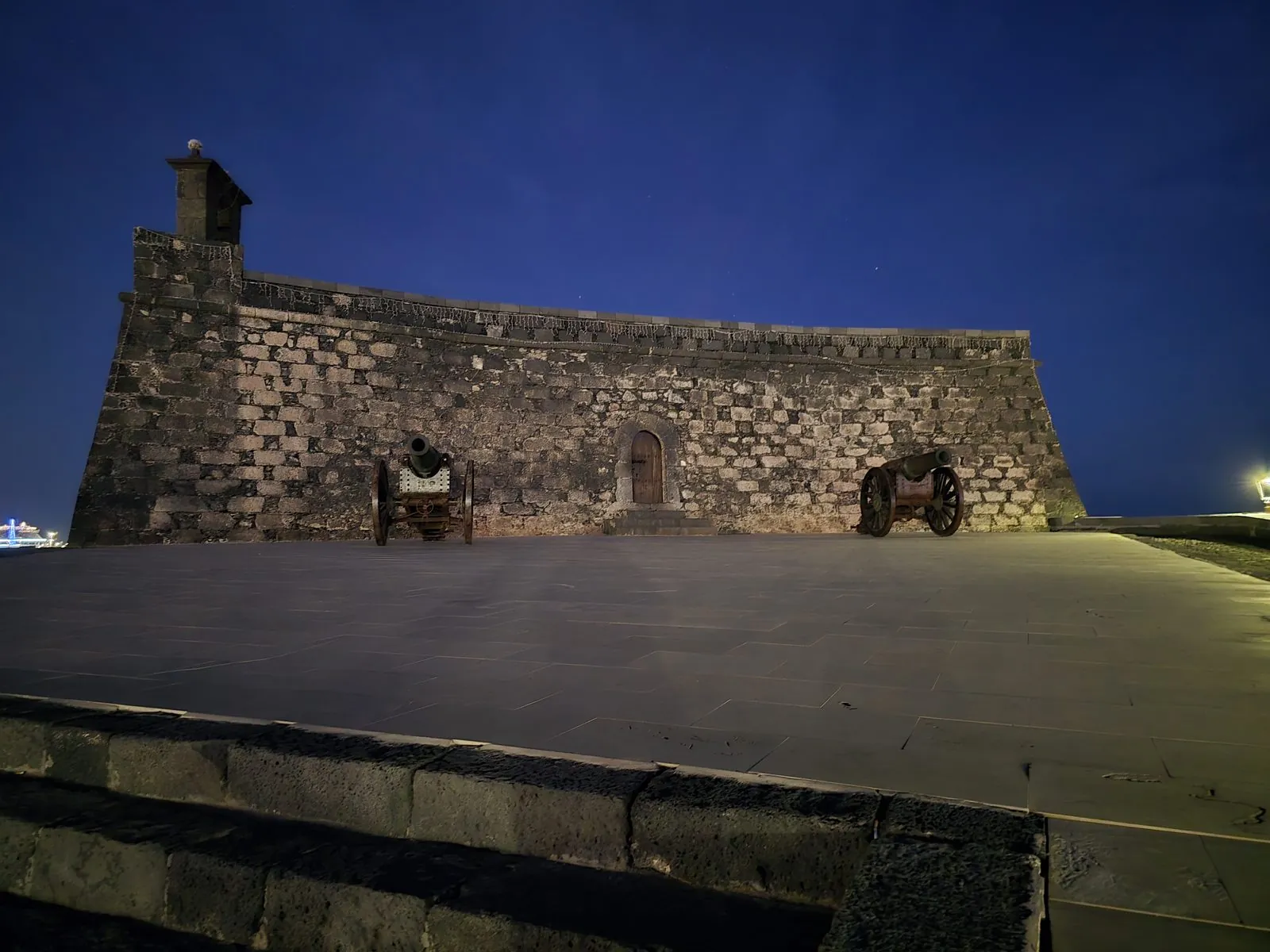
Photo: SH297 · CC BY-SA 4.0 · Wikimedia Commons · scaled
Drake and the great English raids
The most famous assault came in 1595, when Sir Francis Drake and Sir John Hawkins attacked Las Palmas de Gran Canaria with a large English fleet, hoping to sack the city on their way to the Caribbean. The islanders' shore batteries and militia drove them off — a defeat Las Palmas still remembers with pride. Both English commanders would die of disease weeks later in the Caribbean, and the raid is remembered as one of Drake's rare failures.
Worse followed in 1599, when a huge Dutch fleet under Pieter van der Does — dozens of ships and thousands of men — stormed and occupied Las Palmas. The defenders retreated inland and harried the invaders until disease and stiff resistance forced the Dutch to withdraw, but not before they burned much of the city. The forts guarding the bay, and the militia in the hills, had once again saved the island from permanent capture.
The Barbary corsairs — raiding for slaves
Far more relentless, and far more feared by ordinary islanders, were the Barbary corsairs from Morocco and Algiers. They came in fast galleys, often at night, and their aim was human cargo: they seized villagers to sell in the slave markets of North Africa. The eastern islands, closest to the African coast, suffered most.
Lanzarote was raided again and again. In 1618 a devastating corsair attack overran the island, and hundreds of people were carried off into slavery — one of the worst such raids the archipelago endured. Fuerteventura, La Gomera and El Hierro all suffered too. The threat was so constant that whole inland capitals — Teguise on Lanzarote, Betancuria on Fuerteventura, San Sebastián's fortified core — were sited or defended with corsairs in mind, and lookouts watched the sea from clifftop towers.
These raids were not occasional drama but a lived, generational fear. For centuries, coastal Canarians kept an anxious eye on the horizon, and the loss of family members to the slave galleys left deep scars in island memory and folklore.
Castles, towers and forts
The islands' response was to fortify. A network of castles and watchtowers went up, some of which are now among the most atmospheric places to visit.
- Castillo de San Gabriel, Arrecife. This little fortress sits on an islet just off the seafront of Arrecife, reached by a picturesque stone causeway with a drawbridge. Built to guard Lanzarote's main harbour after repeated corsair attacks, it now houses a local history museum and makes an easy, rewarding stop.
- Castillo de San José, Arrecife. An 18th-century fortress on the far side of the bay, later restored by César Manrique to hold the island's modern-art collection — today the MIAC (Castillo de San José), where cannon-era walls frame contemporary paintings above the harbour.
- Torre del Conde, La Gomera. The stout medieval keep in the garden square of San Sebastián de La Gomera — one of the oldest military buildings in the Canaries, and a refuge in times of attack.
- The forts of Las Palmas. Castillo de la Luz guarded the harbour of Las Palmas de Gran Canaria and helped repel Drake and the Dutch; several coastal batteries once ringed the bay.
Add to these the string of humbler torres and lookout points scattered around the coasts, and you get a sense of how seriously the islands took the danger.
Lanzarote makes an ideal "pirate history" day: cross the causeway to San Gabriel in the morning, then visit San José up the coast in the afternoon. Both are within easy reach of Arrecife's waterfront, and together they tell the island's whole defensive story.
Privateers, the crown and self-defence
The islands didn't only defend — they fought back. Local militias, drawn from the population and led by the island gentry, manned the walls and drove off landings. Canarian ships also turned privateer themselves at times, preying on enemy shipping under royal licence. The crown granted the islands special trading rights partly to help them fund their own defence, since help from mainland Spain was slow to arrive across so much water.
When did the danger fade?
The threat eased only gradually. Large European fleets stopped coming as the wars of empire moved elsewhere, and the Barbary raids died away through the 18th and early 19th centuries as North African corsairing was finally suppressed. By then the fortresses had done their work — and had become the landmarks that give so many Canarian ports their character today.
Following the pirate trail
You can build a genuinely fun itinerary around this history. Start at a coastal castle — San Gabriel or San José on Lanzarote, the Torre del Conde on La Gomera, Castillo de la Luz on Gran Canaria — then read up on the raid it was built to stop. It slots neatly into the wider history of the Canary Islands, and it turns a stretch of seafront into a story of daring attacks, desperate defence and the long, uneasy centuries when these sunny islands lived with one eye on the sea.