Imagine finishing your working day and stepping straight onto a city beach for a swim — in February. That's the pitch that has turned the Canary Islands into one of the world's favourite bases for remote workers and digital nomads. The "eternal spring" climate, fast fibre internet, a growing web of coworking spaces and an easy, EU-standard quality of life add up to a place where you can genuinely be productive and have a holiday-grade life at the same time. This guide covers why the islands work so well for remote work, the best bases, the practicalities of internet, cost and community, and a general steer on Spain's digital-nomad visa.
Why the Canaries suit remote work
Plenty of destinations promise "work from paradise" and can't deliver the boring essentials. The Canaries can. They combine reliable infrastructure — good roads, hospitals, supermarkets, banks — with a climate that removes the two productivity-killers of grey winters and sticky summers. The islands sit on GMT/WET, the same time zone as the UK and one hour behind mainland Europe, which keeps you comfortably in sync with clients and colleagues in Britain, Ireland and continental Europe. Add safe streets, a relaxed pace and cheap flights back to the mainland, and it's easy to see the appeal.
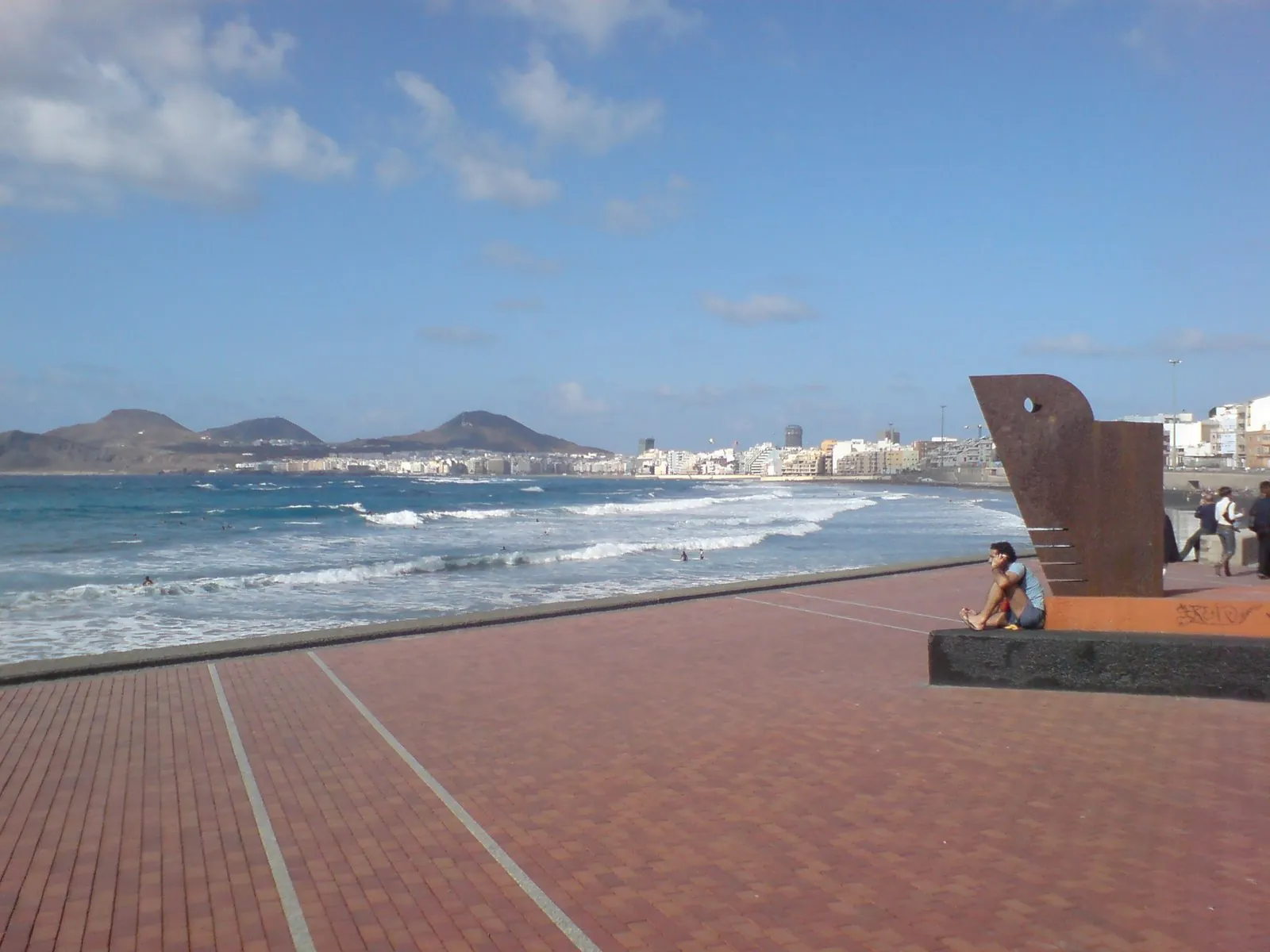
Photo: Pepelopex · CC BY-SA 3.0 · Wikimedia Commons · scaled
The eternal-spring climate
The single biggest draw is the weather. Subtropical and warm year-round, the Canaries never really do winter: even the coolest months stay mild, and the hottest are tempered by Atlantic trade winds. That means you can plan your week around outdoor life — an early swim, a lunchtime walk, a sunset run — without the seasonal slump that saps motivation back home. Each island has microclimates, so if you want it drier and sunnier head to the south coasts; greener and fresher, the north.
If you feel the heat, base yourself on a north coast or up in the hills, where the trade winds keep things fresh. If you want maximum guaranteed sun and beach time after work, the southern resorts deliver it almost every day of the year.
Fast internet and coworking hubs
The islands are well wired: fibre broadband is widespread in the towns and resorts, mobile coverage is good, and a growing network of coworking spaces gives you a proper desk, fast reliable Wi-Fi and the company of other remote workers. The scene is strongest in the capitals and larger towns.
Las Palmas de Gran Canaria
The unofficial nomad capital of the archipelago. A real, year-round city rather than a resort, Las Palmas has the deepest cluster of coworking spaces, cafés and community — much of it within walking distance of the glorious city beach of Las Canteras, where you can surf or swim on your break. It's the easiest place to land, plug in and instantly find your people.
Tenerife, Fuerteventura and beyond
- Tenerife — coworking in and around the southern resorts and the cultured cities of Santa Cruz and La Laguna, with everything the biggest island offers close at hand.
- Fuerteventura — Corralejo draws a surf-and-work crowd, with laid-back coworking near some of Europe's best beaches.
- La Palma — quieter and greener, a favourite for those who want nature, dark skies and calm over nightlife; a smaller but real remote-work community.
Don't rely on holiday-rental Wi-Fi alone for critical calls. Check the actual connection before you commit to a long stay, keep a mobile-data plan as backup, and use a coworking space or café as your dependable office.
Spain's digital-nomad visa
Spain introduced a digital-nomad visa for non-EU remote workers and the self-employed, allowing longer stays than the usual tourist limit if you meet income and employment conditions, and the Canaries are a hugely popular place to use it. EU and EEA citizens don't need it and can live and work freely. Because eligibility rules, income thresholds, tax treatment and paperwork change and are genuinely complex, treat any figure you read online as out of date and check the current official rules — or take professional advice — before you plan a long-term move. This guide is orientation, not legal advice.
Cost of living
The Canaries are generally cheaper than northern Europe and mainland Spain's big cities, helped by the islands' low IGIC sales tax (a fraction of mainland VAT). Rents are lower than London, Paris or Barcelona, eating out is good value, and fuel is notably cheap. That said, popular nomad spots like central Las Palmas have risen in price, and short holiday-let rates are far higher than a long lease — the trick is to secure a monthly or longer rental. For a realistic budget, see our guide to costs and money in the Canaries.
Community and lifestyle
What keeps people beyond one winter is the community. Coworking spaces run events, there are active online groups for meetups, language exchanges and hikes, and the transient nomad crowd mixes with a settled international population. Off the clock, the lifestyle is the reward: surf before work, hike the interior at the weekend, island-hop on a long weekend, and eat well for little. It's a sociable, outdoorsy existence that's easy to slot into even on a short stay.
Choosing your base
| Base | Best for |
|---|---|
| Las Palmas (Gran Canaria) | City life, biggest community, coworking density, beach on your doorstep |
| South Tenerife / the cities | Variety, transport links, sun and resorts plus urban culture |
| Corralejo (Fuerteventura) | Surfers, beach lovers, a slower pace |
| La Palma | Nature, stargazing, quiet and low cost |
Getting set up
For most first-timers, the smart move is a month in Las Palmas to find your feet, then decide whether to settle or roam. Sort a reliable connection and a coworking membership first, then let the island do the rest. Learn how the archipelago fits together in our guide to Gran Canaria, and you'll quickly understand why so many people arrive for a winter and end up staying for years — swapping the commute for a swim at Las Canteras and calling it a working day.